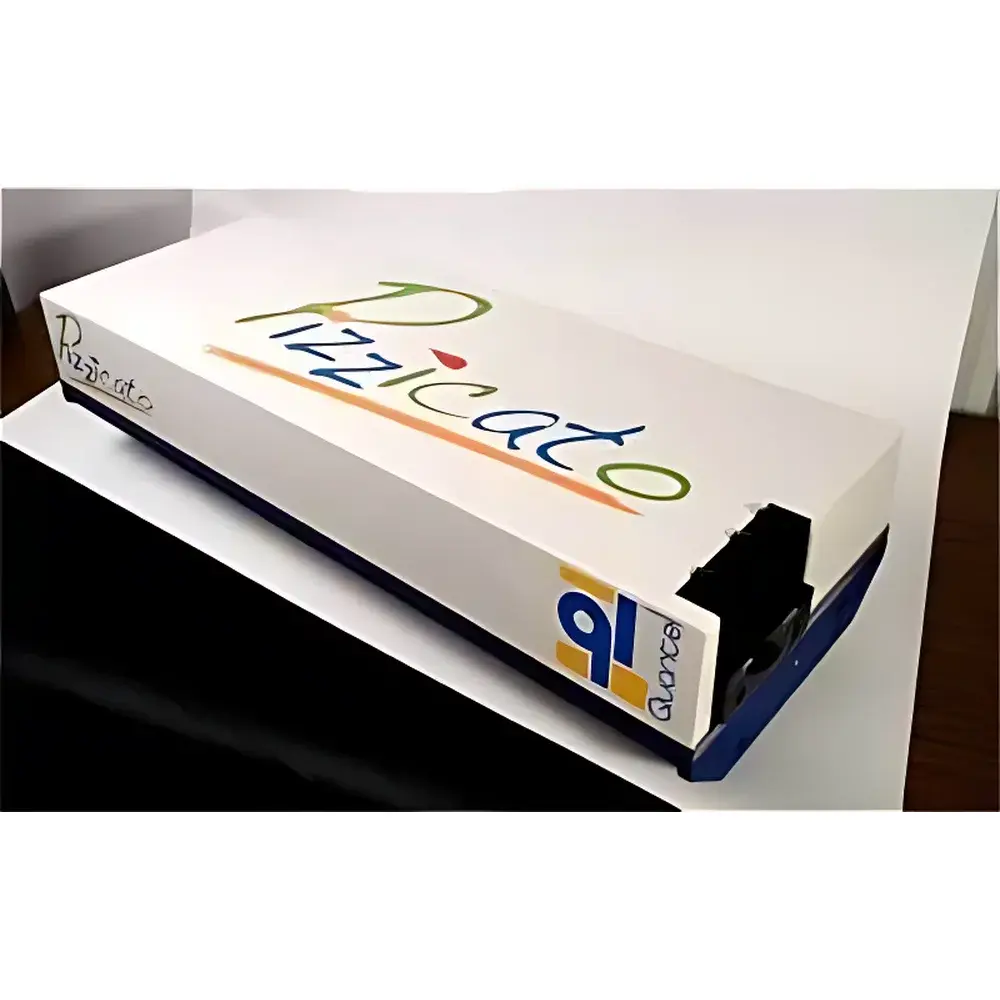
Quantel Pizzicato Series All-Solid-State Mode-Locked Picosecond Laser
| Brand | Quantel |
|---|---|
| Origin | France |
| Model | Pizzicato Series |
| Laser Type | Diode-Pumped All-Solid-State Mode-Locked Nd:YAG |
| Wavelength Options | 1064 nm, 532 nm, 355 nm, 266 nm |
| Pulse Width Options | 20 ps, 35 ps, 50 ps, 70 ps |
| Repetition Rate | Up to 1 kHz (standard) |
| Pulse Energy | Up to 1.5 mJ at 1064 nm (model-dependent) |
| Timing Jitter | < 300 fs RMS (sync output) |
| Energy Stability | < 0.5% RMS over 8 hours |
| Cooling | Air-cooled or optional water-cooling |
| Compliance | CE, RoHS, IEC 60825-1:2014 Class 4 Laser Product |
Overview
The Quantel Pizzicato Series is an all-solid-state, diode-pumped, mode-locked picosecond laser system engineered for high-precision applications requiring exceptional temporal stability, pulse-to-pulse energy reproducibility, and long-term operational reliability. Based on a master oscillator–power amplifier (MOPA) architecture with passive mode-locking in a Nd:YAG gain medium, the Pizzicato eliminates reliance on organic dye-based saturable absorbers—replacing them with robust solid-state components such as semiconductor saturable absorber mirrors (SESAMs) or Kerr-lens mode-locking (KLM) elements. This design enables sub-300 fs timing jitter on synchronization outputs and energy stability better than 0.5% RMS over extended measurement periods, making it suitable for time-resolved spectroscopy, pump-probe experiments, laser-induced breakdown spectroscopy (LIBS), and optical parametric amplification (OPA) seeding. Its fully solid-state construction ensures minimal alignment sensitivity, reduced thermal drift, and compatibility with industrial and academic environments where maintenance downtime must be minimized.
Key Features
- All-solid-state architecture with no liquid dyes or gas cells—enabling zero consumables and simplified lifecycle management.
- Four harmonically generated wavelengths standard: fundamental 1064 nm, second harmonic 532 nm, third harmonic 355 nm, and fourth harmonic 266 nm—each optimized for beam quality (M² < 1.3) and pointing stability (< 5 µrad/°C).
- Selectable pulse durations: 20 ps, 35 ps, 50 ps, and 70 ps—achieved via cavity dispersion management and gain medium selection, supporting trade-offs between peak power and spectral bandwidth.
- Integrated low-noise diode pumping with active temperature stabilization of pump diodes and crystal mounts—ensuring consistent inversion density and minimizing ASE background.
- Programmable repetition rate from single-shot to 1 kHz (standard); optional configurations support up to 10 kHz with energy scaling compensation.
- Built-in diagnostics including real-time pulse energy monitoring, cavity alignment status, and thermal load feedback—accessible via Ethernet or RS-232 interface.
Sample Compatibility & Compliance
The Pizzicato Series is designed for integration into vacuum-compatible, vibration-isolated, and cleanroom-grade optical tables. It operates safely within Class 4 laser safety requirements per IEC 60825-1:2014 and includes interlock-ready connectors, key-switched operation, and emission indicator LEDs. The system meets CE marking directives for electromagnetic compatibility (EMC) and low-voltage equipment, and complies with RoHS 2011/65/EU restrictions on hazardous substances. While not inherently GLP/GMP-certified, its deterministic pulse parameters, audit-trail-capable control software (see Software section), and traceable calibration protocols support use in regulated analytical workflows—including those aligned with ASTM E2912 (Standard Guide for Laser-Induced Breakdown Spectroscopy) and ISO 17025-accredited laboratories.
Software & Data Management
Control and monitoring are managed through Quantel’s QSoft suite—a Windows-based application offering remote configuration of pulse width, repetition rate, harmonic selection, and internal delay generators. QSoft supports scripting via Python API (COM interface) for automated experiment sequencing and synchronization with external detectors (e.g., streak cameras, time-correlated single-photon counting modules). All operational parameters, timestamps, and energy logs are stored in HDF5 format with embedded metadata (wavelength, pulse width, ambient temperature, pump current), enabling FAIR data principles (Findable, Accessible, Interoperable, Reusable). Optional firmware upgrades include FDA 21 CFR Part 11-compliant user access control, electronic signatures, and audit trail generation for pharmaceutical or clinical research deployments.
Applications
- Pump-probe spectroscopy requiring precise temporal overlap and high signal-to-noise ratio in ultrafast dynamics studies of charge transfer, phonon coupling, or exciton relaxation.
- Laser ablation and LIBS for elemental analysis in metallurgy, geoscience, and cultural heritage conservation—leveraging high peak power and minimal thermal loading.
- Optical parametric amplifier (OPA) and optical parametric chirped-pulse amplifier (OPCPA) seeding, where narrow spectral bandwidth and low timing jitter are critical for carrier-envelope phase stability.
- Time-of-flight mass spectrometry (TOF-MS) ionization sources demanding sub-ps timing precision relative to detector gating signals.
- Nonlinear microscopy techniques including multiphoton excitation fluorescence (MPEF) and second-harmonic generation (SHG) imaging in biological tissue, enabled by high-repetition-rate, diffraction-limited beams at visible and UV wavelengths.
FAQ
Is the Pizzicato Series compatible with ultra-high vacuum (UHV) environments?
Yes—optical path components are UHV-compatible upon request; vacuum feedthrough options for trigger and monitoring signals are available as factory-configured accessories.
Can pulse duration be adjusted dynamically during operation?
No—pulse width is fixed per configured cavity design; however, interchangeable resonator kits allow rapid reconfiguration between 20 ps, 35 ps, 50 ps, and 70 ps variants with minimal realignment.
Does the system support external cavity dumping or cavity length stabilization?
Yes—QSoft provides analog voltage outputs for piezoelectric cavity length control and digital TTL triggers for synchronous cavity dumping; optional interferometric stabilization kits are available.
What is the typical warm-up time to achieve specified energy stability?
Less than 30 minutes from cold start under ambient temperature variation ≤ ±2°C; full specification compliance is guaranteed after 45 minutes of continuous operation.
Are OEM integration services available for custom mounting, cooling, or electrical interfaces?
Yes—Quantel offers mechanical, thermal, and electrical co-design support for turnkey integration into larger instruments, including MIL-STD-810G compliant shock/vibration hardening and custom I/O pinouts.