
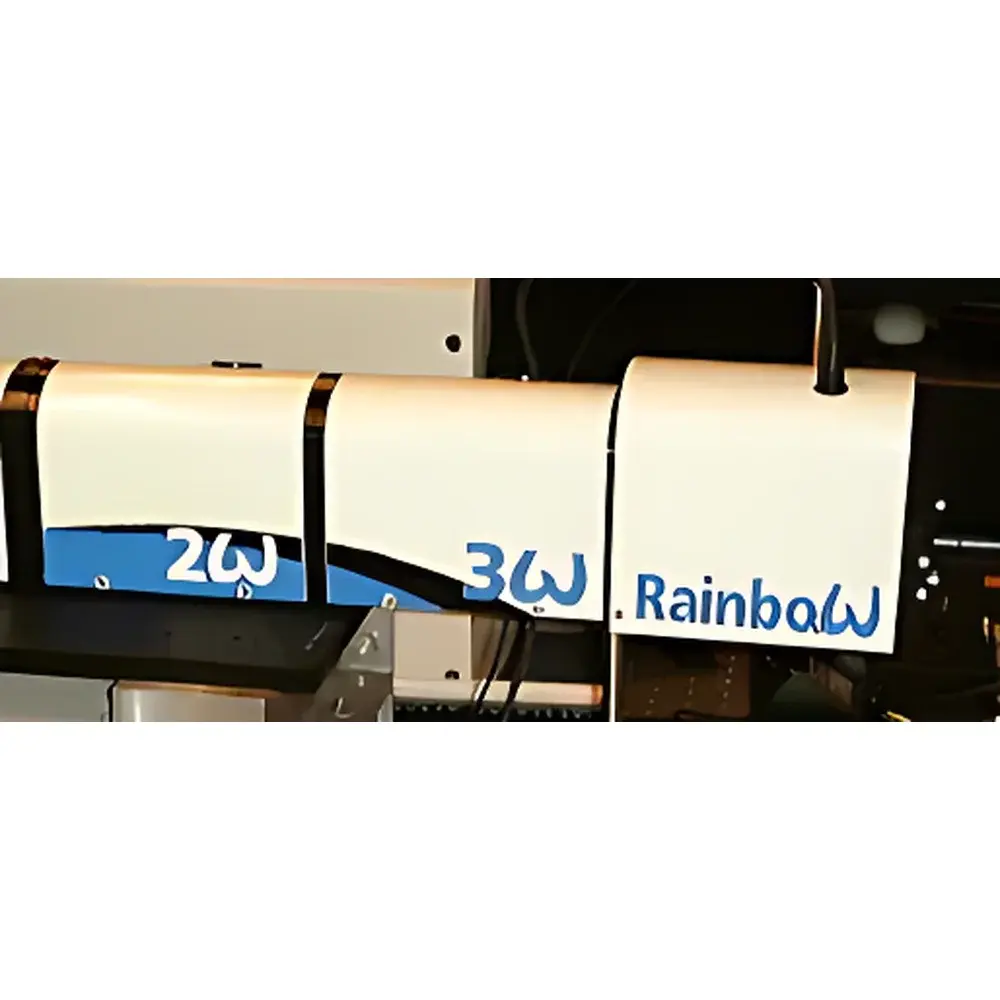
Quantel Rainbow OPO Tunable Laser Module
| Brand | Quantel |
|---|---|
| Origin | France |
| Model | Rainbow |
| Core Technology | Optical Parametric Oscillator (OPO) with Ring-Cavity Architecture |
| Compatible Pump Source | Brilliant Series Nd:YAG Lasers |
| Output Configuration | Coaxial Signal and Idler Beams |
| Beam Path Correction | Integrated Beam-Deviation Compensation |
| Control Interface | Full Scan Automation Suite |
| Regulatory Compliance | CE Marked, RoHS Compliant |
| Distribution Model | Authorized International Distributor (Non-OEM) |
Overview
The Quantel Rainbow OPO Tunable Laser Module is an engineered optical parametric oscillator system designed for precision wavelength agility in scientific and industrial spectroscopic applications. Operating on the principle of nonlinear optical frequency conversion, the Rainbow leverages a patented ring-cavity architecture to generate coherent, tunable output across the near-UV to mid-infrared spectrum (typically 210–2100 nm, dependent on pump laser wavelength and nonlinear crystal selection). It is not a standalone laser source but a modular OPO engine—intended for integration with Quantel’s Brilliant series Q-switched Nd:YAG pump lasers (e.g., Brilliant B, BX, or Ultra models). This architecture enables high conversion efficiency, excellent pulse-to-pulse stability (<1.5% RMS), and intrinsic suppression of spatial mode distortion. The system is optimized for time-resolved fluorescence, CARS microscopy, LIBS excitation, and gas-phase absorption spectroscopy where discrete, narrowband, and precisely tunable irradiation is required.
Key Features
- Patented Ring-Cavity Design: Eliminates conventional linear cavity alignment complexity by integrating all critical optical elements—including walk-off-compensated nonlinear crystals (e.g., BBO, KTA, or PPLN)—into a monolithic, thermally stabilized ring configuration. This reduces parasitic reflections, minimizes sensitivity to mechanical drift, and enhances long-term pointing stability.
- Coaxial Signal and Idler Output: Both parametric beams exit through a single collimated aperture with fixed spatial overlap, enabling simplified beam delivery, consistent focus geometry, and compatibility with single-path spectrometers or scanning optics without realignment.
- Integrated Beam-Deviation Compensation: Active compensation circuitry corrects angular deviation induced by crystal temperature gradients or pump beam walk-off, maintaining sub-50 µrad pointing stability over full tuning ranges and extended operation cycles.
- Modular Integration Architecture: Designed as a drop-in OPO module with standardized mechanical interfaces (ISO-KF flanges and 48 mm optical axis height), electrical connectors (Lemo 00 for trigger, SMA for analog monitoring), and TTL-synchronized digital control lines—facilitating rapid integration into OEM laser systems or custom laboratory platforms.
- Full Scan Automation Suite: Includes Quantel’s OPOScan firmware with programmable wavelength ramping, step-and-hold sequences, and external synchronization (via gate/delay inputs), supporting automated spectral acquisition protocols compliant with ASTM E1421-22 (standard practice for spectroscopic data acquisition).
Sample Compatibility & Compliance
The Rainbow OPO operates exclusively with nanosecond-pulsed Nd:YAG pump sources delivering ≥5 mJ at 1064 nm (or harmonics at 532/355/266 nm). Its output is compatible with standard UV-VIS-NIR spectrometers, FTIR accessories, and fiber-coupled detection systems using silica or fluoride-based delivery fibers (depending on selected wavelength range). All optical coatings meet ISO 10110-7 surface quality specifications; housing conforms to IP54 environmental rating for laboratory use. The system complies with EU Directive 2014/30/EU (EMC), 2014/35/EU (LVD), and is CE-marked per EN 60825-1:2014 (laser safety classification Class IV). Documentation includes full Declaration of Conformity and traceable calibration certificates for wavelength accuracy (±0.2 nm typical, verified against NIST-traceable reference lines).
Software & Data Management
Control is executed via Quantel’s OPOScan GUI (Windows 10/11, 64-bit), which supports scripting in Python (through provided COM interface) and LabVIEW (NI-VISA drivers included). All scan parameters—including crystal angle, temperature setpoint, pump energy, and output wavelength—are logged with timestamps and stored in HDF5 format, ensuring FAIR (Findable, Accessible, Interoperable, Reusable) data principles. Audit trails record user actions, parameter changes, and calibration events—fully compliant with GLP and 21 CFR Part 11 requirements when deployed with validated IT infrastructure and electronic signature modules.
Applications
- Time-resolved Raman and fluorescence spectroscopy requiring picosecond-to-nanosecond gated detection
- Multi-wavelength photoacoustic imaging of biological tissues and contrast agents
- High-resolution gas-phase absorption spectroscopy (e.g., CH₄, CO₂, NOₓ) in environmental monitoring chambers
- Pump-probe studies in ultrafast physics, including carrier dynamics in 2D materials
- Calibration source for hyperspectral imagers and radiometric transfer standards
FAQ
Is the Rainbow OPO a self-contained laser system?
No—it requires an external Q-switched Nd:YAG pump laser from the Brilliant series (e.g., Brilliant BX or Ultra) for operation.
What nonlinear crystals are supported out-of-the-box?
Standard configurations include BBO (210–650 nm signal), KTA (1.4–4.5 µm idler), and periodically poled lithium niobate (PPLN) for mid-IR extension; custom crystal sets are available under NDA.
Can the Rainbow be integrated into automated production lines?
Yes—its digital I/O interface supports PLC-level handshake protocols (e.g., Modbus TCP optional), and mechanical footprint is designed for rack-mount or benchtop OEM integration.
Does Quantel provide application-specific alignment support?
Yes—Quantel’s Application Engineering team offers remote and on-site commissioning, including spectral calibration validation and system performance verification reports.
Is firmware update capability available post-deployment?
Yes—field-upgradable firmware is delivered via secure HTTPS portal with version-controlled release notes and backward-compatible binary images.





