
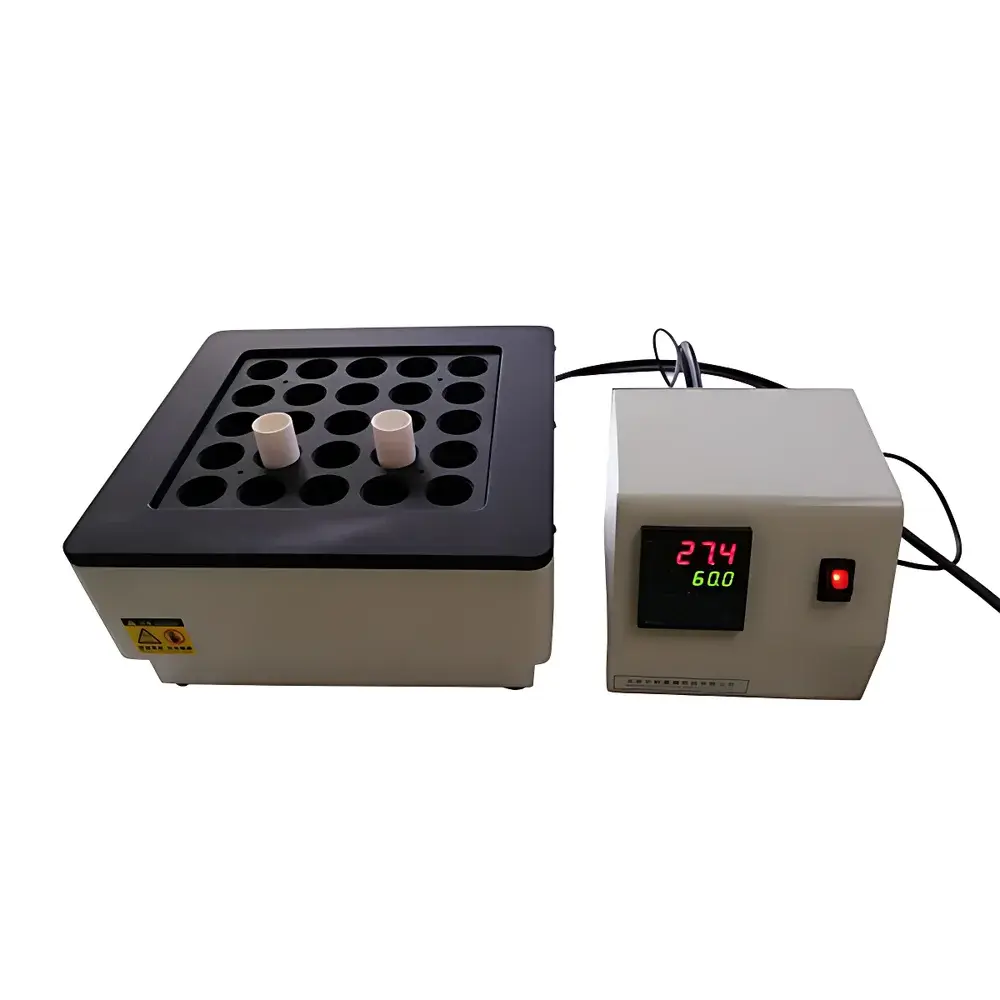
Zhongke Aobo XY44-25F Graphite Block Digestion System
| Brand | Zhongke Aobo |
|---|---|
| Origin | Beijing, China |
| Manufacturer Type | Authorized Distributor |
| Country of Origin | China |
| Model | XY44-25F |
| Instrument Type | Graphite Block Digestion System |
| Automation Level | Semi-Automatic |
| Digestion Positions | 25 |
| Max. Heating Temperature | 450 °C |
| Temperature Control Accuracy | ±1 °C |
| Heating Material | High-Purity Isostatic Graphite with PTFE Coating |
| Reagent Channels | 25 |
| Sample Capacity | 25 × 100 mL |
| Digestion Well Dimensions (D × H) | Φ44 × 50 mm |
| Power Supply | 220 V / 50 Hz |
| Heating Power | 3200 W |
| Control Method | Intelligent PID Programmable Temperature Control |
| Ramp/Soak Steps | 30 |
| Temperature Resolution | 0.1 °C |
| Inter-Well Uniformity | ±2 °C |
| Controller Dimensions (L×W×H) | 250 × 250 × 205 mm |
| Heating Block Dimensions (L×W×H) | 420 × 420 × 220 mm |
| Net Weight | 33 kg |
Overview
The Zhongke Aobo XY44-25F Graphite Block Digestion System is a semi-automated, high-temperature sample preparation instrument engineered for open-vessel acid digestion and post-digestion concentration (‘acid removal’ or ‘acid evaporation’) of solid and semi-solid matrices. It operates on the principle of conductive heating via a monolithic, high-purity isostatic graphite block—uniformly heated by embedded resistance elements and insulated with high-efficiency thermal barriers. Unlike hotplate or ceramic heater-based systems, this design ensures superior temperature homogeneity across all 25 digestion wells, minimizing inter-sample variability and supporting quantitative trace-metal analysis. The system is specifically optimized as a complementary platform to microwave-assisted digestion workflows—serving both as a pre-digestion conditioning unit and as a dedicated acid evaporation station for microwave digests prior to instrumental analysis. Its operational range (up to 450 °C) and robust PTFE-coated graphite surface meet the thermal and chemical resistance requirements of EPA, ISO, ASTM, and GB standard methods for environmental, food, clinical, and industrial sample preparation.
Key Features
- Semi-integrated architecture: Separated controller and heating block enable independent maintenance, enhanced operator safety, and simplified calibration procedures.
- 30-step programmable PID temperature control: Supports customizable ramp rates, hold times, and multi-stage profiles—including controlled cooling phases—to accommodate diverse matrix decomposition kinetics (e.g., organic-rich soils vs. inorganic ceramics).
- Monolithic isostatic graphite heating block with uniform PTFE coating: Provides exceptional thermal conductivity, chemical inertness against HNO₃, HCl, HF, and H₂O₂ mixtures, and long-term dimensional stability under repeated thermal cycling.
- Optimized well geometry (Φ44 × 50 mm): Accommodates standard 100 mL digestion tubes (e.g., borosilicate glass or quartz), ensuring full immersion of sample volume while minimizing acid fume escape and cross-contamination risk.
- Real-time overtemperature protection: Dual-sensor monitoring with thermocouple redundancy triggers automatic power cutoff and audible alarm if sensor failure or thermal runaway is detected—compliant with IEC 61010-1 safety requirements.
- Extended duty cycle capability: Rated for continuous operation >48 hours at temperatures up to 350 °C, supporting unattended overnight digestion protocols under supervised laboratory conditions.
- Modular customization: Well diameter, depth, and layout (e.g., 16-, 25-, or 36-position configurations) are available per client specifications—ensuring compatibility with existing tube inventory and workflow integration.
Sample Compatibility & Compliance
The XY44-25F supports digestion of heterogeneous samples including soil, sediment, biological tissue, food composites, pharmaceutical excipients, polymer additives, and electronic waste (e-waste). Its validated performance aligns with method requirements for US EPA Methods 3010A, 3050B, 3060A (soil/sediment), 200.7, 200.8, 200.9 (water), and 365.1 (total recoverable metals); ISO 11466 (soil leaching), ISO 17294-2 (water by ICP-MS); ASTM D3682 (ash content), D5177 (trace metals in coal); and Chinese national standards GB/T 22105.1–2008 (soil As/Hg), GB/T 5009.11–2003 (food As), GB/T 17138–1997 (soil Cu/Pb/Zn/Cd), and SJ/T 11365–2006 (RoHS screening). All PTFE-coated surfaces comply with FDA 21 CFR 177.1550 for incidental food contact during sample prep.
Software & Data Management
The integrated controller features an LCD interface with real-time temperature logging (timestamped, resolution 0.1 °C) stored internally for ≥100 runs. Data export is supported via USB port (CSV format) for traceability in GLP/GMP environments. While the base system does not include network connectivity or electronic signature functionality, its programmable profile structure and audit-ready event logs (including alarm timestamps and manual override records) satisfy core documentation requirements of ISO/IEC 17025:2017 Clause 7.7 and FDA 21 CFR Part 11 Annex A (electronic records) when paired with laboratory information management systems (LIMS) or validated third-party data acquisition software.
Applications
- Preparation of certified reference materials (CRMs) for ICP-OES, ICP-MS, AAS, and HG-AFS analysis.
- Routine digestion of environmental samples (sludge, fly ash, airborne particulates) prior to heavy metal quantification.
- Urine iodine analysis per WHO/UNICEF protocols requiring low-volume, high-precision acid evaporation.
- Pharmaceutical raw material testing per USP and EP 2.2.57 for elemental impurities (Category 1 & 2 elements).
- Food safety labs performing multi-element screening in infant formula, seafood, and fortified cereals per GB 5009 series.
- QC/QA in battery recycling facilities analyzing Li, Co, Ni, Mn in cathode scrap using HNO₃–H₂O₂–HF mixtures.
FAQ
What types of acids are compatible with the PTFE-coated graphite block?
Concentrated nitric acid (HNO₃), hydrochloric acid (HCl), hydrofluoric acid (HF) up to 5% v/v, hydrogen peroxide (H₂O₂), and sulfuric acid (H₂SO₄) below 180 °C are routinely used. Avoid aqua regia above 200 °C and molten alkali salts.
Can the XY44-25F be used for closed-vessel digestion?
No—it is designed exclusively for open-vessel digestion and acid evaporation. Closed-vessel microwave digestion requires pressure-rated vessels and separate instrumentation.
Is the controller compatible with external data acquisition systems?
Yes—via RS-232 or optional analog output (4–20 mA), enabling integration into centralized lab automation platforms with appropriate signal conditioning.
What maintenance is required for long-term accuracy?
Annual verification of thermocouple calibration against NIST-traceable reference standards and visual inspection of PTFE coating integrity are recommended. No routine lubrication or consumable replacement is needed.
Does the system support GLP-compliant audit trails?
The internal event log captures start/stop times, profile IDs, alarm events, and manual interventions. Full GLP compliance requires supplemental LIMS integration for user authentication and electronic signature enforcement.



