
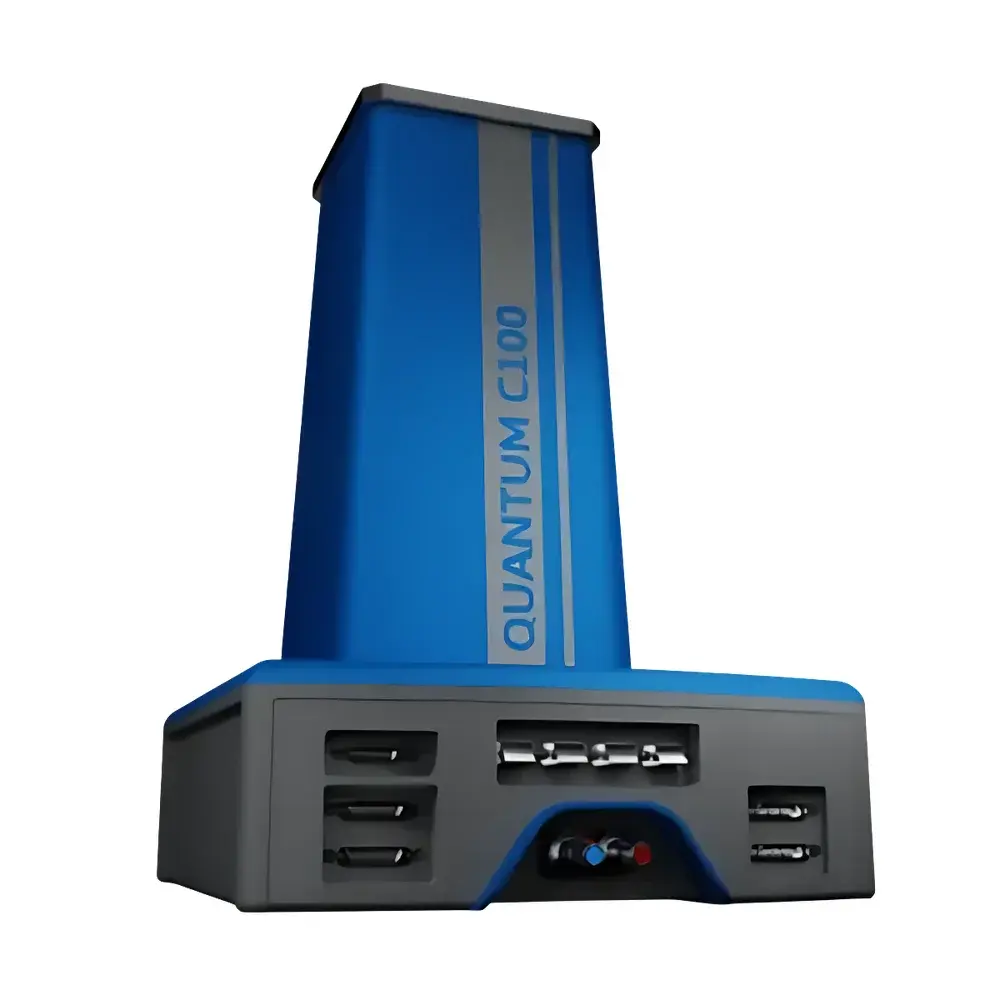
Quantum Detectors Quantum C100 Direct Detection Camera for Cryo-EM
| Brand | Quantum Detectors |
|---|---|
| Origin | United Kingdom |
| Model | Quantum C100 |
| Frame Rate | 2000 fps (continuous) |
| Pixel Array | 2048 × 2048 |
| Readout | Fiber-optic coupled direct electron detection |
| Interface | GUI-controlled, open-format data export (TIFF, MRC, HDF5) |
| Compatibility | Optimized for 100 keV transmission electron microscopes |
| Regulatory Compliance | Designed for GLP/GMP-aligned workflows |
Overview
The Quantum Detectors Quantum C100 is a high-performance, direct electron detection camera engineered specifically for cryogenic transmission electron microscopy (cryo-TEM) at 100 keV accelerating voltage. Unlike conventional phosphor-based or scintillator-coupled cameras, the C100 employs monolithic silicon pixel sensor architecture with back-thinned, radiation-hardened design to achieve single-electron sensitivity and exceptional detective quantum efficiency (DQE) at low-dose imaging conditions. Its development emerged from a strategic UK national initiative led by the Science and Technology Facilities Council (STFC), in close collaboration with the Rosalind Franklin Institute (RFI) and the MRC Laboratory of Molecular Biology (MRC LMB), Cambridge. The system addresses a critical bottleneck in structural biology: the historical reliance on 200–300 keV TEM platforms—costly, power-intensive, and operationally complex—by enabling high-resolution single-particle analysis (SPA) on compact, lower-voltage instruments without sacrificing resolution or signal fidelity.
Key Features
- 2000 fps continuous frame acquisition: Enables ultra-low-dose movie-mode imaging with minimal beam-induced motion and radiation damage—essential for preserving native conformation of frozen-hydrated biomolecules.
- 2048 × 2048 pixel monolithic sensor: Provides large active area (≥ 80 mm diagonal) with uniform gain and point-spread function, optimized for 100 keV electrons to maximize DQE(0) > 0.4 and DQE(0.1 nm⁻¹) > 0.3.
- Fiber-optic coupling architecture: Eliminates light spread and preserves spatial resolution across full field-of-view; supports both counting and integrating readout modes.
- GUI-driven acquisition platform: Intuitive, scriptable interface compatible with standard cryo-EM workflow engines (e.g., MotionCor2, RELION, cryoSPARC); supports real-time drift correction and dose fractionation.
- Open-data export protocols: Native output in TIFF, MRC, and HDF5 formats ensures seamless integration into established processing pipelines and institutional data management systems.
- Modular mechanical integration: Designed for bottom-entry installation on existing JEOL, Thermo Fisher, and Hitachi TEM platforms; custom flange kits available for OEM integration into next-generation 100 keV microscope designs.
Sample Compatibility & Compliance
The Quantum C100 is validated for use with vitrified biological specimens—including membrane proteins, viral capsids, ribonucleoprotein complexes, and synthetic nanomaterials—imaged under standard cryo-TEM conditions (≤ −180 °C, high vacuum). Its performance meets key metrological benchmarks defined in ISO/IEC 17025 for analytical instrumentation used in accredited laboratories. When deployed with compliant acquisition software, the system supports ALCOA+ (Attributable, Legible, Contemporaneous, Original, Accurate, Complete, Consistent, Enduring, Available) data integrity principles and can be configured to satisfy FDA 21 CFR Part 11 electronic record/electronic signature requirements. It is routinely employed in academic core facilities, pharmaceutical R&D labs, and contract research organizations conducting structural characterization under GLP or early-stage GMP frameworks.
Software & Data Management
The C100 operates via Quantum Detectors’ proprietary QDCam Control Suite—a cross-platform application built on Qt and Python-based backend modules. The suite includes hardware-level synchronization with stage motors, beam blankers, and energy filters, ensuring precise temporal alignment of dose-fractionated movies. All metadata (exposure time, gain reference, temperature log, stage coordinates) are embedded in image headers using EMDB-compliant schema. Raw frames are written directly to NVMe storage arrays with checksum validation, supporting parallel I/O for real-time preprocessing. Integration with institutional LIMS and electronic lab notebooks (ELNs) is achieved through RESTful API endpoints and standardized JSON metadata wrappers.
Applications
- High-throughput single-particle analysis of macromolecular complexes at near-atomic resolution (≤ 3.0 Å) on 100 keV platforms.
- In situ cryo-electron tomography (cryo-ET) tilt-series acquisition with sub-2° angular increment stability.
- Time-resolved cryo-EM studies leveraging millisecond-scale shutterless acquisition for capturing transient conformational states.
- Quality control of lipid nanoparticles (LNPs), virus-like particles (VLPs), and extracellular vesicles in biomanufacturing environments.
- Method development for automated specimen screening, including ice thickness assessment and particle distribution mapping.
FAQ
Is the Quantum C100 compatible with 200 keV or 300 keV TEMs?
Yes—while optimized for 100 keV operation, the sensor’s radiation hardness and adjustable gain settings allow functional use on higher-voltage instruments; however, DQE performance is calibrated and guaranteed only for 100 keV beam energy.
Does the system support hardware binning or region-of-interest (ROI) readout?
No—full-frame readout is mandatory to preserve spatial coherence required for phase retrieval and contrast transfer function (CTF) estimation in SPA workflows.
Can the C100 be integrated into automated data collection pipelines?
Yes—QDCam Control Suite provides command-line interface (CLI) and Python SDK for integration with serialEM, Leginon, and custom acquisition scripts.
What maintenance is required for long-term operational stability?
The detector requires no routine calibration beyond initial factory characterization; annual verification of DQE and gain uniformity is recommended for regulated environments.
Is remote operation supported?
Yes—secure SSH-based access and VNC-enabled GUI streaming are supported over institutional networks, subject to local IT security policy compliance.






