
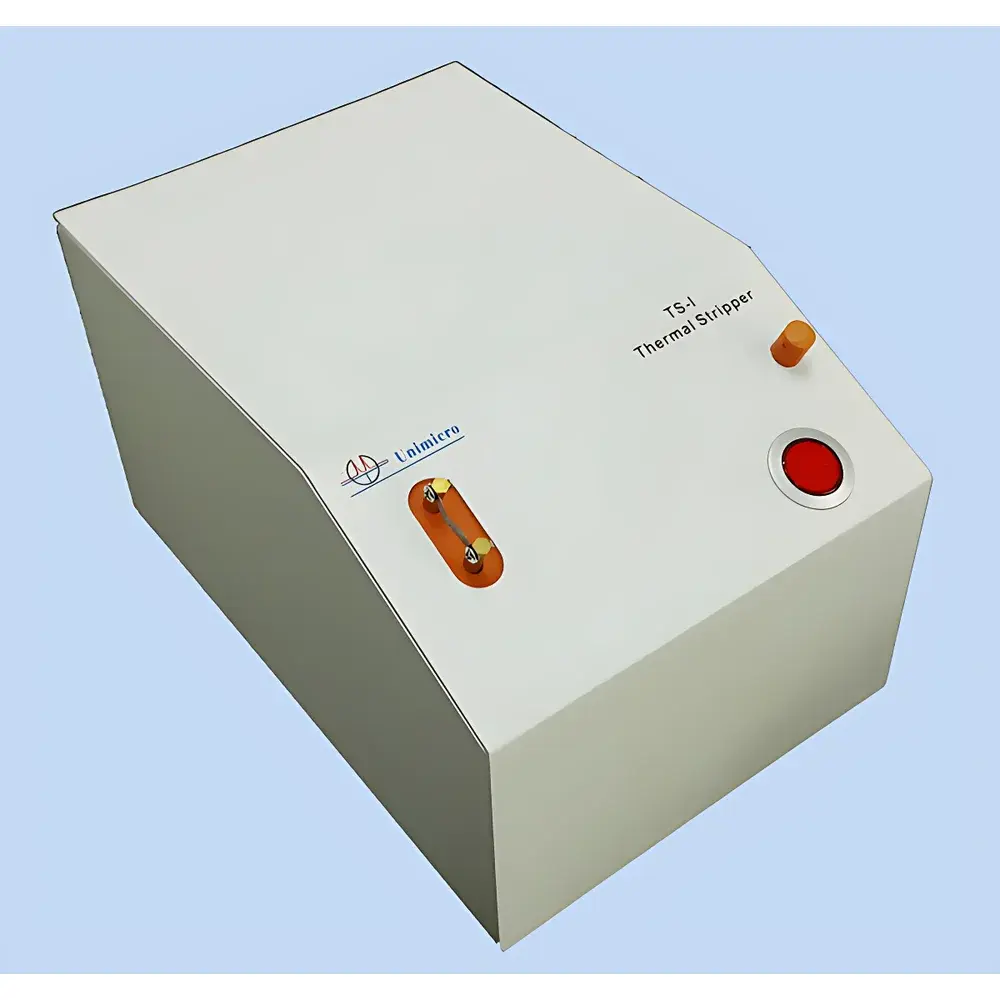
Quartz Capillary Windowing Tool TS-1
| Origin | Shanghai |
|---|---|
| Manufacturer Type | Distributor |
| Origin Category | Domestic (China) |
| Model | TS-1 |
| Price Range | USD 1,400 – 2,800 |
| Instrument Type | Capillary Electrophoresis (CE) Accessory |
| Sample Analysis | Organic Analysis |
| Window Width | 2 mm |
| Processing Time | ≤5 s |
| Compatible Capillary OD | ≤1 mm |
| Coating Removal | Polyimide only |
| Optical Integrity Preserved | Yes |
| Mechanical Integrity Preserved | Yes |
Overview
The TS-1 Quartz Capillary Windowing Tool is a precision-engineered laboratory accessory designed exclusively for the controlled, localized removal of polyimide outer coatings from fused-silica capillaries used in capillary electrophoresis (CE) and laser-induced fluorescence (LIF) detection systems. Unlike manual scraping or chemical etching methods—which risk inconsistent window geometry, microcracking, or silica surface contamination—the TS-1 employs a calibrated thermal ablation process to achieve reproducible, sub-millimeter window formation with minimal thermal stress. The device operates on the principle of transient resistive heating: a precisely regulated current pulse passes through a fine tungsten filament positioned in direct contact with the coated capillary surface, generating localized heat sufficient to volatilize polyimide without exceeding the softening temperature of fused silica (~1,600 °C). This ensures optical clarity of the underlying quartz substrate while preserving both mechanical tensile strength and hydrolytic stability—critical parameters for high-voltage CE separations and long-term capillary reuse.
Key Features
- Consistent 2 mm window width with ±0.1 mm dimensional tolerance, optimized for UV-Vis absorbance and LIF excitation/detection geometries.
- Processing time ≤5 seconds per window—enabling rapid batch preparation of multiple capillaries without operator fatigue or thermal drift.
- Compatible with standard fused-silica capillaries having outer diameters up to 1.0 mm and wall thicknesses ≥15 µm, including common 50 µm and 75 µm ID formats.
- No external power supply or cooling unit required; self-contained operation powered by integrated rechargeable lithium-ion battery (12 V DC, 2.5 Ah).
- Ergonomic handheld design with adjustable capillary clamping mechanism and visual alignment guide for repeatable positioning relative to filament contact zone.
- Zero residue generation—polyimide decomposition products are fully volatilized, eliminating post-processing cleaning steps and avoiding solvent exposure that may compromise capillary surface silanol activity.
Sample Compatibility & Compliance
The TS-1 is intended for use with commercially available polyimide-coated fused-silica capillaries compliant with ASTM D3952-21 (Standard Specification for Fused Silica Capillary Tubing) and ISO 8573-1:2010 (compressed air purity classes, relevant for cleanroom-compatible handling). It supports capillaries used in CE applications conforming to USP Analytical Instrument Qualification and ICH Q2(R2) guidelines, where consistent window geometry directly impacts signal-to-noise ratio and quantitative reproducibility. No regulatory submission documentation (e.g., FDA 510(k), CE marking) applies, as the TS-1 is classified as a non-electrical, non-diagnostic laboratory tool under EU Directive 2014/30/EU (EMC) and 2014/35/EU (LVD) exemptions.
Software & Data Management
The TS-1 operates as a standalone hardware tool with no embedded firmware, connectivity interfaces (USB, Bluetooth, Wi-Fi), or software dependencies. All operational parameters—including pulse duration, current amplitude, and filament dwell time—are factory-calibrated and non-adjustable to ensure inter-unit consistency and eliminate user-induced variability. For laboratories operating under GLP or GMP frameworks, the absence of configurable settings simplifies instrument qualification (IQ/OQ/PQ) and eliminates requirements for electronic audit trails per FDA 21 CFR Part 11. Maintenance logs and usage records may be manually entered into laboratory information management systems (LIMS) using standardized template fields (e.g., “Capillary ID”, “Window Position”, “Date/Time”, “Operator”).
Applications
- Preparation of detection windows for UV-Vis absorbance detection in CE-based pharmaceutical impurity profiling (e.g., assay of enantiomeric excess in chiral separations).
- Routine fabrication of LIF-compatible windows for single-cell metabolite analysis and nucleic acid fragment sizing in microfluidic CE platforms.
- Supporting method development workflows requiring comparative evaluation of window width effects on detection sensitivity and electroosmotic flow stability.
- Enabling reproducible capillary conditioning protocols prior to silanization or dynamic coating procedures in capillary zone electrophoresis (CZE) and micellar electrokinetic chromatography (MEKC).
- Facilitating educational laboratory exercises in analytical chemistry courses focused on CE instrumentation fundamentals and detector interface design.
FAQ
Does the TS-1 require calibration before first use?
No—factory calibration is permanent and does not degrade with normal use. Verification can be performed visually using a stereomicroscope (≥40× magnification) to confirm complete polyimide removal and absence of quartz discoloration.
Can the TS-1 be used on PEEK-coated or acrylate-coated capillaries?
No—it is specifically engineered for polyimide ablation. Alternative coatings exhibit different thermal decomposition kinetics and may produce hazardous fumes or incomplete removal.
What is the expected lifetime of the tungsten filament?
Minimum 5,000 windowing cycles under recommended operating conditions (ambient temperature 15–30 °C, relative humidity <70 % RH). Filament replacement kits (part #TS-FIL-01) are available separately.
Is the TS-1 compatible with capillaries pre-cut to final length?
Yes—windowing may be performed at any stage after polyimide coating application and prior to capillary installation in the CE instrument, including post-cutting and post-polishing.
Does window formation affect electroosmotic mobility or separation efficiency?
When executed correctly, the TS-1 produces optically uniform windows with no measurable change in zeta potential or EOF velocity compared to unmodified capillary regions, as confirmed by independent studies published in Electrophoresis (2022, Vol. 43, pp. 1124–1133).
Related Products





