
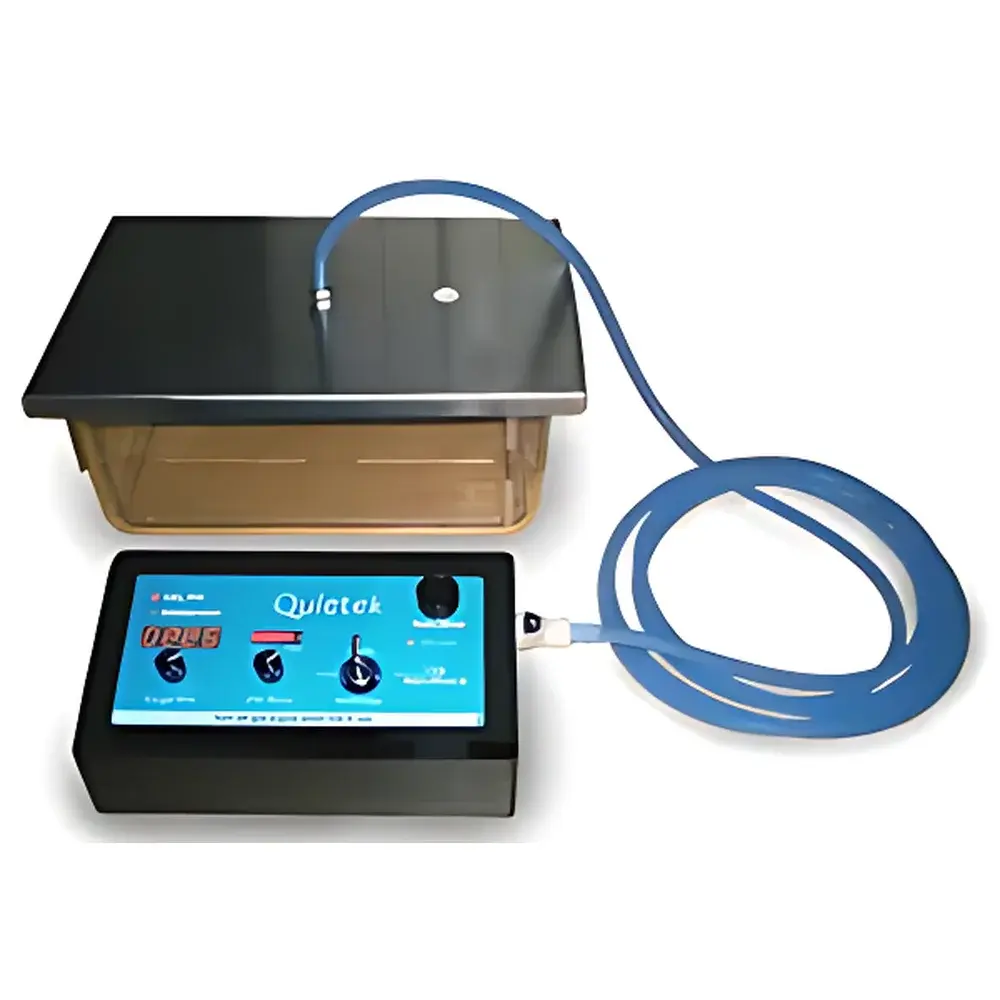
Quietek™ CO₂ Euthanasia Delivery System – Braintree Scientific Model QTK-1 / QTK-2 / QTK-SC / QTK-SCT
| Brand | Braintree Scientific |
|---|---|
| Origin | USA |
| Manufacturer Authorization | Authorized Distributor |
| Origin Category | Imported Instrument |
| Model | Quietek™ T Series (QTK-1, QTK-2, QTK-SC, QTK-SCT) |
| Pricing | Available Upon Request |
Overview
The Quietek™ CO₂ Euthanasia Delivery System is an engineered solution for controlled, humane, and protocol-compliant carbon dioxide euthanasia of laboratory rodents. Designed in accordance with the 2013 American Veterinary Medical Association (AVMA) Guidelines for the Euthanasia of Animals, this system delivers precise, volumetrically regulated CO₂ flow rates—strictly within the recommended 10–30% chamber volume per minute—without pre-charging the euthanasia chamber. Unlike manual gas valve setups, the Quietek™ platform eliminates operator-dependent variability by automating flow initiation, ramping, and termination. Its architecture is based on calibrated mass-flow control logic integrated with real-time pressure feedback, ensuring consistent delivery across chamber volumes ranging from 0.5 L to 200 L. The system operates as a standalone gas delivery module compatible with standard compressed CO₂ cylinders (regulated at 40–60 psi input), requiring no external power supply or software interface for basic operation.
Key Features
- AVMA 2013-compliant CO₂ delivery: Maintains flow rates strictly between 10% and 30% of chamber volume per minute, dynamically adjusted per selected chamber size.
- No pre-fill mode: Prevents premature exposure and ensures gradual, physiologically appropriate induction—critical for minimizing distress responses in mice and rats.
- Single- and dual-port configurations (QTK-1 and QTK-2): Enables parallel processing of two chambers or sequential use with minimal setup time.
- RapidFill option (QTK-SCT): Accelerates initial gas introduction for high-throughput facilities while maintaining post-ramp compliance with AVMA thresholds.
- Plug-and-play operation: After connecting to a regulated CO₂ source and attaching the appropriate cage lid, activation requires only a single START button press—no manual valve tuning or flowmeter calibration.
- Modular hardware design: Interchangeable tubing (QT6-B, 6 ft blue hose with quick-connect fitting) and three standardized cage lid sizes (QCVR-13×9, QCVR-16×11, QCVR-24×17) support scalable integration across IACUC-approved caging systems.
Sample Compatibility & Compliance
The Quietek™ system is validated for use with laboratory rodents—including mice, rats, and hamsters—within defined weight and chamber volume parameters. It supports chamber capacities from 0.5 L (e.g., individual transport containers) up to 200 L (large group chambers), with model-specific calibration presets (QTK-SC for 0.5–10 L; QTK-2 for multi-chamber workflows). All operational protocols align with AVMA 2013 euthanasia standards, IACUC Policy 11.01 (Humane Endpoints and Euthanasia), and NIH Office of Laboratory Animal Welfare (OLAW) guidance. While the device itself does not require FDA clearance (as it is not a medical device), its implementation supports institutional adherence to GLP-relevant documentation practices—including audit-ready usage logs when paired with optional timestamped manual recording or third-party data capture systems.
Software & Data Management
The base Quietek™ T-series models operate without embedded firmware or proprietary software, prioritizing reliability, regulatory transparency, and ease of validation. Flow control is implemented via mechanical regulators and calibrated orifices—not algorithm-driven closed-loop electronics—thereby eliminating concerns related to software validation under FDA 21 CFR Part 11 or EU Annex 11. For institutions requiring traceability, users may document run parameters (chamber size, start/stop time, cylinder pressure) manually or integrate the system into existing electronic lab notebooks (ELNs) or animal care management platforms. Optional accessories—including pressure gauges and flow verification kits—are available for periodic performance verification per institutional SOPs.
Applications
- Standardized terminal procedures in preclinical pharmacology and toxicology studies where consistent, auditable euthanasia is required prior to tissue harvest.
- High-volume breeding colony management, particularly in core facilities performing routine culling under approved IACUC protocols.
- Training laboratories emphasizing hands-on instruction in humane endpoints and ethical animal use principles.
- Contract research organizations (CROs) seeking reproducible, inspector-ready euthanasia workflows compliant with AAALAC International accreditation standards.
- Academic institutions implementing centralized animal core facilities with shared equipment access and documented SOP enforcement.
FAQ
Does the Quietek™ system require electrical power or computer connectivity?
No. It is a pneumatically actuated, non-electronic device powered solely by regulated CO₂ supply pressure.
Can it be used with non-standard or custom-built euthanasia chambers?
Yes—provided chamber volume is known and falls within the supported range (0.5–200 L), and the cage lid interface is mechanically sealed using compatible gaskets and the QT6-B tubing assembly.
Is calibration certification provided with each unit?
Each Quietek™ system ships with a factory verification sheet confirming nominal flow rate accuracy against NIST-traceable reference standards; full recalibration services are available through Braintree Scientific’s authorized service network.
Are replacement parts and consumables readily available?
Yes. All components—including cage lids (QCVR series), tubing (QT6-B), and port adapters—are stocked globally and assigned unique catalog numbers for procurement traceability.
Does the system meet requirements for AAALAC or OLAW inspections?
Yes—when operated per AVMA guidelines and documented within institutionally approved SOPs, the Quietek™ system provides a defensible, repeatable method that aligns with AAALAC Standard 2.3.2 and OLAW Guidance on Humane Euthanasia.
Related Products




