
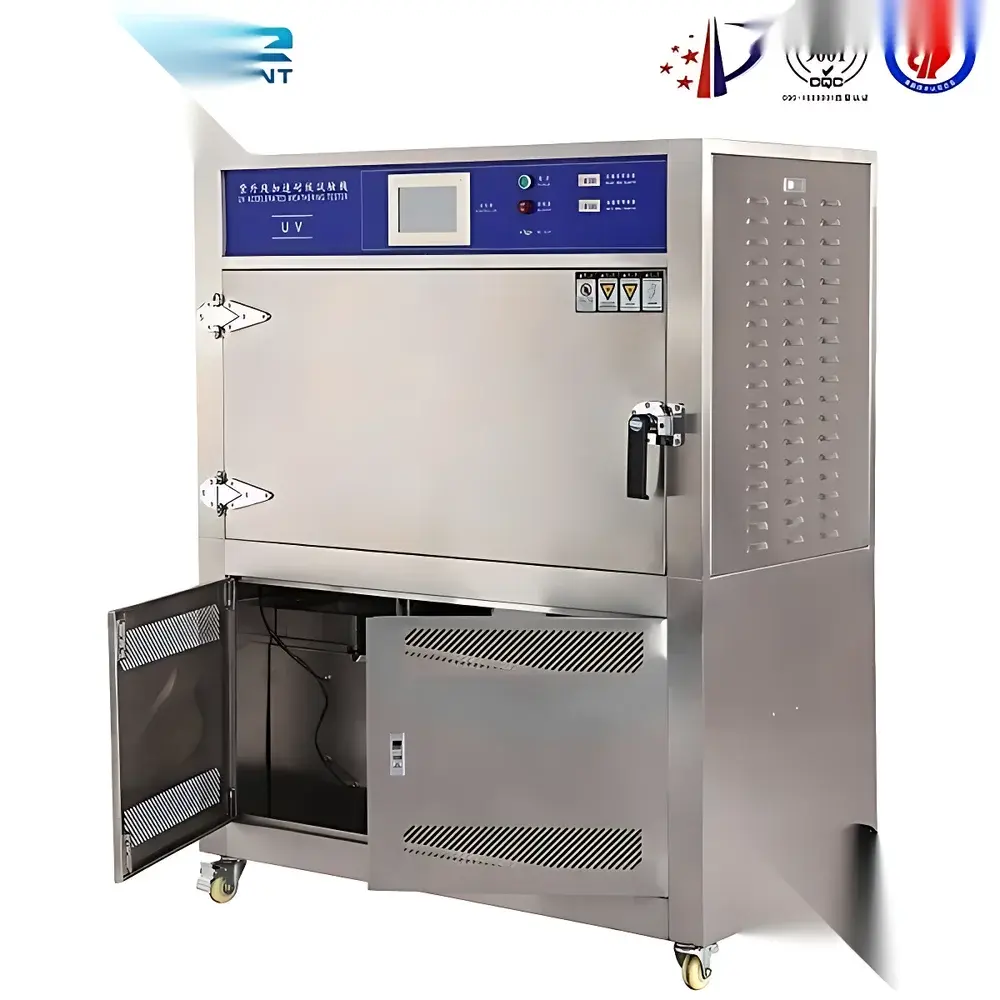
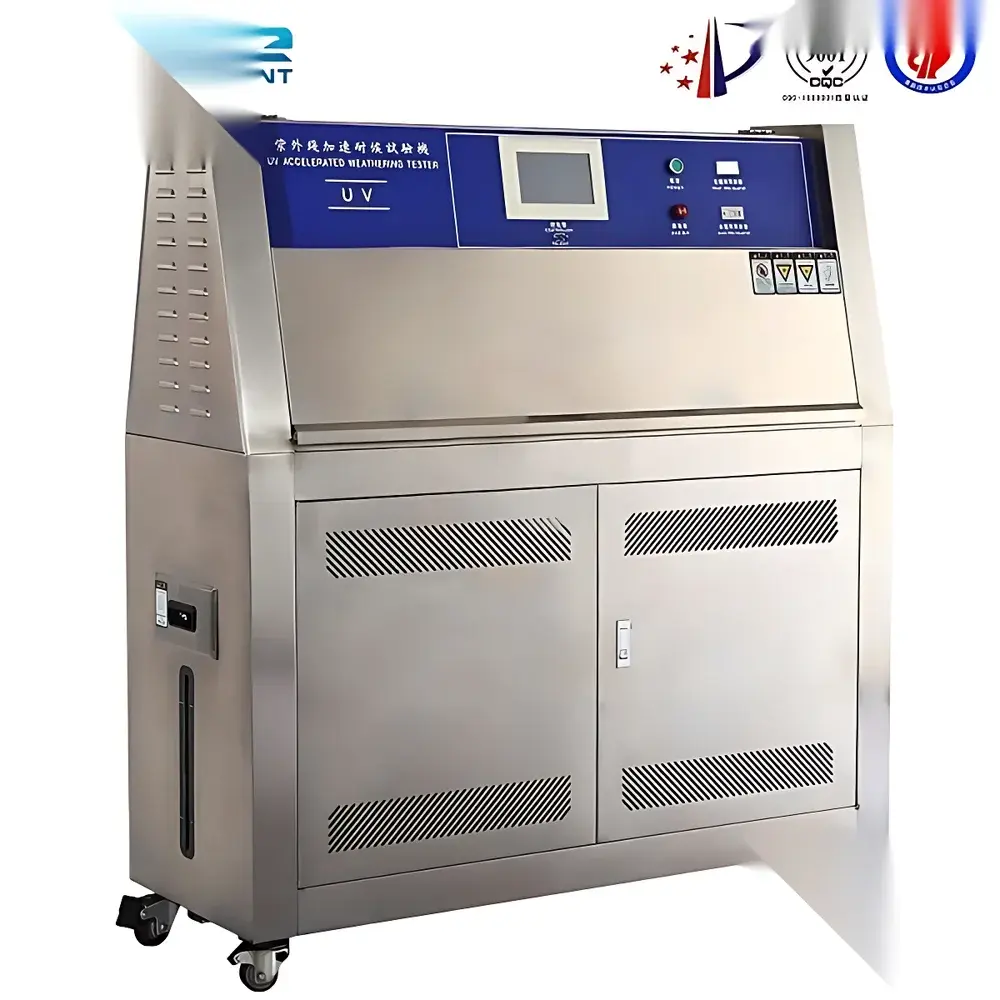
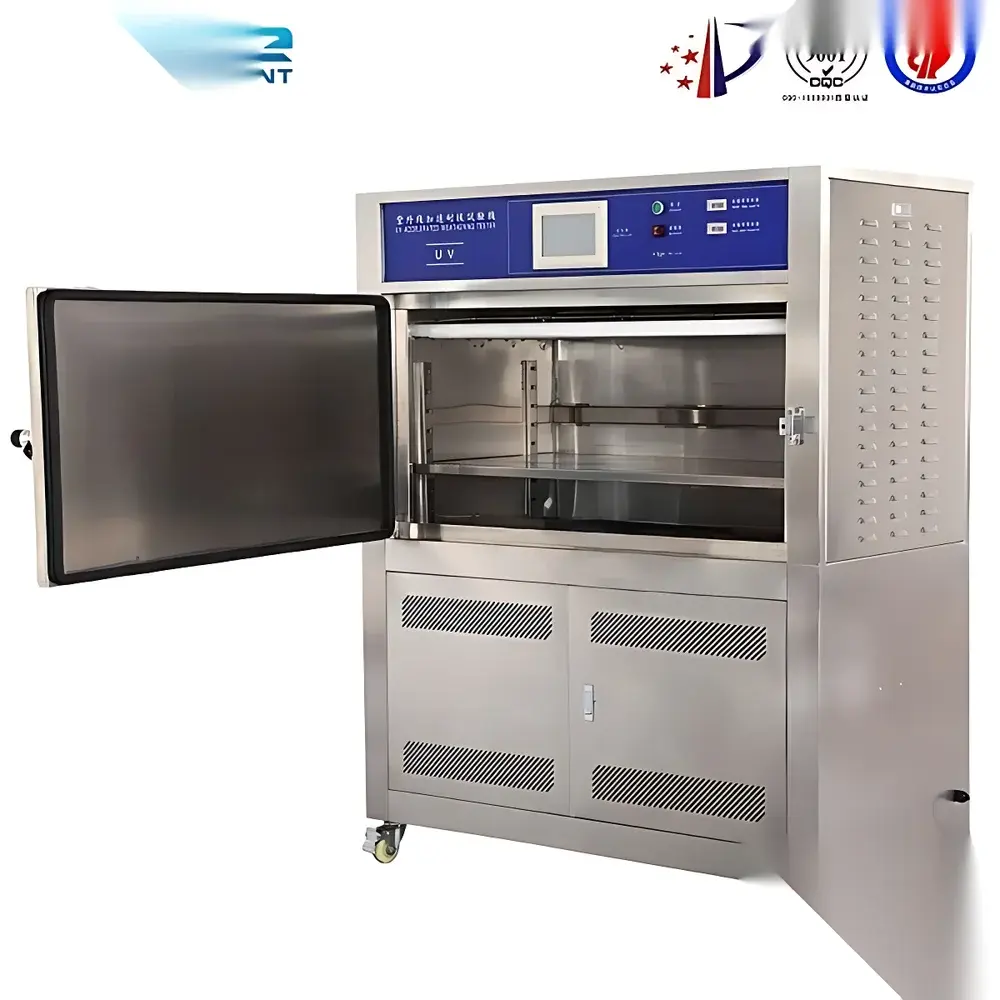
QUV UV Aging Test Chamber – OK-UV-290 Model
| Brand | OK Instruments |
|---|---|
| Model | OK-UV-290 |
| Chamber Internal Dimensions (W×H×D) | 114 × 40 × 40 cm |
| External Dimensions (W×H×D) | 135 × 140 × 65 cm |
| Temperature Range | Ambient to 70 °C |
| Humidity Range | ≥95% RH |
| Temperature Control Accuracy | ≤±0.5 °C |
| Temperature Uniformity | ≤±2 °C or ≤±3% |
| UV Light Source | Fluorescent UV Lamps (UVA-340 or UVB-313 typical, 280–400 nm) |
| Lamp Lifetime | ~1500 h |
| Exposure Time Setting Range | 0–999 h |
| Construction Material | SUS#304 Stainless Steel (Interior & Exterior) |
| Heating System | U-shaped Titanium Alloy High-Speed Heating Elements |
| Safety Protections | Interlocked Door Cut-off, Over-Temperature Protection, Low-Water Level Detection |
| Power Supply | AC 220 ±5 V, 50 ±0.5 Hz |
Overview
The QUV UV Aging Test Chamber (Model OK-UV-290) is an engineered environmental test system designed to accelerate the degradation of materials under controlled ultraviolet (UV) radiation, condensation, and thermal cycling—mimicking key outdoor weathering stressors including solar UV exposure, dew formation, and thermal shock. Unlike broad-spectrum xenon arc testers, the QUV chamber employs fluorescent UV lamps calibrated to emit within the biologically and chemically active 280–400 nm spectral range (UVA and UVB), enabling reproducible simulation of photodegradation mechanisms such as polymer chain scission, pigment fading, and surface oxidation. Its closed-loop condensation cycle replicates nocturnal dew deposition via saturated humid air contact with cooled specimen surfaces—without requiring water spray nozzles—thereby delivering high-fidelity moisture exposure aligned with natural diurnal cycles. This architecture supports accelerated correlation studies between laboratory exposure and real-world service life, particularly for organic coatings, thermoplastics, adhesives, and composite substrates.
Key Features
- Fluorescent UV lamp array with selectable spectral output (UVA-340 for daylight simulation or UVB-313 for aggressive, short-wavelength acceleration)
- Programmable exposure cycles integrating UV irradiation (at controlled black-panel temperature) and condensation phases (100% RH, ambient-to-60 °C surface cooling)
- Precision temperature control system with ±0.5 °C accuracy and uniformity maintained at ≤±2 °C across the test chamber volume
- Full SUS#304 stainless steel construction—interior and exterior—for corrosion resistance and long-term stability in humid, UV-rich environments
- Interlocked safety circuitry: automatic UV lamp deactivation upon door opening, over-temperature cutoff, and low-water-level detection
- Digital timer with 0–999 hour exposure duration setting and cycle memory retention
- Black-panel thermometer integration for direct specimen surface temperature monitoring during irradiation
Sample Compatibility & Compliance
The OK-UV-290 accommodates flat panel specimens up to 110 × 40 cm (standard rack configuration), supporting standardized sample holders per ASTM G154 and ISO 4892-3. It is validated for compliance with multiple international material weathering standards, including ASTM G153 (for enclosed carbon-arc apparatuses, adapted for UV equivalence), ASTM G154 (practice for fluorescent UV-condensation exposures), ASTM D4329 (plastics), ASTM D4587 (coatings), ASTM D4799 (wood products), SAE J2020 (automotive exterior materials), and ISO 4892-3 (methods for laboratory light exposure). The chamber’s design enables traceable calibration per ISO/IEC 17025 requirements when operated within an accredited laboratory environment. While not inherently 21 CFR Part 11 compliant, its data logging interface supports integration with validated LIMS or ELN platforms for GLP/GMP-regulated durability assessments.
Software & Data Management
The OK-UV-290 operates via a dedicated microprocessor-based controller with LED display and tactile keypad interface—no external PC dependency required. All operational parameters (UV setpoint, condensation duration, cycle count, elapsed time) are retained in non-volatile memory. Optional RS-485 or analog 4–20 mA output ports enable connection to centralized building management systems (BMS) or SCADA networks for remote status monitoring and alarm logging. For audit-ready documentation, users may pair the unit with third-party data acquisition software that records timestamped black-panel temperature, chamber humidity, and UV irradiance (when equipped with calibrated radiometer add-ons), satisfying traceability needs in regulated quality assurance workflows.
Applications
This chamber serves as a core tool in R&D and QC laboratories evaluating photochemical stability across diverse material classes: architectural and industrial coatings (e.g., acrylics, polyurethanes, epoxies); automotive exterior plastics (PP, ABS, PC blends); pressure-sensitive adhesives; wood finishes and laminates; textile dyes and UV-stabilized fibers; medical device polymer housings; and printed electronics substrates. Its predictive capability is especially valuable during formulation screening, supplier qualification, and failure root-cause analysis—where correlation coefficients between QUV exposure hours and field performance (e.g., gloss loss, chalking, color ΔE* > 3.0 per CIEDE2000) are routinely established using historical validation datasets.
FAQ
What UV lamp types are compatible with the OK-UV-290?
Standard configurations use UVA-340 lamps (peak emission at 340 nm) for realistic sunlight simulation; UVB-313 lamps are available for accelerated testing where higher-energy photons are required.
Is calibration certification included with shipment?
The unit ships with factory-set temperature and time calibration; NIST-traceable lamp irradiance calibration requires optional radiometer installation and periodic third-party verification.
Can the chamber operate continuously for extended cycles (e.g., 1,000+ hours)?
Yes—provided routine maintenance is performed: lamp replacement every ~1,500 operating hours, condensate reservoir refills, and quarterly inspection of gasket integrity and heater element resistance.
Does the OK-UV-290 meet IEC 60068-2-5 for UV testing?
While IEC 60068-2-5 specifies general requirements for solar radiation testing, the OK-UV-290 aligns with its methodology through controlled spectral irradiance and thermal profiles—but formal IEC certification requires independent test lab validation per clause 7.2.
How is specimen temperature monitored during UV exposure?
A black-panel thermometer (BPT) mounted adjacent to the sample plane provides real-time surface temperature feedback, critical for correlating degradation kinetics with thermal activation energy models.



