
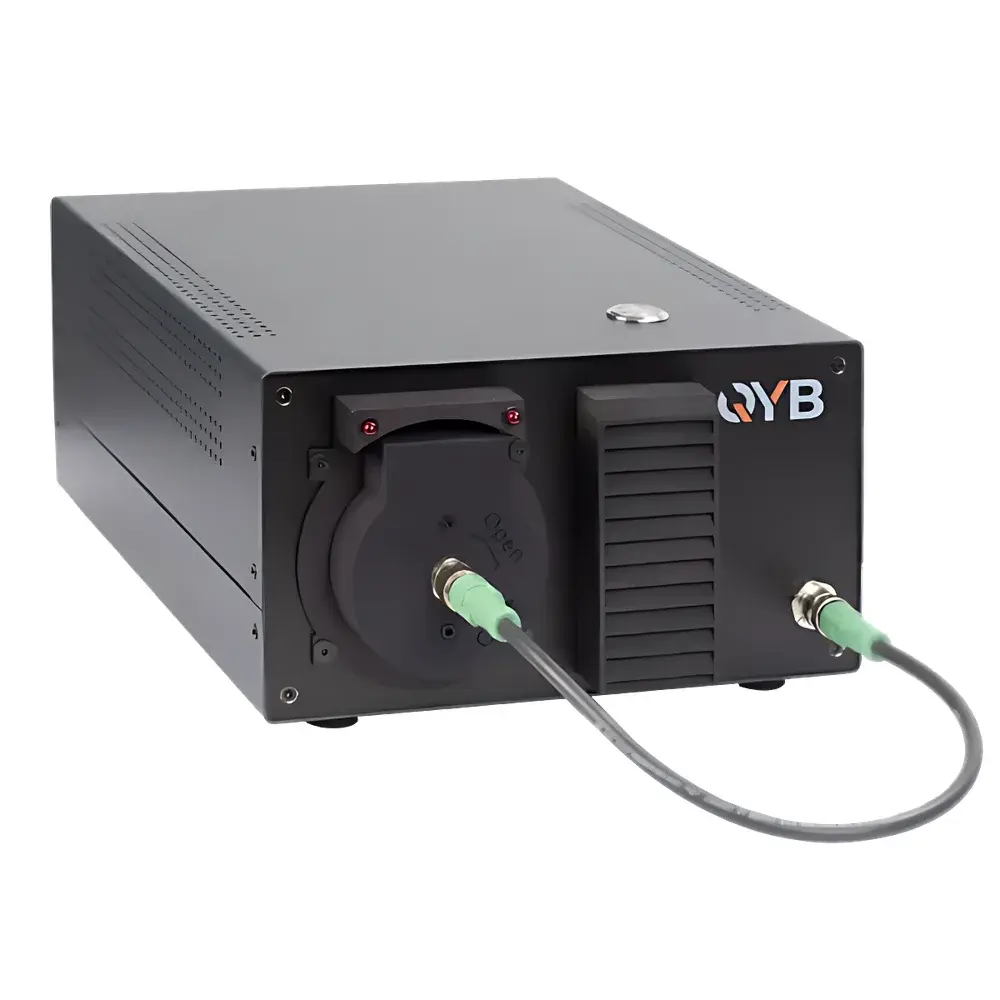
QYB PLQY Pro Absolute Electroluminescence & Photoluminescence Quantum Yield and Quasi-Fermi Level Splitting Measurement System
| Brand | QYB / Quantum Yield Berlin |
|---|---|
| Origin | Germany |
| Manufacturer Type | Authorized Distributor |
| Origin Category | Imported |
| Model | PLQY Pro |
| Measurement Mode | DC |
| Photon Excitation Wavelength | 532 nm |
| Maximum Laser Power | 140 mW |
| Excitation Spot Size Options | 0.1 cm² or 1 cm² |
| Spectral Range | 550–1050 nm |
| Minimum Detectable Quantum Yield | ≥1×10⁻⁶ |
| Integration Time | 1 ms – 35 min |
| Spectral Sampling Interval | 1 nm |
| SNR | 600:1 |
| Voltage Source Range | ±10 V |
| Current Source/Measurement Range | ±150 mA |
| Voltage Accuracy | ±10 mV |
| Voltage Sensing Accuracy | ±50 µV |
| Current Sensing Accuracy (selectable ranges) | ±100 nA, ±1 µA, ±10 µA |
| Sample Holder | Customizable (max. 30 mm × 30 mm × 10 mm) |
| Max. Subcell Capacity | 6 |
| Dimensions | 220 mm × 390 mm × 120 mm |
| Weight | 6.1 kg |
Overview
The QYB PLQY Pro is a compact, glovebox-compatible absolute quantum yield and quasi-Fermi level splitting (QFLS) measurement system engineered for precision characterization of optoelectronic devices—including perovskite/silicon tandem solar cells, organic photovoltaics (OPVs), LEDs, and emerging wide-bandgap semiconductors. It implements calibrated, traceable photon-counting methodology based on dual-channel spectral radiometry: one channel measures absolute electroluminescence (EL) or photoluminescence (PL) emission spectra under controlled electrical bias or optical excitation; the second channel simultaneously records incident photon flux using a NIST-traceable reference lamp and certified reference solar cells from Fraunhofer ISE CalLab PV Cells. This architecture enables direct calculation of absolute ELQY and PLQY without empirical correction factors—critical for validating Shockley–Queisser limit compliance and quantifying non-radiative recombination losses. The system uniquely integrates QFLS derivation in real time, supporting both rapid screening and high-fidelity analysis of carrier dynamics under variable excitation intensities (0.001–10 “suns”) and bias conditions.
Key Features
- Traceable absolute quantum yield measurement (ELQY & PLQY) with uncertainty <±3% (k=2), certified against NIST-traceable standards and Fraunhofer ISE reference cells
- Dual-mode operation: DC-biased EL spectroscopy and pulsed/steady-state PL spectroscopy with integrated 532 nm laser (140 mW max, intensity continuously tunable)
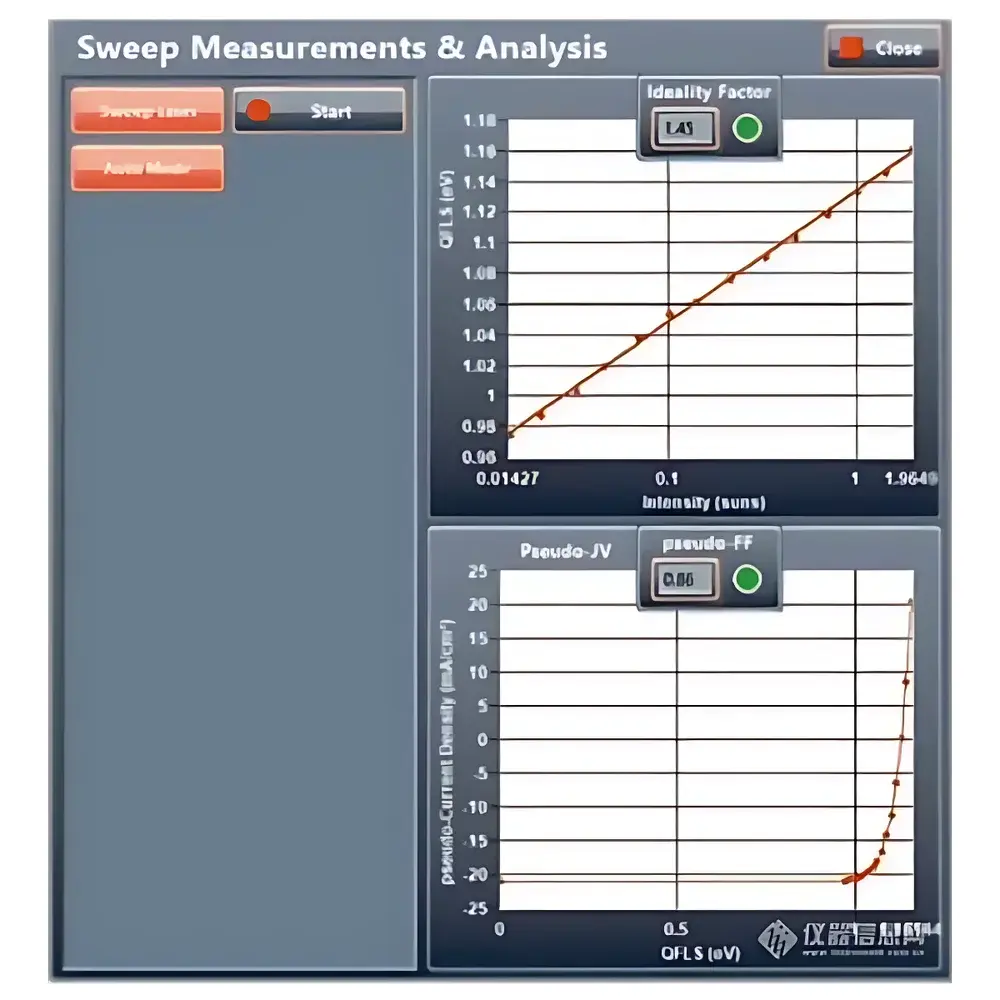
- Real-time QFLS computation using two complementary algorithms—“Direct” mode (no absorption input required) and “Refined” mode (leveraging user-provided EQE or absorption spectra)
- Glovebox-integrated design (220 × 390 × 120 mm, 6.1 kg) with vacuum-compatible feedthroughs and modular sample stage accommodating up to six subcells (max. 30 × 30 × 10 mm)
- High-sensitivity spectrometer (550–1050 nm, 1 nm sampling, SNR 600:1) coupled to low-noise current–voltage source (±10 V, ±150 mA, voltage sensing ±50 µV, current sensing down to ±100 nA)
- Automated laser intensity sweep and bias sweep protocols with synchronized spectral acquisition and on-the-fly LuQY/QFLS calculation
Sample Compatibility & Compliance
The PLQY Pro supports standard device architectures used in R&D and pilot-line validation, including inverted and regular-structure perovskite solar cells, thin-film LEDs, quantum dot emitters, and organic semiconductors. Its optical and electrical interfaces comply with ISO/IEC 17025–accredited calibration practices, and all spectral and electrical measurements adhere to ASTM E1021 (Standard Test Method for Determining the Spectral Responsivity of Photovoltaic Devices) and IEC 60904-8 (Photovoltaic devices — Part 8: Measurement of spectral response of a photovoltaic (PV) device). Data integrity meets GLP/GMP-aligned requirements through audit-trail-enabled software logging (timestamped parameter sets, raw spectra, calibration certificates, and metadata export). While not FDA 21 CFR Part 11–certified out-of-the-box, the system’s deterministic measurement chain and exportable HDF5/CSV data formats support integration into validated QA workflows.
Software & Data Management
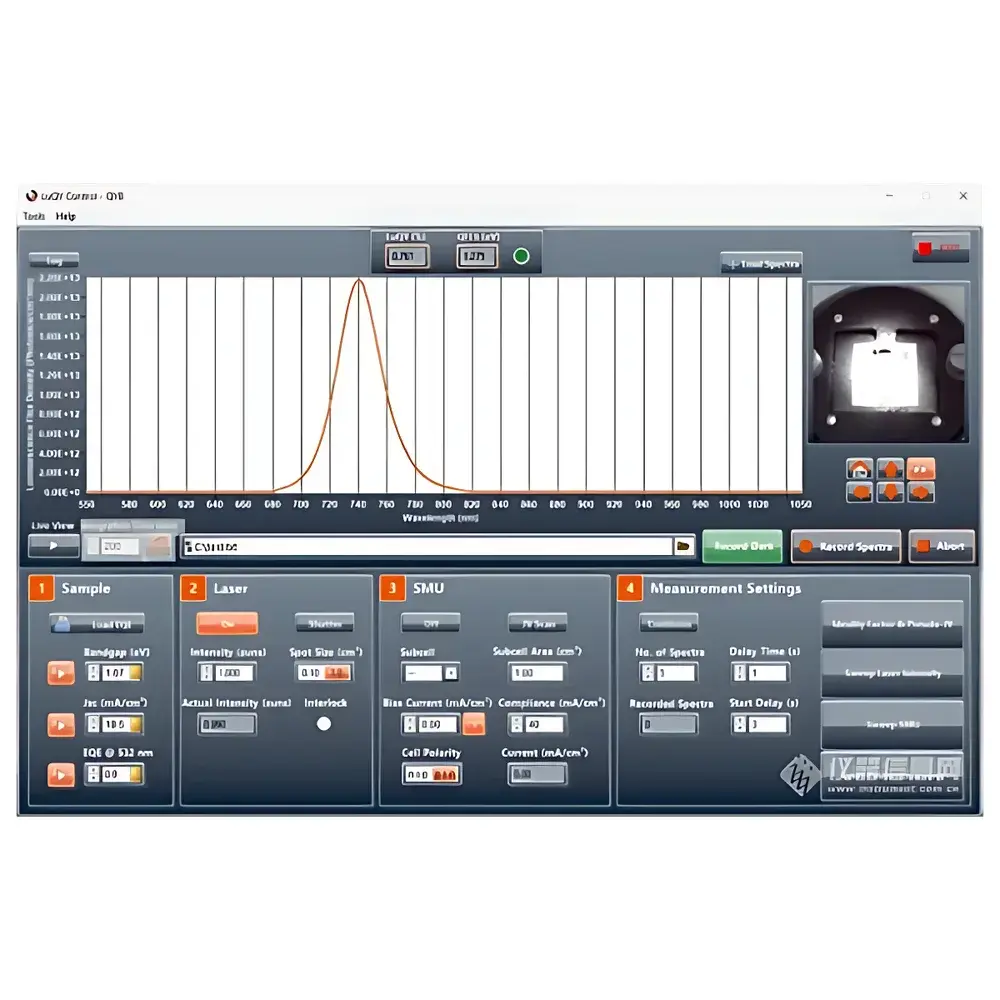
The proprietary SMUl (Spectral Measurement & QFLS Utility) software provides a unified interface for instrument control, spectral visualization, and physics-based analysis. The GUI features a split-view layout: the upper panel displays live emission spectra, camera feed (for spatial alignment), and dynamically updated values of ELQY/PLQY and QFLS; the lower panel manages sample metadata, excitation configuration (laser power, bias point, integration time), and calibration status. Two QFLS algorithms are embedded—“Direct QFLS” (based on thermodynamic reciprocity and ideal diode assumptions) and “Refined QFLS” (which incorporates measured or imported absorption/EQE data to correct for sub-bandgap losses and Stokes shift effects). The software automatically selects the optimal algorithm per dataset, assigning confidence scores based on spectral width, signal-to-noise ratio, and consistency between measured Jsc and integrated EQE. All raw and processed data—including calibrated spectra, IV curves, and QFLS trajectories—are stored in timestamped, version-controlled project files with full metadata (excitation intensity, temperature, ambient O2/H2O if logged externally).
Applications
- Quantitative assessment of non-radiative voltage losses in perovskite tandem solar cells (e.g., validating >29% efficiency pathways as reported in Science and Nature)
- Correlating QFLS with VOC deficit across material systems (e.g., bromine-substituted self-assembled monolayers, antimony-doped SnO2 ETLs)
- Optimizing charge extraction layers via comparative ELQY mapping under forward bias
- Stability benchmarking: tracking QFLS decay kinetics during thermal/light soaking stress tests
- LED efficiency grading: absolute external quantum efficiency (EQE) and radiative efficiency ηrad = ELQY / (1 − PLQY) derivation
- Band-edge photophysics studies: resolving fine structure in near-infrared emission (700–1050 nm) with 1 nm resolution and sub-100 nA current detection
FAQ
What calibration standards are used for absolute photon flux and spectral responsivity?
The system employs dual-traceable calibration: laser intensity is referenced to Fraunhofer ISE CalLab PV Cells (certified under ISO/IEC 17025); spectral sensitivity is calibrated using a NIST-traceable tungsten-halogen lamp with known absolute spectral irradiance.
Can the PLQY Pro operate inside nitrogen-filled gloveboxes?
Yes—the fully enclosed, fanless chassis (IP20-rated) and low-power consumption (<45 W) enable stable operation in inert-atmosphere gloveboxes; optional feedthrough kits support electrical and optical interfacing.
Does the software support batch processing of multiple samples?
Yes—SMUl includes scriptable automation (Python API) and batch analysis modules for throughput-oriented labs, enabling parallel QFLS extraction across subcell arrays or process variations.
Is absorption data mandatory for accurate QFLS calculation?
No—“Direct QFLS” mode operates without absorption input but assumes ideal absorption above Eg; “Refined QFLS” improves accuracy by incorporating measured EQE or absorption, especially for low-Eg or high-Stokes-shift materials.
How is the 1×10⁻⁶ quantum yield detection limit achieved?
Through optimized optical throughput (high-efficiency gratings, back-thinned CCD), ultra-low-noise current measurement (100 nA range), and long integration times (up to 35 minutes) with dark-current subtraction and pixel binning—all rigorously validated per ISO 17025 uncertainty budgets.





