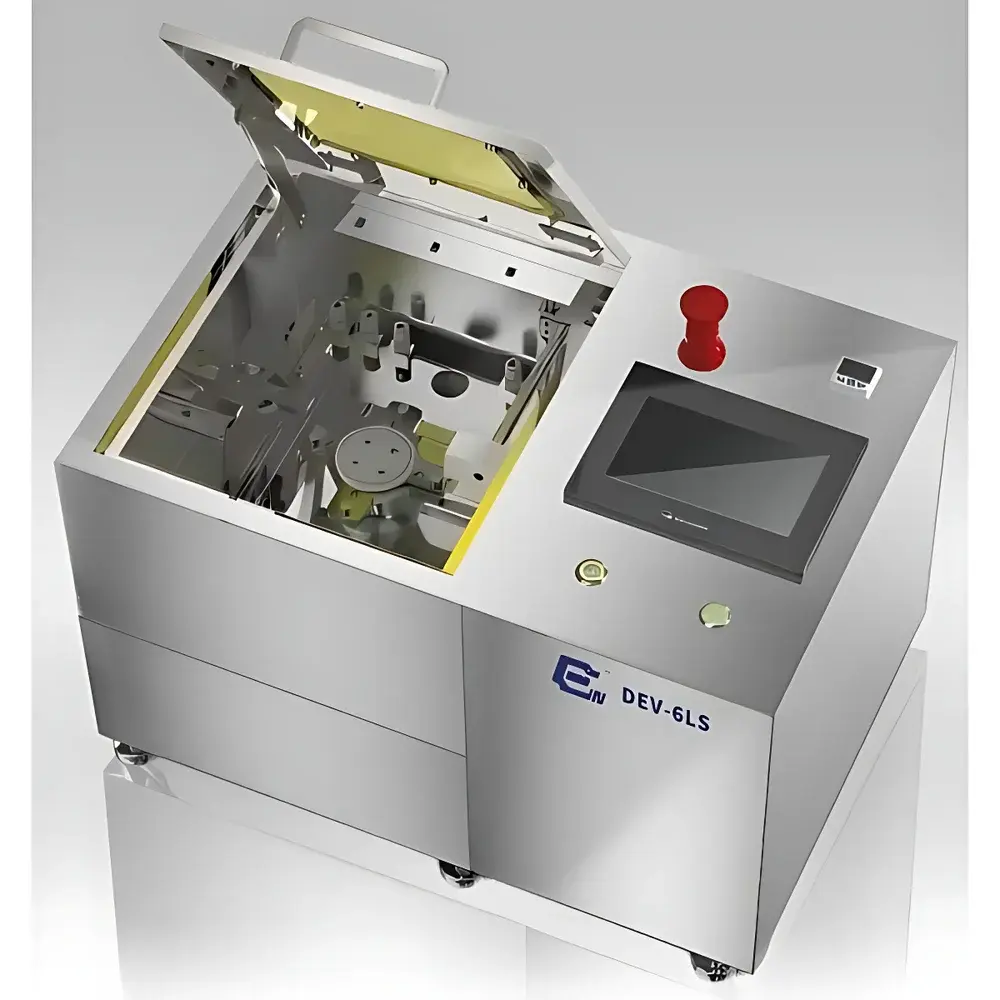
R2P/R2R Nanoimprint Lithography System – Stensborg Uni A6 DT
| Origin | Denmark |
|---|---|
| Manufacturer Type | Authorized Distributor |
| Origin Category | Imported |
| Model | Uni A6 DT |
| Price Range | USD 68,000 – 109,000 |
Overview
The Stensborg Uni A6 DT is a benchtop roll-to-plate (R2P) and roll-to-roll (R2R) nanoimprint lithography (NIL) system engineered for high-fidelity, scalable replication of micro- and nanoscale topographic patterns onto diverse substrates. Unlike conventional holographic printing methods reliant on pre-fabricated foils or vacuum-based e-beam lithography, the Uni A6 DT implements Stensborg’s proprietary Holoprint® process—a continuous, in-line UV-curable nanoimprinting technology that directly transfers master templates onto pre-coated polymer films, glass, flexible plastics, or rigid wafers. The system operates on a contact-mode thermal/UV hybrid imprint principle, where precise mechanical alignment, controlled pressure (0.1–5 MPa), and spatially uniform UV irradiation (365 nm LED array, ±3% intensity uniformity) enable sub-50 nm feature fidelity with <±2 nm overlay repeatability over 100 mm × 100 mm areas. Designed for R&D labs and pilot-line manufacturing, it bridges the gap between academic nanofabrication and industrial-scale optical component production.
Key Features
- Benchtop footprint (750 × 650 × 420 mm) with integrated environmental enclosure for dust-free operation
- Modular R2P and R2R configuration support—switchable via tooling kit without recalibration
- Motorized precision stage with 0.1 µm resolution linear encoders and active force feedback control (0.05–10 N range)
- UV-curing module featuring collimated 365 nm LEDs (peak irradiance ≥ 300 mW/cm²), thermally stabilized to ±0.5°C
- Template handling system compatible with quartz, silicon, Ni, and PDMS masters up to 150 mm diameter
- Real-time process monitoring via integrated load cell, UV dosimeter, and gap-sensing capacitive probe
- Compliant with ISO 14644-1 Class 5 cleanroom requirements when operated inside laminar flow hoods
Sample Compatibility & Compliance
The Uni A6 DT accommodates substrates ranging from 25 µm-thick PET films to 500 µm-thick fused silica wafers, including curved, textured, or low-surface-energy surfaces (e.g., fluorinated polymers). It supports UV-curable acrylate, epoxy, and hybrid organic-inorganic resins (viscosity 10–5000 cP). All wetting and release behavior is validated per ASTM D7334 (surface energy measurement) and ISO 8510-2 (adhesion testing). Template lifetime exceeds 30,000 imprints under GLP-compliant process logging, verified per ISO/IEC 17025 calibration traceability. System firmware complies with IEC 61508 SIL2 for functional safety during automated cycles.
Software & Data Management
Controlled via Stensborg’s ImprintStudio™ v4.2 software (Windows 10/11 64-bit), the system provides full audit trail functionality compliant with FDA 21 CFR Part 11—including electronic signatures, user role-based access (admin/operator/technician), and immutable process logs (timestamped pressure, UV dose, temperature, gap, and stage position at 10 Hz). Raw data export supports HDF5 and CSV formats; pattern alignment routines integrate with common metrology tools (e.g., Zeiss Axio, Keysight B1500A) via TCP/IP API. Software validation documentation (IQ/OQ/PQ protocols) is supplied for GMP environments.
Applications
- Diffractive optical elements (DOEs) for AR/VR waveguides and holographic optical elements (HOEs)
- Anti-counterfeiting microstructures (e.g., kinetic security images, polarization-selective gratings)
- Light-trapping textures for perovskite and silicon photovoltaics (measured >12% relative PCE gain)
- LED extraction enhancement structures (e.g., moth-eye arrays, photonic crystals)
- Microfluidic channel networks with sub-10 µm cross-sections and surface-functionalized sidewalls
- Superhydrophobic/superhydrophilic biomimetic surfaces (Cassie-Baxter state stability validated per ISO 27448)
- Plasmonic metasurfaces for biosensing (LSPR shift resolution ≤ 0.3 nm)
- NIL hard masks for subsequent dry etching (SiO₂, SiNₓ, Al₂O₃) in semiconductor front-end processes
FAQ
What is the minimum resolvable feature size achievable with the Uni A6 DT?
Sub-30 nm line/space features have been demonstrated using optimized PDMS templates and low-viscosity acrylate resins under controlled humidity (<30% RH) and nitrogen purge.
Can the system be integrated into an existing cleanroom automation workflow?
Yes—SECS/GEM interface support is available as an optional hardware module; SMEMA-compatible conveyor integration is documented in the Installation Qualification manual.
Is template cleaning and reconditioning supported in situ?
No—template maintenance requires off-line plasma cleaning (O₂/Ar) or UV-ozone treatment; however, the system includes a dedicated template storage drawer with inert gas purge (N₂) to minimize contamination between runs.
Does the system meet ISO 13485 requirements for medical device manufacturing?
While not certified out-of-the-box, the Uni A6 DT’s design basis, documentation package (including risk analysis per ISO 14971), and change control procedures fully support ISO 13485:2016 implementation under customer-led QMS oversight.