
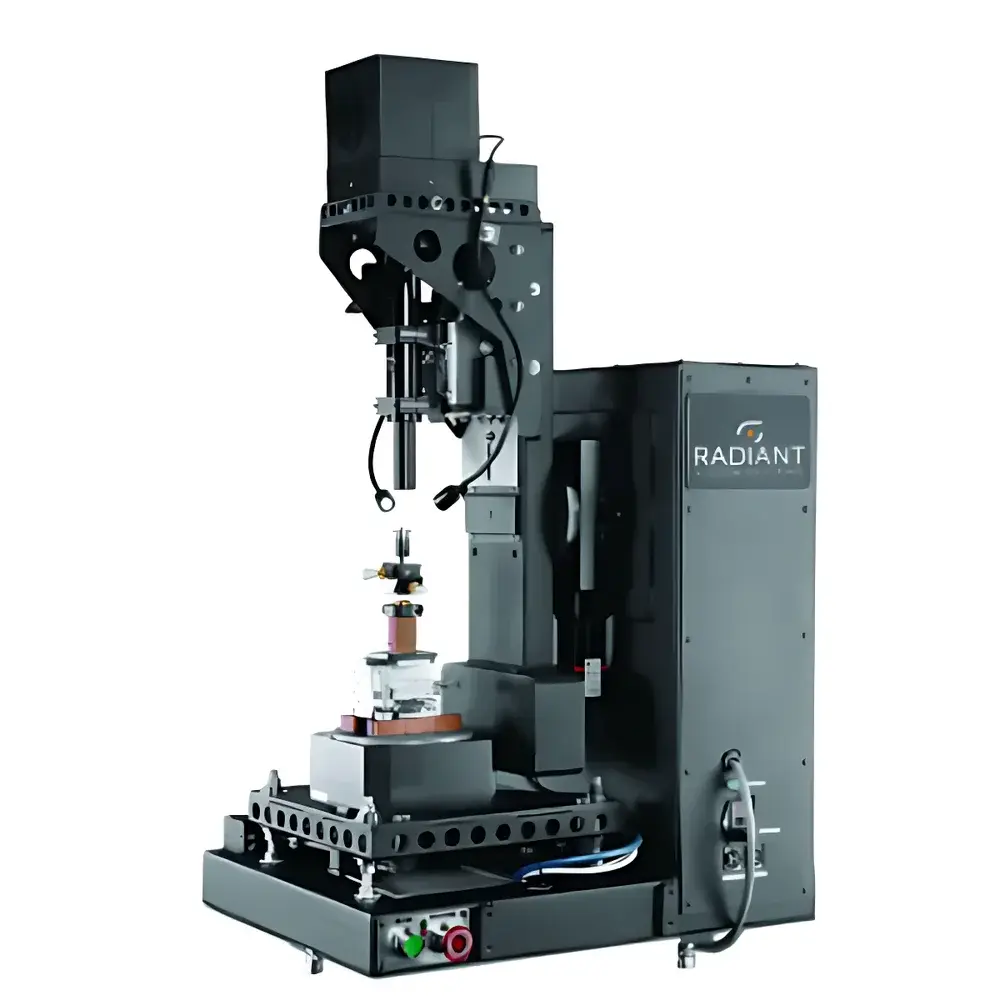
Radiant Vision Systems SIG-400™ Near-Field Source Imaging Goniometer
| Brand | Radiant Vision Systems |
|---|---|
| Origin | USA |
| Model | SIG-400 |
| Application | Near-field radiometric and photometric characterization of small light sources |
| Compatible Detector | ProMetric® imaging colorimeters and photometers |
| Output Format | Radiant Source Model™ (RSM), IES, EULUMDAT, ASAP, LightTools, TracePro, Zemax-compatible ray sets |
| Software Platform | ProSource® v5.0+ |
Overview
The Radiant Vision Systems SIG-400™ Near-Field Source Imaging Goniometer is a fully automated, motorized goniometric measurement system engineered for high-fidelity spatial, angular, and spectral characterization of small-area light sources—particularly LEDs, micro-LEDs, OLED emitters, and other compact solid-state lighting devices. Operating on the principle of near-field angular radiance mapping, the SIG-400™ captures luminance, chromaticity, and radiant intensity distributions at sub-degree angular resolution across a full 360° azimuthal and ±90° polar range. Unlike far-field goniophotometers that infer source behavior from distant measurements, the SIG-400™ directly samples the near-field emission profile—within millimeters to centimeters of the emitting surface—enabling physically accurate modeling of optical coupling, package-level crosstalk, lens-induced asymmetries, and die-level nonuniformities. This capability is essential for predictive optical design, where errors introduced by idealized or far-field–extrapolated source models propagate into system-level performance inaccuracies in automotive headlamps, AR/VR microdisplays, surgical lighting, and backlight units.
Key Features
- Fully programmable 3-axis goniometric stage with sub-arcminute positional repeatability and thermal-stabilized servo control
- Integrated mounting interface for Radiant ProMetric® I-series imaging colorimeters and photometers (e.g., ProMetric I2, I8, I16), enabling pixel-level luminance and CIE x,y, u’v’ mapping
- Automated calibration routine supporting NIST-traceable photometric and colorimetric standards (including spectral correction via optional PR-788 spectroradiometer integration)
- Real-time alignment verification using integrated fiducial detection and auto-focus algorithms to maintain optimal working distance during multi-angle acquisition
- Modular sample stage accommodating packages from 0.3 mm × 0.3 mm chip-scale LEDs to 25 mm × 25 mm multi-die modules, with vacuum and thermal chuck options for operational-state testing
- Compliance-ready metadata tagging per ISO/CIE 19476:2014 (Photometry — Measurement of near-field distribution of light sources) and ANSI C78.377-2021 (Specifications for the Chromaticity of Solid-State Lighting Products)
Sample Compatibility & Compliance
The SIG-400™ supports measurement of both powered and unpowered sources under controlled environmental conditions (temperature range: 15–40 °C; humidity: 30–60% RH non-condensing). It accommodates standard LED footprints—including 0402, 0603, 2835, 3030, and COB configurations—as well as custom substrates with fiducial markers for registration. All acquired data conforms to industry-standard reporting formats required for regulatory submissions and optical simulation interoperability: Radiant Source Model™ (RSM) files embed calibrated, spatially resolved radiance data with full uncertainty quantification; exported ray sets comply with ASAP, FRED, LightTools, TracePro, and Zemax OpticStudio import protocols. The system architecture supports audit trails and electronic signatures aligned with FDA 21 CFR Part 11 and ISO/IEC 17025 requirements when deployed in GLP/GMP environments.
Software & Data Management
ProSource® software serves as the unified control, analysis, and export engine for the SIG-400™ platform. Version 5.0 and later provide scriptable measurement sequences, batch processing of multi-batch RSM generation, and statistical comparison tools for process validation (e.g., wafer-to-wafer or lot-to-lot consistency). Each RSM file contains not only directional radiance values but also metadata on test conditions (drive current, junction temperature estimation, ambient calibration date), enabling traceable root-cause analysis. Ray sets generated from RSMs use importance-sampling techniques—not Monte Carlo randomization—ensuring higher signal-to-noise ratio per ray and faster convergence in non-sequential ray tracing simulations. Data exports include encrypted RSM archives, ASCII-based IESNA LM-63 and EULUMDAT (.ldt) files, and binary ray sets with full polarization and spectral weighting support.
Applications
- LED package development: Quantifying Lambertian deviation, beam steering effects, and phosphor conversion uniformity at the die level
- Optical design validation: Providing ground-truth input for illumination systems requiring sub-millilumen precision (e.g., automotive adaptive driving beams, LiDAR illuminators)
- Manufacturing quality assurance: Monitoring near-field chromaticity shift across production lots per TM-30-20 Annex E guidelines
- Microdisplay characterization: Capturing angular color shift and viewing cone asymmetry in RGB micro-LED arrays for AR waveguide integration
- Standards development support: Generating reference datasets for CIE TC 2-83 (Near-field measurement of light sources) and IEC TR 62758-2
FAQ
What distinguishes near-field modeling from far-field goniophotometry?
Near-field measurement captures spatially resolved radiance at distances comparable to the source dimension, preserving geometric and optical structure lost in far-field projection. This enables accurate modeling of secondary optics interaction, whereas far-field methods assume point-source or extended-source approximations that fail for modern high-density emitters.
Can the SIG-400™ measure pulsed or modulated LED sources?
Yes—when synchronized with ProMetric® high-speed imaging modes and external trigger inputs, the system supports transient near-field characterization at frequencies up to 10 kHz, including PWM dimming artifacts and thermal transient effects.
Is RSM export compatible with Zemax OpticStudio’s Non-Sequential mode?
Yes—RSM-derived ray sets are natively supported in Zemax OpticStudio v22+ via the “Import Rays” tool, retaining wavelength, polarization, and flux-weighting information without interpolation loss.
Does the system support automated pass/fail criteria against specification limits?
ProSource® includes configurable tolerance bands for luminance uniformity, chromaticity deviation (Δu’v’), and total flux—enabling automated QA reporting with CSV/PDF export and SPC charting.




