
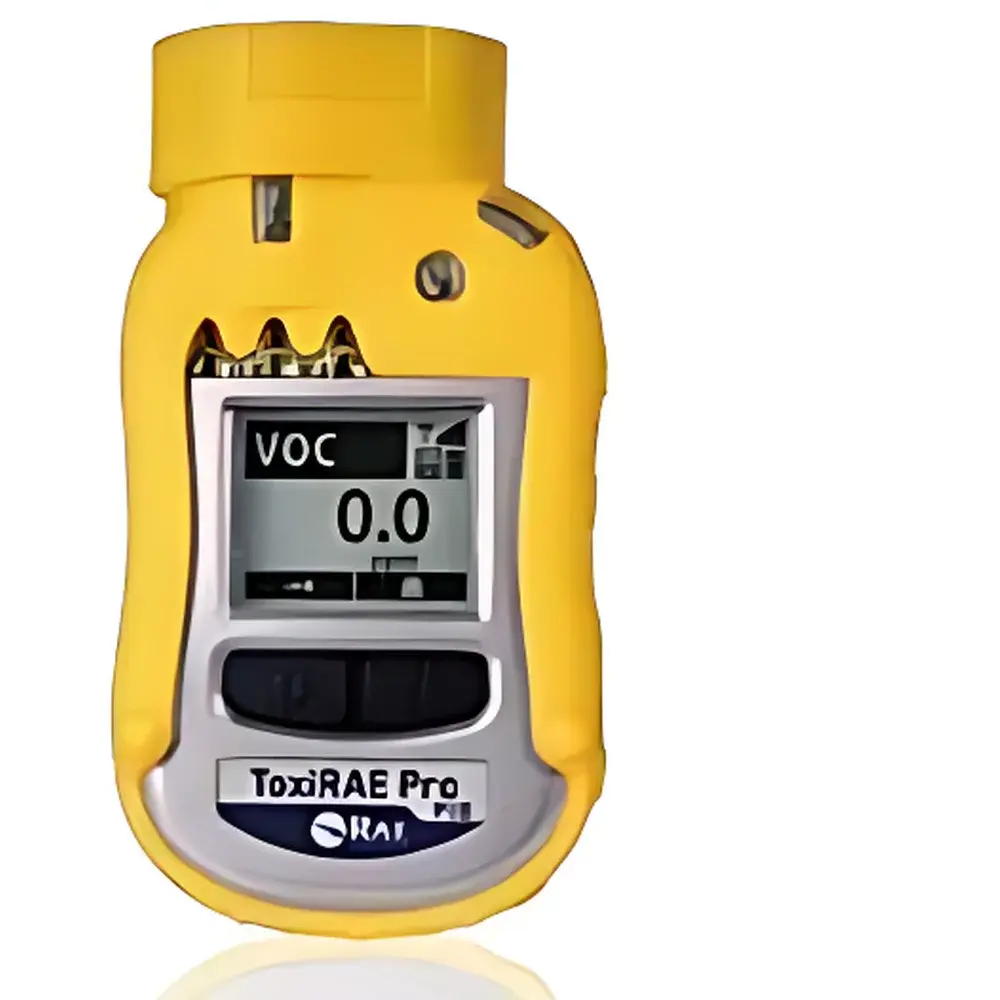
RAE Systems ToxiRAE Pro PID Personal VOC Detector PGM-1800
| Brand | RAE Systems Inc. |
|---|---|
| Origin | USA |
| Instrument Type | Portable VOC Detector |
| Detection Principle | Photoionization Detection (PID) |
| Measurement Range | 0–1000 ppm (standard), 0.1–2000 ppm (extended) |
| Resolution | 1 ppm / 0.1 ppm |
| Response Time | <15 s |
| Certifications | ATEX, UL, CSA, IECEx |
| IP Rating | IP65 |
| Battery Life | Up to 12 hours (rechargeable Li-ion) |
| Data Logging | Internal memory for ≥90 days of time-stamped measurements |
| Display | Backlit graphical LCD with multilingual menu support (including English) |
| Environmental Compensation | Intelligent temperature and zero-point compensation algorithms |
| Enclosure | Stainless steel housing with dust- and water-resistant design |
| Communication | Integrated wireless data transmission (2.4 GHz ISM band, optional Bluetooth or proprietary RF protocol) |
Overview
The RAE Systems ToxiRAE Pro PID Personal VOC Detector (Model PGM-1800) is a compact, intrinsically safe photoionization detection (PID) instrument engineered for real-time, quantitative monitoring of volatile organic compounds (VOCs) in occupational and industrial environments. Utilizing a 10.6 eV ultraviolet lamp and a high-sensitivity ionization chamber, the device detects a broad spectrum of VOCs—including benzene, toluene, xylene, styrene, chlorinated hydrocarbons, and aliphatic/aromatic solvents—without requiring compound-specific calibration. Its miniaturized architecture enables continuous personal exposure monitoring in confined spaces, refineries, chemical processing units, environmental remediation sites, and emergency response scenarios. Designed for compliance with OSHA, NIOSH, and ACGIH exposure guidelines, the PGM-1800 delivers rapid, repeatable readings under variable ambient conditions—operating reliably across –20 °C to +50 °C and 15–95% RH (non-condensing).
Key Features
- Ultra-compact form factor (115 × 65 × 32 mm) optimized for belt-clip or pocket wear without compromising sensor integrity or ergonomics.
- Dual-range PID sensor with selectable full-scale modes (0–1000 ppm and 0.1–2000 ppm), enabling high-resolution quantification at trace levels and robust linearity up to saturation thresholds.
- Graphical backlit LCD supporting English and other major languages; intuitive icon-driven interface reduces operator training requirements and minimizes misinterpretation risk.
- Intelligent on-board compensation algorithms dynamically correct for temperature drift and baseline offset, ensuring measurement stability across thermal transients and extended field deployments.
- Stainless steel enclosure rated IP65 for protection against dust ingress and low-pressure water jets—validated for use in outdoor, offshore, and high-humidity process areas.
- Modular sensor, pump, and battery assembly allows field-replaceable components without specialized tools or recalibration, reducing downtime and lifecycle maintenance cost.
- Integrated rechargeable lithium-ion battery delivering ≥12 hours of continuous operation on a single charge; supports hot-swap capability during shift handovers.
Sample Compatibility & Compliance
The PGM-1800 is validated for direct air sampling of gaseous-phase VOCs with ionization potentials below 10.6 eV. It does not respond to methane, ethane, CO, CO₂, H₂S, or most inorganic gases—minimizing false positives in mixed-gas environments. The instrument meets international safety and performance standards including ATEX II 2G Ex ib IIB T4 Gb, UL 913 Class I, Division 1, Groups B, C, D; CSA C22.2 No. 152; and IECEx Ex ib IIB T4 Gb. It is designed for use in accordance with OSHA 29 CFR 1910.120 (HAZWOPER), EPA Method TO-15 and TO-17 protocols (as screening tool), and ISO 16000-22 for indoor air quality preliminary assessment. All firmware and calibration records support audit-ready documentation per GLP/GMP principles.
Software & Data Management
Data logging captures time-stamped VOC concentration values at user-configurable intervals (1–300 seconds), storing ≥90 days of historical readings internally (≥100,000 data points). Wireless telemetry options—including Bluetooth Low Energy (BLE) and proprietary 2.4 GHz RF—enable secure, encrypted transmission to central safety management platforms (e.g., RAE’s MultiRAE Pro software suite or third-party SCADA/MES systems). Export formats include CSV and XML; all logged events include sensor status flags, battery voltage, temperature, and alarm activation metadata. Firmware updates are performed via USB or over-the-air (OTA), with version control and digital signature verification to ensure regulatory traceability.
Applications
- Personal exposure monitoring for refinery turnaround crews, tank cleaning personnel, and pipeline maintenance teams.
- Leak detection and repair (LDAR) surveys in petrochemical facilities compliant with EPA 40 CFR Part 60, Subpart VV.
- Indoor air quality (IAQ) screening during building commissioning, renovation, or post-remediation verification.
- Hazardous materials (HAZMAT) response—rapid identification of unknown VOC plumes during spill incidents or clandestine lab investigations.
- Environmental site assessments (ESAs) and vapor intrusion investigations where real-time spatial mapping informs sampling strategy.
- Process safety management (PSM) programs requiring continuous monitoring near flange joints, valves, and transfer points.
FAQ
What VOCs can the PGM-1800 detect?
It detects VOCs with ionization potentials ≤10.6 eV, including aromatics, ketones, aldehydes, esters, and many halogenated compounds—but not permanent gases (e.g., CH₄, CO₂) or low-IP inorganics (e.g., NH₃, H₂S).
Is calibration required before each use?
A bump test with certified isobutylene gas is recommended prior to each shift; full calibration is required every 6–12 months or after sensor replacement, per manufacturer guidelines and internal QA procedures.
Can the device be used in explosive atmospheres?
Yes—its intrinsic safety certification (ATEX/UL/CSA/IECEx) permits deployment in Zone 1/Division 1 hazardous locations where flammable vapors may be present.
Does it support multi-gas configurations?
No—the PGM-1800 is a dedicated single-sensor PID platform. For simultaneous VOC + combustible gas + toxic gas detection, consider the MultiRAE family or QRAE series.
How is data integrity ensured during wireless transmission?
All RF transmissions employ AES-128 encryption and packet-level CRC validation; receipt acknowledgment and retry logic prevent data loss in noisy RF environments.
Related Products







