
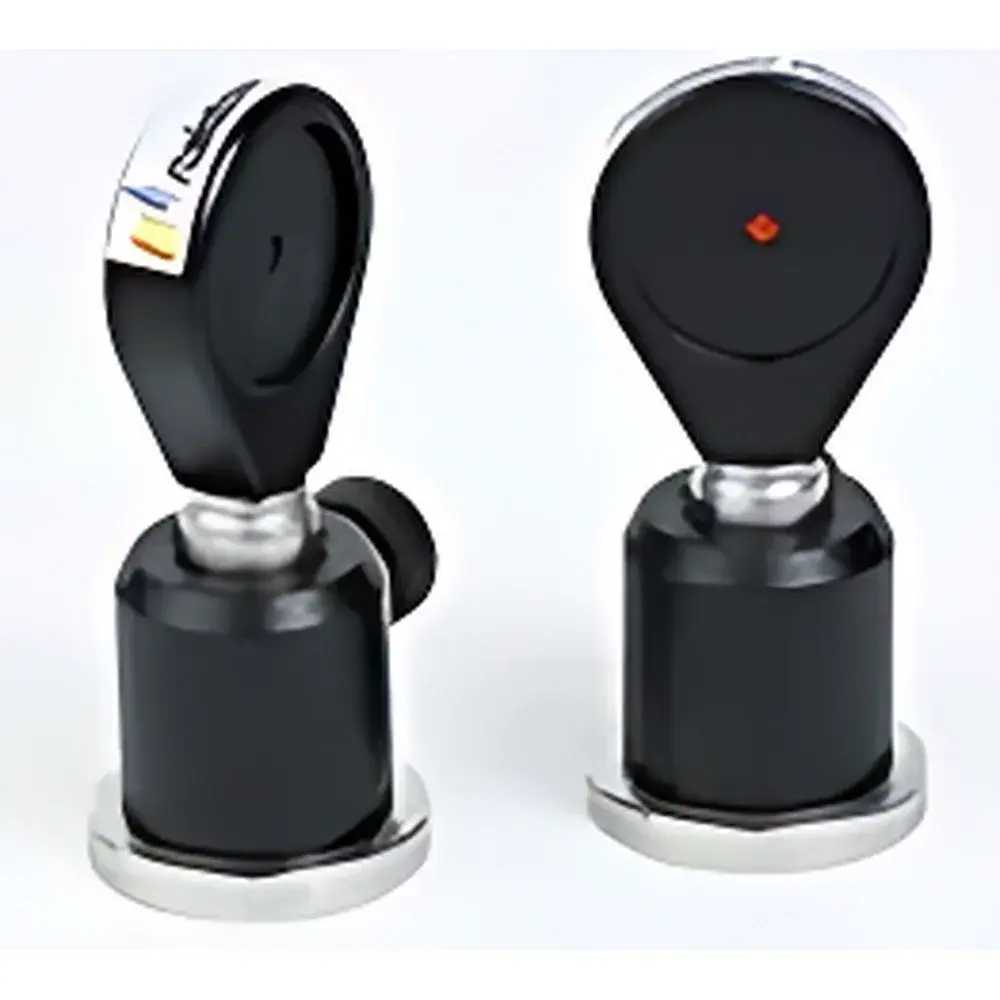
Rainbow Photonics newopto THz Emitter & Detector
| Brand | Rainbow Photonics |
|---|---|
| Origin | Switzerland |
| Model | newopto |
| Aperture | 2–5 mm (custom available) |
| Damage Threshold | 150 GW/cm² @ 150 fs pulse |
| Photon Conversion Efficiency | 2×10⁻⁴ per MW peak power |
| Optimized Pump Wavelength | 1200–1600 nm |
| THz Bandwidth | 0.3–20 THz |
| Nonlinear Crystals | DAST, OH1, DSTMS |
| Primary Function | Optical Rectification & Difference-Frequency Generation |
Overview
The Rainbow Photonics newopto THz Emitter & Detector is a high-performance optoelectronic module engineered for broadband terahertz generation and coherent detection in time-domain spectroscopy (TDS) and imaging systems. It operates on the physical principles of optical rectification and difference-frequency generation (DFG) in non-centrosymmetric organic nonlinear crystals—specifically DAST, OH1, and DSTMS—enabling efficient conversion of near-infrared femtosecond laser pulses into coherent THz radiation. With intrinsic phase-matching advantages across the 1200–1600 nm pump window and a measured bandwidth spanning 0.3 to 20 THz, the device supports high-dynamic-range spectral acquisition and sub-picosecond temporal resolution. Its robust crystal mounting architecture minimizes thermal lensing and mechanical drift, ensuring long-term stability under repetitive ultrafast excitation. Designed for integration into vacuum- or purged-path THz-TDS platforms, the module complies with standard optical breadboard footprints and kinematic mounting interfaces.
Key Features
- High-efficiency organic nonlinear crystals: DAST, OH1, and DSTMS—selected for superior electro-optic coefficients and low two-photon absorption at telecom- and Yb-fiber-laser wavelengths
- Broadband emission and detection coverage from 0.3 THz to 20 THz, validated via Fourier-transform analysis of electro-optic sampling waveforms
- Customizable aperture sizes (2 mm, 3 mm, 4 mm, or 5 mm), with optional custom geometries for collimated or focused beam coupling
- Damage threshold rated at 150 GW/cm² for 150 fs pulses—engineered for compatibility with amplified Ti:sapphire and Yb-based oscillators
- Photon conversion efficiency of 2×10⁻⁴ per MW of peak pump power—enabling high signal-to-noise ratio even at moderate average powers (≤100 mW)
- Optimized for 1200–1600 nm pump sources, including fiber-amplified femtosecond lasers and optical parametric amplifiers (OPAs)
Sample Compatibility & Compliance
The newopto emitter/detector is compatible with solid, liquid, and thin-film samples placed in transmission or reflection geometry within standard THz-TDS sample chambers. Its spectral range enables characterization of phonon resonances in crystalline dielectrics, intermolecular vibrations in pharmaceuticals, carrier dynamics in semiconductors, and hydration states in biomolecules. The crystal substrates are polished to λ/10 surface flatness and AR-coated for minimal Fresnel loss at both pump and THz frequencies. All units are manufactured in accordance with ISO 9001-certified cleanroom processes in Switzerland. While not a medical device, the system supports GLP-compliant data acquisition when integrated with traceable calibration standards (e.g., NIST-traceable reference foils) and audit-ready software environments compliant with FDA 21 CFR Part 11 requirements.
Software & Data Management
The module is driver-agnostic and interfaces seamlessly with industry-standard THz control suites—including TeraView’s TeraPulse software, Menlo Systems’ TeraScan, and open-source platforms such as Python-based terapy and MATLAB-based THzToolbox. Raw time-domain waveforms are acquired via synchronized lock-in or digitizer-based sampling, supporting FFT-based spectral reconstruction, complex refractive index extraction, and thickness-independent parameter fitting. Full metadata logging (pump fluence, delay stage position, ambient humidity/temperature) is supported through TTL-triggered external sensor integration. Export formats include HDF5, MAT, and CSV, enabling reproducible analysis pipelines compliant with FAIR (Findable, Accessible, Interoperable, Reusable) data principles.
Applications
- Ultrafast carrier dynamics mapping in 2D materials (e.g., graphene, MoS₂) and perovskite photovoltaics
- Non-destructive evaluation of polymer layer adhesion, coating uniformity, and microvoid formation in aerospace composites
- Pharmaceutical polymorph identification and crystallinity quantification using characteristic low-frequency lattice modes
- Security screening via spectral fingerprinting of explosives and illicit substances in mail and baggage inspection systems
- Fundamental studies of hydrogen-bond network relaxation in aqueous solutions and protein hydration shells
- Calibration reference source for THz quantum cascade lasers (QCLs) and bolometric detector arrays
FAQ
What pump laser specifications are required for optimal performance?
A femtosecond laser with central wavelength between 1200 nm and 1600 nm, pulse duration ≤150 fs, and repetition rate 1–100 MHz is recommended. Average power should be maintained between 30–100 mW to balance SNR and crystal longevity.
Can this module be used in air or does it require dry nitrogen purging?
For measurements below 2 THz, purging with dry nitrogen (<10 ppm H₂O) is strongly advised to suppress atmospheric water vapor absorption lines. Above 5 THz, operation in ambient lab air is feasible for qualitative screening.
Is crystal replacement possible by the end user?
No—crystal alignment is factory-optimized using interferometric feedback and hermetically sealed mounting. Replacement requires return to Rainbow Photonics’ Swiss service center for recalibration and wavefront verification.
Does the detector support heterodyne or homodyne detection schemes?
It is designed for electro-optic sampling (EOS) in homodyne configuration. For heterodyne detection, an external THz local oscillator and balanced photodiode pair must be integrated externally.
Are NIST-traceable calibration certificates available?
Yes—upon request, calibrated spectral responsivity data (±3% uncertainty) referenced to NIST SRM 1937a can be provided with individual units.



