
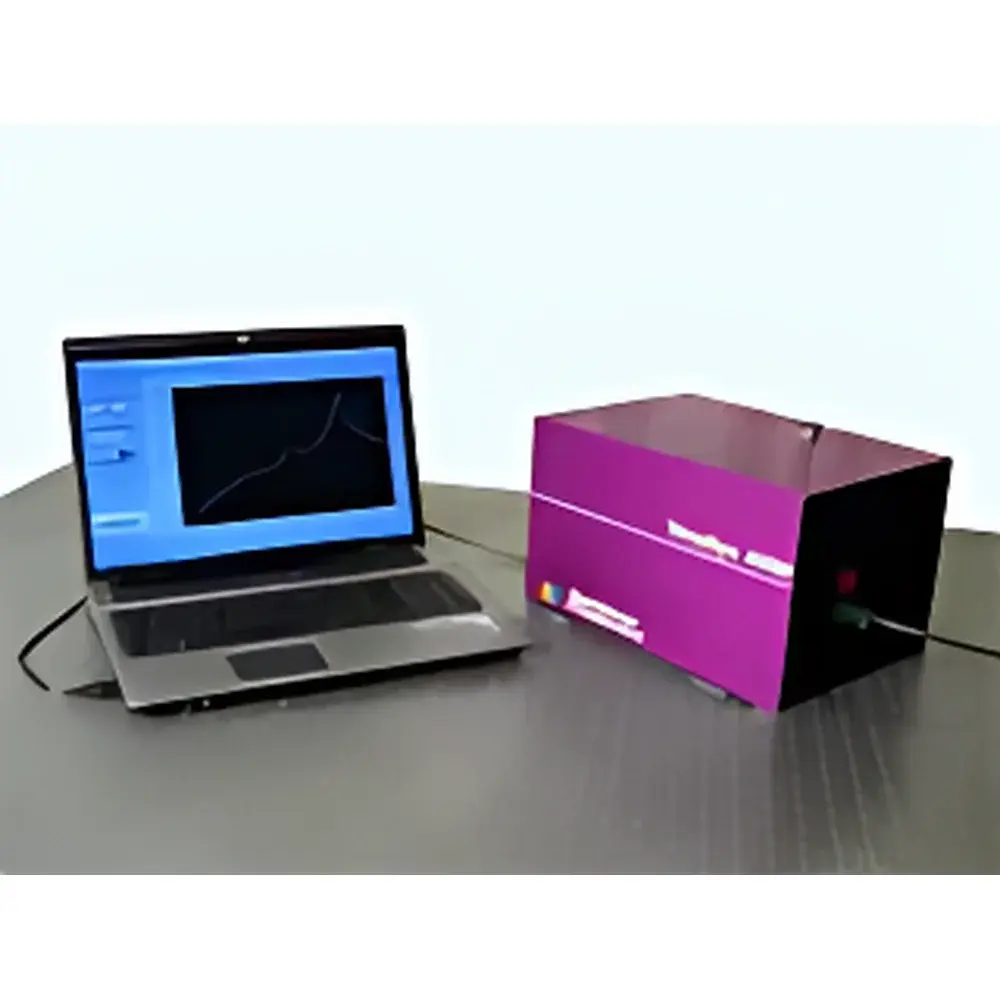
Rainbow Photonics TeraSys 4000 Integrated Terahertz Time-Domain Spectroscopy System
| Brand | Rainbow Photonics |
|---|---|
| Origin | Switzerland |
| Model | TeraSys 4000 |
| Frequency Range | 0.3–4 THz |
| Output Power | >50 nW |
| Spectral Resolution | <0.01 THz |
| Polarization Ratio (Linear, Vertical) | >100:1 |
| Input Voltage | 110 V / 240 V, 50 or 60 Hz |
| Power Consumption | <60 W |
| Warm-up Time | 15 min |
| Operating Ambient Temperature | 18–30 °C |
| Dimensions | 400 mm × 250 mm × 180 mm |
| Component Category | Optical Instrument Module |
Overview
The Rainbow Photonics TeraSys 4000 is a compact, turnkey terahertz time-domain spectroscopy (THz-TDS) system engineered for high-fidelity spectral acquisition in research and industrial laboratory environments. Based on photoconductive antenna technology driven by femtosecond fiber lasers, the system generates and detects coherent broadband THz pulses via optical rectification and electro-optic sampling—enabling non-contact, non-ionizing, and label-free characterization of dielectric and semiconducting materials. Its solid-state architecture eliminates moving parts and cryogenic requirements, supporting stable, long-term operation without routine maintenance. Designed for integration into optical tables or OEM platforms, the TeraSys 4000 delivers calibrated amplitude and phase information across 0.3–4 THz, facilitating quantitative analysis of complex refractive index, absorption coefficient, and dispersion behavior.
Key Features
- Fully integrated THz-TDS platform with synchronized fs-fiber laser, emitter, detector, delay stage, and control electronics in a single benchtop enclosure
- Broadband spectral coverage from 0.3 to 4 THz with <0.01 THz intrinsic spectral resolution (limited by Fourier transform window and signal-to-noise ratio)
- Vertical linear polarization output with extinction ratio >100:1, optimized for anisotropic sample interrogation and polarimetric studies
- Low-power consumption (<60 W) and rapid thermal stabilization (15-minute warm-up), enabling deployment in shared instrumentation labs with constrained HVAC capacity
- Universal AC input (110/240 V, 50/60 Hz) with internal EMI filtering and surge protection compliant with IEC 61000-4 standards
- Robust mechanical design featuring vibration-damped baseplate and kinematic optical mounts compatible with standard 25 mm or 50 mm rail systems
Sample Compatibility & Compliance
The TeraSys 4000 accommodates transmission and reflection-mode measurements of planar, non-metallic samples up to 50 mm in diameter—including pharmaceutical tablets, polymer films, semiconductor wafers, composite laminates, and packaged biological tissues. Sample chambers support ambient, dry-air purged, or nitrogen-flushed environments to mitigate water vapor absorption lines below 1 THz. The system conforms to ISO/IEC 17025 general requirements for calibration laboratories and supports traceable measurement workflows aligned with ASTM E2960–22 (Standard Guide for Terahertz Spectroscopy Measurements). Data integrity meets GLP/GMP documentation prerequisites through software-enforced audit trails, user access controls, and electronic signature capability per FDA 21 CFR Part 11 when configured with optional validation package.
Software & Data Management
Control and analysis are performed via TeraSoft™ v4.x—a modular, Windows-based application developed in-house by Rainbow Photonics. The software provides real-time waveform acquisition, FFT-based spectral extraction, baseline correction, complex permittivity modeling (Drude-Lorentz, Debye), and multi-layered thin-film inversion algorithms. All raw time-domain transients and processed spectra are stored in HDF5 format with embedded metadata (instrument settings, environmental conditions, operator ID, timestamp). Export options include CSV, MATLAB .mat, and SDF (Spectral Data Format) for interoperability with third-party chemometric tools (e.g., Unscrambler®, Python SciPy). Remote operation via TCP/IP API enables integration into automated test sequences or LIMS environments.
Applications
- Pharmaceutical Quality Control: Polymorph identification, coating thickness mapping, and counterfeit drug screening using spectral fingerprinting in the 1–3 THz range
- Non-Destructive Testing: Delamination detection in carbon-fiber composites, void quantification in adhesive bonds, and moisture ingress monitoring in encapsulated electronics
- Security Screening: Standoff identification of concealed explosives (e.g., RDX, PETN), illicit narcotics (e.g., methamphetamine, fentanyl analogs), and biohazard simulants through characteristic rotational and vibrational resonances
- Materials Science Research: Carrier dynamics in 2D materials (graphene, TMDCs), phonon-polariton dispersion in ferroelectrics, and low-energy excitations in high-Tc superconductors
- Academic Teaching Labs: Undergraduate and graduate instruction in ultrafast optics, electromagnetic theory, and spectroscopic data analysis with reproducible, hands-on THz experiments
FAQ
Is the TeraSys 4000 compatible with external laser sources?
Yes—the system includes an optical input port for synchronization with user-provided femtosecond oscillators (e.g., Ti:sapphire or Yb-fiber lasers) operating at 780–800 nm or 1030–1064 nm, enabling custom pulse duration and repetition rate configurations.
Can it perform imaging in addition to spectroscopy?
While the base TeraSys 4000 is a point-scan spectrometer, optional motorized XY translation stages and beam-expanding optics enable raster-scanned THz imaging at up to 50 µm spatial resolution (diffraction-limited at 2 THz).
What calibration standards are supplied?
Each unit ships with NIST-traceable polyethylene and silicon reference pellets for amplitude normalization and frequency calibration; additional certified standards (e.g., sucrose, lactose) are available upon request.
Does the system require regular recalibration?
No—factory calibration remains valid for 24 months under normal operating conditions; annual verification using supplied reference materials is recommended for ISO 17025 compliance.




