
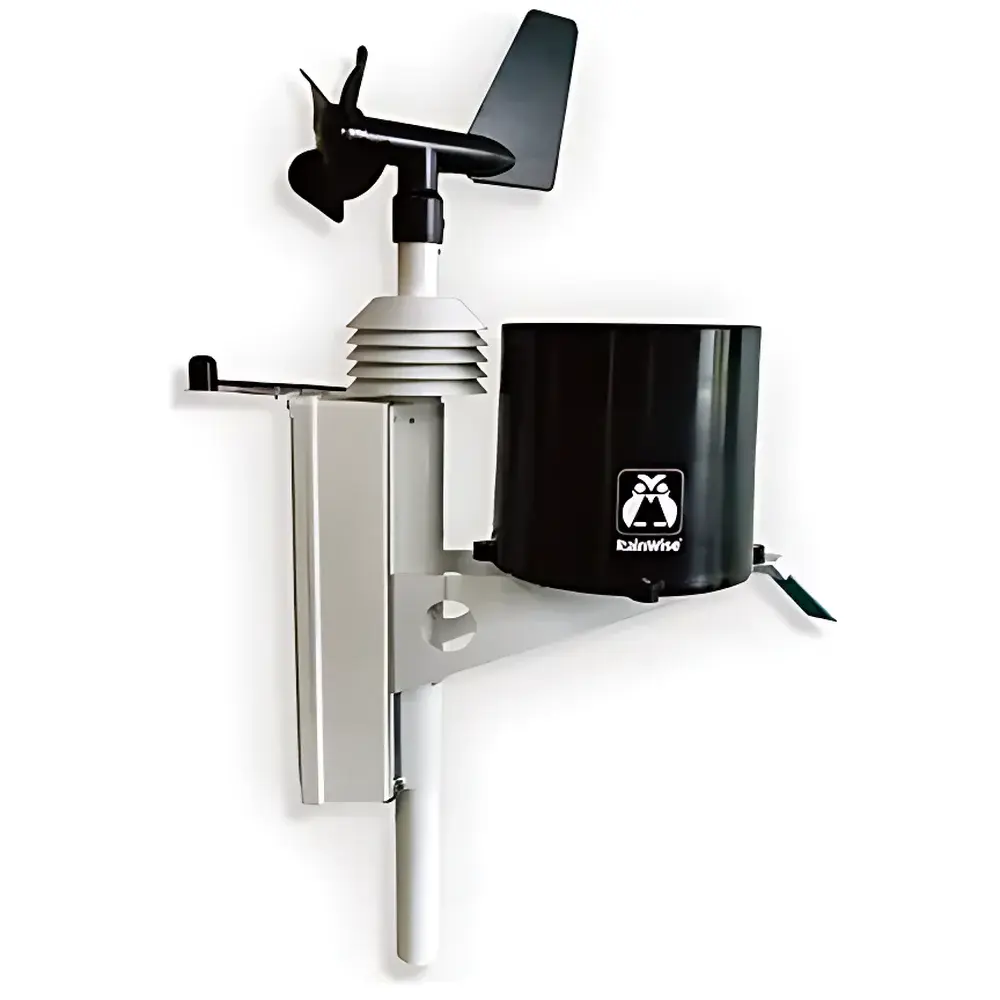
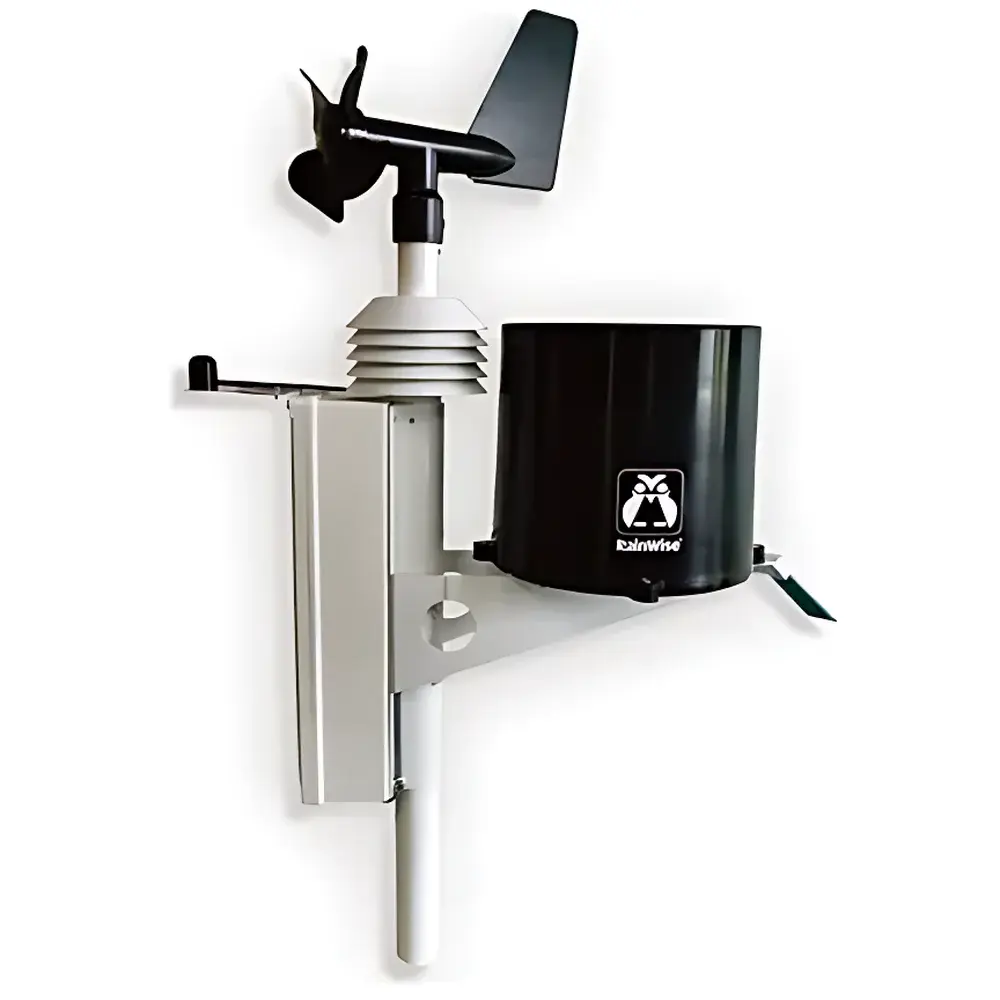
RainWise AgroMET-MB Modular Modbus Weather Station
| Brand | RainWise |
|---|---|
| Origin | USA |
| Model | AgroMET-MB |
| Instrument Type | Portable Weather Station |
| Communication Protocol | Modbus RTU (RS-422/RS-485) |
| Power Supply | 6 V 5 Ah AGM Sealed Lead-Acid Battery + 0.6 W Solar Panel |
| Operating Temperature | −55 to +85 °C |
| Enclosure Materials | PVC, ABS, Anodized Aluminum, Stainless Steel, Polycarbonate (LEXAN®/Makrolon® 2658) |
Overview
The RainWise AgroMET-MB is a fully integrated, compact, wired modular weather station engineered for precision environmental monitoring in demanding agricultural, industrial, and infrastructure applications. Built upon the field-proven MK-III sensor architecture, the AgroMET-MB delivers calibrated, time-synchronized measurements of seven core meteorological parameters—wind speed and direction, ambient air temperature, relative humidity, barometric pressure, precipitation accumulation and intensity, and global solar irradiance—via a standardized Modbus RTU interface. Its design adheres to fundamental physical measurement principles: cup-and-vane anemometry with thermistor-based temperature compensation, capacitive polymer humidity sensing, piezoresistive pressure transduction, tipping-bucket rain gauge mechanics with optional heated collector, and thermopile-based pyranometry with cosine-corrected optical response. The system operates continuously across extreme climatic conditions (−55 °C to +85 °C), making it suitable for deployment in unconditioned outdoor environments without active climate control.
Key Features
- Modbus RTU (RS-422/RS-485, 2-wire half-duplex) interface for seamless integration into industrial control ecosystems including PLCs, RTUs, SCADA, DCS, and BMS platforms
- Pre-assembled, ruggedized enclosure constructed from corrosion-resistant anodized aluminum, stainless steel hardware, UV-stabilized polycarbonate (LEXAN®/Makrolon® 2658), and chemical-resistant ABS/PVC components
- Factory-calibrated sensors with optional NIST-traceable calibration certificates supporting ISO/IEC 17025-aligned quality assurance workflows
- Low-power architecture: 6 V 5 Ah AGM battery with integrated 0.6 W monocrystalline solar panel enabling multi-year autonomous operation in most temperate and semi-arid zones
- Expandable sensor suite—including optional leaf wetness, soil temperature (PT100), volumetric soil moisture (TDR or capacitance), and industrial-grade heated rain gauge (120/240 V AC)
- Compliance with RoHS Directive 2011/65/EU; lead-free soldering and halogen-free internal wiring
Sample Compatibility & Compliance
The AgroMET-MB is designed for continuous, unattended outdoor exposure under IEC 60529 IP65-rated environmental protection (dust-tight and protected against low-pressure water jets). Its sensor suite meets performance benchmarks aligned with WMO Guide to Meteorological Instruments and Methods of Observation (CIMO Guide, 2018 edition) for Class II reference stations. While not certified to UL/CE for hazardous locations, its electrical architecture conforms to IEC 61000-6-2 (immunity) and IEC 61000-6-4 (emissions) standards. Optional NIST-traceable calibration supports audit readiness for GLP-compliant agricultural research, USDA NRCS irrigation scheduling programs, and FDA-regulated controlled-environment agriculture (CEA) facilities where environmental parameter traceability is required per 21 CFR Part 11 data integrity expectations.
Software & Data Management
The AgroMET-MB does not include proprietary software but functions as a transparent Modbus slave device (slave ID configurable via DIP switch). It outputs raw sensor values scaled according to standard Modbus register maps—enabling direct ingestion into third-party platforms such as Ignition SCADA, Siemens Desigo CC, Honeywell Experion PKS, or open-source solutions like Node-RED and Grafana with Modbus TCP/RTU gateways. All measurements are timestamped at the sensor node level using internal real-time clock synchronization (±2 s/day drift). Data logging intervals are governed externally by the master controller; no onboard memory or SD card is provided, ensuring deterministic latency and eliminating firmware update dependencies. Audit trails, change history, and electronic signatures must be implemented at the supervisory system level per organizational SOPs.
Applications
- Agricultural decision support: Real-time input for evapotranspiration (ETo) modeling (FAO-56 Penman-Monteith), irrigation scheduling, frost warning systems, pesticide spray advisory models, and greenhouse climate control logic
- Infrastructure resilience monitoring: Road surface condition forecasting (via dew point depression and wet-bulb temperature), airport wind shear detection, bridge icing alerts, flood stage correlation with rainfall intensity, and crane safety interlocks based on gust thresholds
- Renewable energy asset management: Solar farm soiling loss estimation (using irradiance degradation trends), wind turbine cut-in/cut-out validation, and microclimate assessment for site feasibility studies
- Environmental compliance reporting: Continuous emission monitoring system (CEMS) auxiliary meteorological inputs for dispersion modeling (e.g., AERMOD), landfill gas flare efficiency verification, and ambient air quality network augmentation
FAQ
Does the AgroMET-MB support wireless communication?
No—the AgroMET-MB is a wired Modbus RTU device only. Wireless capability requires external gateway hardware (e.g., Modbus-to-LoRaWAN or Modbus-to-Cellular bridges) deployed at the master controller site.
Can sensor data be logged locally on the station?
No—the unit has no internal storage. Data persistence must be handled by the connected SCADA, PLC, or BMS system.
Is the solar radiation sensor calibrated to ISO 9060:2018 Class C specifications?
Yes—the thermopile pyranometer meets ISO 9060:2018 Class C requirements for spectral response, directional (cosine) error, and temperature dependence, with documented ±5% uncertainty at 1000 W/m² under standard test conditions.
What is the maximum recommended cable run length for RS-485 communication?
Up to 1200 meters at 9600 bps with proper twisted-pair cabling (AWG 22–24), 120 Ω termination, and shielded conduit in electrically noisy environments.
Are replacement sensors field-swappable without recalibration?
Yes—all MK-III-derived sensors use standardized mechanical and electrical interfaces; however, post-replacement functional verification and optional recalibration are recommended to maintain measurement traceability.







