
RainWise PortLog Portable Automatic Weather Station
| Brand | RainWise |
|---|---|
| Origin | USA |
| Model | PortLog |
| Instrument Type | Portable Weather Station |
| Power | 3 W solar panel + 4 Ah sealed lead-acid battery |
| Data Storage | Non-volatile memory (standard: 9 months at 1-hr interval |
| Data Output | CSV format |
| Communication | RS-232 (USB adapter optional) |
| Sensor Traceability | NIST-traceable |
| Compliance | Designed for field-deployable environmental monitoring per ASTM D5098, ISO 16487, and US EPA Guidance for Ambient Air Monitoring Systems |
Overview
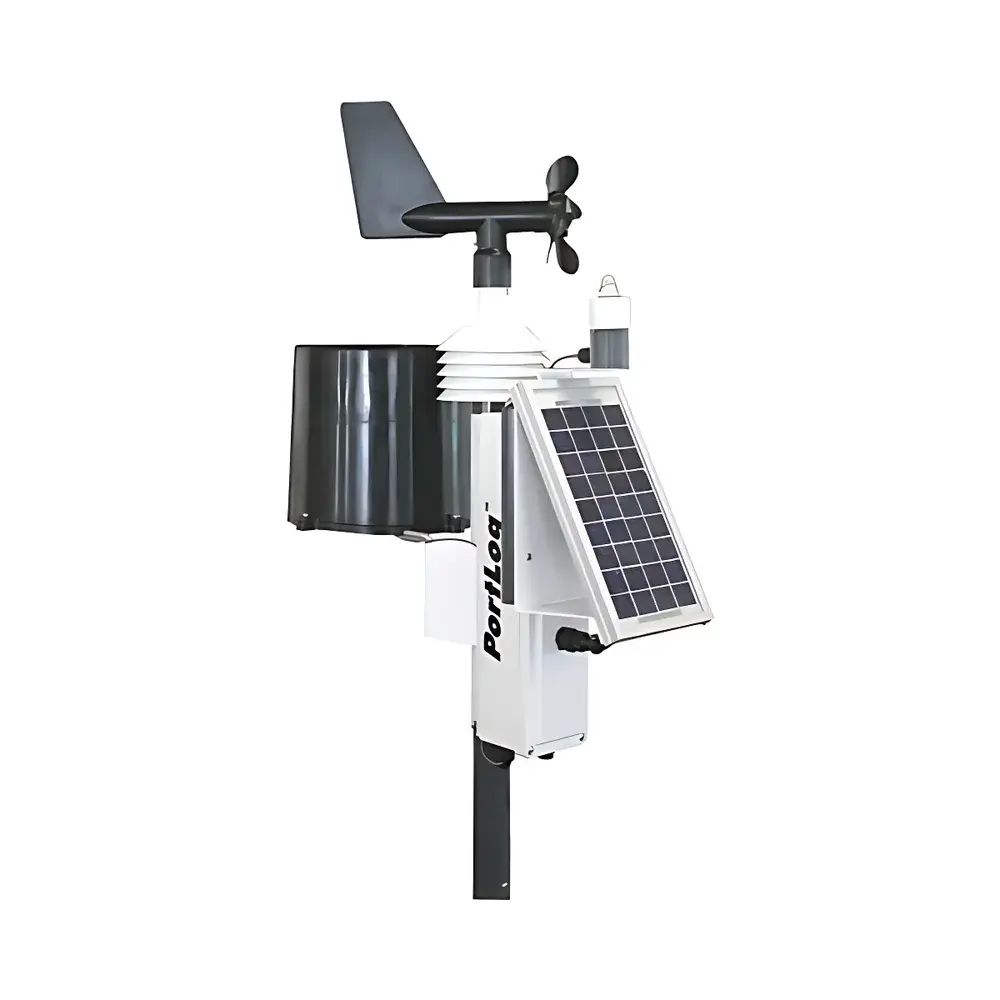
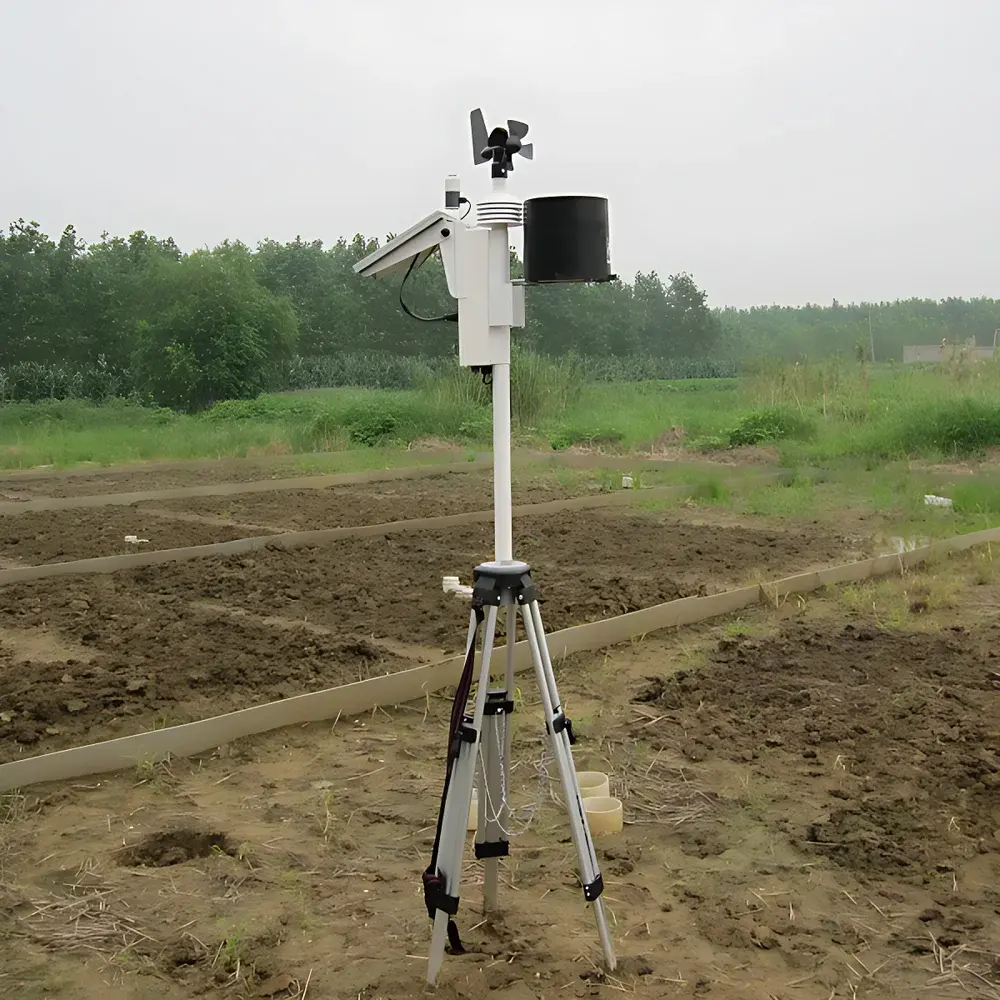
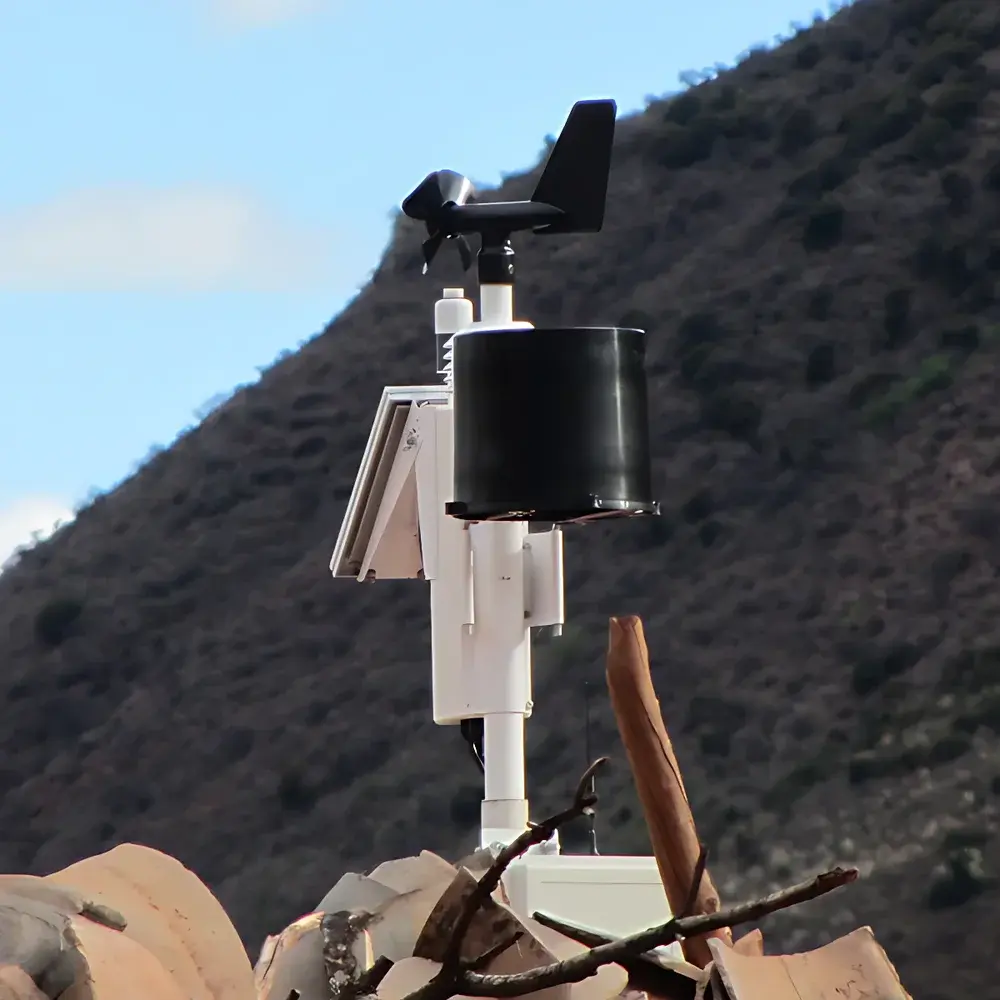
The RainWise PortLog Portable Automatic Weather Station is an industrial-grade, self-contained environmental monitoring system engineered for rapid deployment, long-term unattended operation, and high-reliability data acquisition in remote or challenging field conditions. Built on a robust aluminum housing with IP65-rated sensor integration, the PortLog employs proven physical measurement principles—including cup-and-vane anemometry, capacitive humidity sensing, thermistor-based temperature detection, piezoresistive barometric pressure transduction, tipping-bucket precipitation measurement, and silicon photodiode-based pyranometry—to deliver traceable, meteorologically valid measurements across eight core atmospheric parameters. Its compact, modular architecture enables single-person setup in under five minutes—making it suitable for temporary deployments in construction sites, disaster response zones, agricultural research plots, ecological field studies, and boundary-layer atmospheric investigations.
Key Features
- Integrated sensor suite with factory-calibrated, NIST-traceable components: wind speed (0–67 m/s, ±2% full-scale accuracy, 0.1 m/s resolution), wind direction (0–360°, ±3° accuracy, 1° resolution, zero-dead-zone patented vane), air temperature (−54 to +65 °C, ±1.0 °C), relative humidity (0–100% RH, ±2% within −40 to +65 °C), dew point temperature (−40 to +43 °C, ±2.0 °C), barometric pressure (300–1100 hPa, ±0.5 hPa at 25 °C with full temperature compensation), rainfall (8-inch diameter tipping bucket, ±2% accuracy, 0.25 mm resolution), and solar radiation (0–2000 W/m², 400–1200 nm spectral response, ±2% accuracy).
- Autonomous power management: 3 W monocrystalline solar panel paired with a maintenance-free 4 Ah sealed lead-acid battery ensures continuous operation through extended periods of low insolation.
- Non-volatile internal memory with user-configurable logging intervals (1 minute to 1 hour); standard capacity supports 9 months of data at 1-hour resolution; optional memory upgrades (256K, 512K, 1M, 2M) extend archival depth without external media.
- Flexible data retention policy: configurable overwrite-on-full or stop-on-full behavior to prevent unintended data loss during extended deployments.
- RS-232 serial interface (with optional USB-to-serial adapter) enables direct connection to laptops, PDAs, telemetry modems, or wireless data loggers; no proprietary hardware drivers required.
- Comprehensive real-time and historical data handling via WLCom software—a Windows-based application supporting live monitoring, scheduled downloads, CSV export, time-synchronized calibration logging, and metadata tagging for GLP-compliant field records.
Sample Compatibility & Compliance
The PortLog is designed for ambient outdoor atmospheric sampling in accordance with internationally recognized environmental monitoring standards. All sensors meet or exceed requirements specified in ASTM D5098 (Standard Practice for Calibration of Anemometers), ISO 16487 (Meteorological instruments — Specifications for weather stations), and US EPA Reference Method Guidance for Continuous Ambient Air Monitoring. Pressure sensor outputs include automatic altitude compensation, implemented via WLCom software using user-entered GPS-derived elevation data. Humidity and temperature sensors are housed in a naturally aspirated, double-louvered radiation shield to minimize solar loading error. Rain gauge geometry conforms to WMO recommendations for catch efficiency. The entire system supports audit-ready data integrity: timestamps are generated internally with onboard RTC, and all downloaded datasets retain embedded acquisition metadata—including sensor ID, firmware version, battery voltage, and solar charge status—for traceability in regulatory or scientific reporting contexts.
Software & Data Management
WLCom software serves as the primary interface for configuration, visualization, and data retrieval. It provides intuitive graphical displays of real-time parameter trends, configurable alarm thresholds (e.g., wind gust > 25 m/s), and batch-download functionality for multi-station networks. Exported CSV files contain ISO 8601-formatted timestamps, SI-unit values, and column headers compatible with MATLAB, Python pandas, R, and commercial statistical platforms. The software maintains a local calibration history log—including date, technician ID, reference standard used, and deviation values—for adherence to ISO/IEC 17025 documentation requirements. While the PortLog itself does not implement FDA 21 CFR Part 11 electronic signature controls, its deterministic data flow and immutable CSV output support integration into validated laboratory information management systems (LIMS) where raw file ingestion and manual review workflows are employed per GLP/GMP-aligned protocols.
Applications
- Short- to medium-term microclimate characterization for wind resource assessment and solar farm site feasibility studies.
- Environmental baseline monitoring prior to infrastructure development (e.g., highways, pipelines, mining operations) in compliance with NEPA or equivalent national impact assessment frameworks.
- Real-time severe weather alerting at airports, fire-prone wildland-urban interfaces, and flood-prone river basins.
- Field validation of numerical weather prediction (NWP) model outputs and satellite-derived atmospheric products.
- Longitudinal phenological studies requiring synchronized temperature, humidity, and precipitation metrics across distributed ecological transects.
- Educational deployment in university atmospheric science programs for hands-on instrumentation training and experimental design coursework.
FAQ
Is the PortLog still in production?
No—the PortLog was officially discontinued by RainWise, Inc. in 2019. Units currently available are legacy inventory or refurbished systems supported by third-party service providers.
Can the PortLog operate without solar input?
Yes—it will run continuously on battery power alone for approximately 3–5 days under typical logging intervals and moderate thermal load; solar recharging extends operational life indefinitely in most temperate and subtropical climates.
Does the system support remote telemetry?
The PortLog lacks built-in cellular or LoRaWAN radios, but its RS-232 port is fully compatible with industry-standard external telemetry modules (e.g., Campbell Scientific RF430, Sierra Wireless AirLink RV50) when integrated via custom enclosure wiring.
How is barometric pressure calibrated for local elevation?
Users enter site-specific elevation (in meters) into WLCom software, which applies the International Standard Atmosphere (ISA) model to convert raw sensor output into sea-level-adjusted pressure values for synoptic comparison.
Are replacement sensors available?
Yes—RainWise continues to supply certified replacement transducers (anemometer, hygrometer, barometer, rain gauge) with full NIST-traceable calibration certificates, enabling modular maintenance without full-system replacement.







