
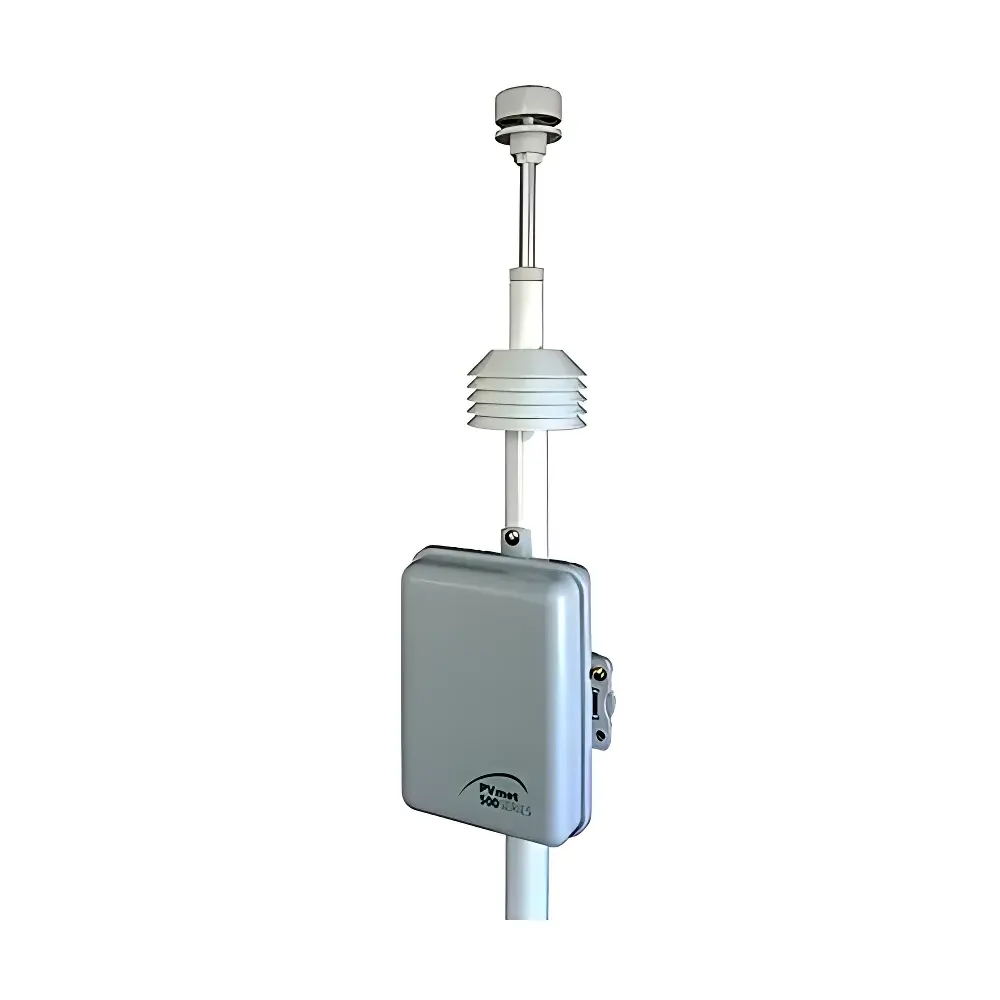
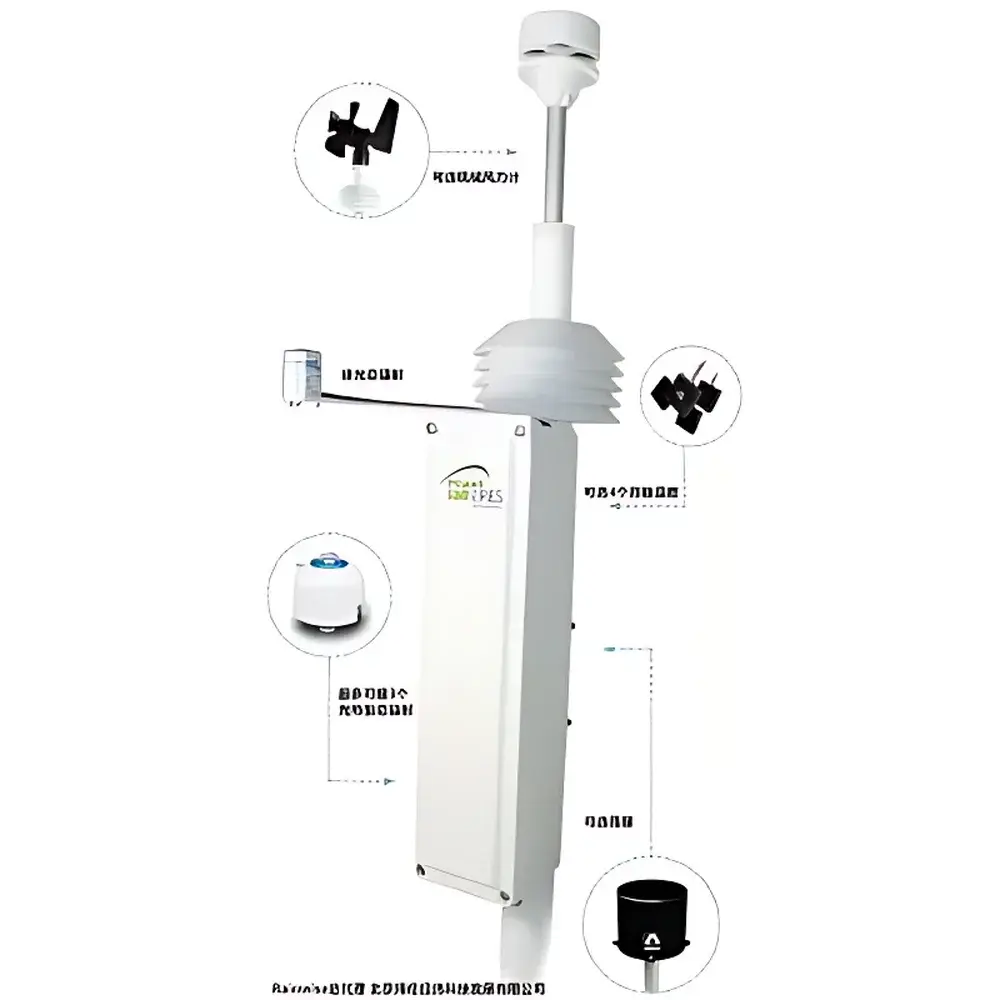
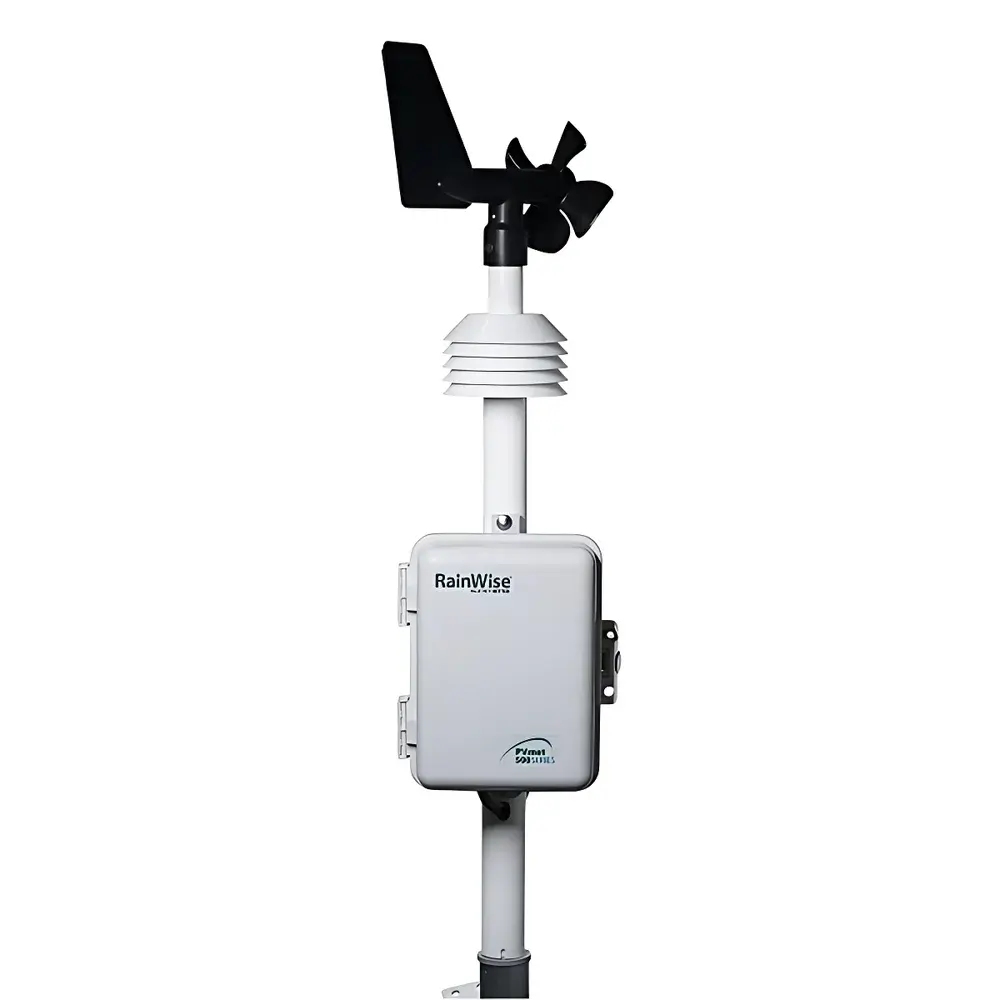
RainWise PVmet 500 Photovoltaic Monitoring Weather Station
| Brand | RainWise |
|---|---|
| Origin | USA |
| Model | PVmet 500 |
| Sensor Types | Air Temperature, Relative Humidity, Barometric Pressure, Global Horizontal Irradiance (GHI), Plane-of-Array Irradiance (POA), Reflected Irradiance, Backsheet Temperature (×3), Wind Speed & Direction, Precipitation |
| Communication | MODBUS RTU over RS-485/422, SunSpec Compliant |
| Operating Temperature | −40 °C to +60 °C |
| Power Supply | 10–30 VDC, 50 mA |
| Enclosure Materials | PVC, ABS, Anodized Aluminum, Stainless Steel, Polycarbonate (LEXAN®, Makrolon® 2658) |
| IP Rating | IP65 (sensor assembly), IP67 (junction box) |
| Cable Length | 7.62 m |
| Weight | 3.17 kg |
| Dimensions (packaging) | 73.99 × 35.56 × 20.32 cm |
Overview
The RainWise PVmet 500 Photovoltaic Monitoring Weather Station is an engineered solution for high-fidelity, long-term performance monitoring of utility-scale and commercial photovoltaic (PV) power plants. Designed specifically to support IEC 61724-1:2021-compliant performance ratio (PR) calculations and yield validation, the system integrates calibrated, co-located environmental sensors into a single modular architecture optimized for minimal maintenance, field robustness, and metrological traceability. Unlike generic weather stations, the PVmet 500 implements a multi-sensor irradiance configuration—comprising GHI, POA, and albedo (reflected) pyranometers—to enable precise plane-of-array irradiance modeling, soiling loss quantification, and thermal derating correction. Its fully assembled and NIST-traceably calibrated sensor suite eliminates on-site calibration drift and ensures consistency across fleet-wide deployments. The station operates continuously under harsh outdoor conditions—from desert heat to coastal humidity—while maintaining data integrity through industrial-grade signal conditioning and ESD-protected RS-485 interfaces.
Key Features
- Fully integrated, factory-calibrated sensor array—including three thermopile-based irradiance sensors (GHI, POA, reflected) compliant with ISO 9060:2018 Class A specifications when equipped with optional EKO MS-802 or MS-402 sensors
- Triple backsheet temperature measurement using Pt1000 RTD sensors mounted at standardized locations per IEC 61215-2 MQT 14, enabling accurate cell temperature estimation and thermal coefficient modeling
- Dual wind sensing options: precision mechanical cup-and-vane (ISO 12213-2 compliant) or ultrasonic (no moving parts, ice-resistant, ±0.1 m/s threshold)
- SunSpec Modbus RTU profile (SunSpec ID 203) certified—ensuring seamless integration with SCADA, inverters, and energy management systems (EMS) without custom protocol mapping
- Modular expansion capability: supports optional rain gauge (tipping bucket, 0.2 mm resolution), UV-A/B radiometer, or spectral PAR sensor via auxiliary digital input
- Ruggedized housing constructed from UV-stabilized polycarbonate (Makrolon® 2658), marine-grade stainless steel fasteners, and anodized aluminum mounting hardware—rated IP65 for sensor head and IP67 for terminal junction box
- Low-power design (50 mA @ 24 VDC) compatible with solar-powered telemetry systems and battery-backed data loggers
Sample Compatibility & Compliance
The PVmet 500 meets the physical and metrological requirements defined in IEC 61724-1:2021 (Photovoltaic system performance monitoring – Guidelines for measurement, data exchange and analysis) and aligns with ASTM E2848-20 (Standard Practice for Reporting Photovoltaic Performance Measurements). All irradiance sensors are supplied with individual calibration certificates traceable to NIST or PTB standards. The system supports GLP-aligned data logging workflows, including time-stamped metadata, sensor health flags, and configurable diagnostic thresholds. It is designed for deployment in accordance with UL 61730 and IEC 62109 safety standards for PV monitoring equipment. The enclosure materials comply with RoHS Directive 2011/65/EU and are free of lead, cadmium, mercury, hexavalent chromium, PBB, and PBDE.
Software & Data Management
Data output follows SunSpec Modbus register map v2.0, enabling direct ingestion into industry-standard platforms including SolarLog, Fronius Solar.web, Schneider Electric EcoStruxure, and custom Python- or Node-RED-based monitoring dashboards. Each sensor channel provides real-time values plus diagnostic registers (e.g., sensor saturation flag, heater status, self-test result). Optional firmware updates support enhanced timestamping accuracy (<±100 ms via internal RTC with temperature compensation) and configurable sampling intervals (1–300 seconds). Raw data streams include embedded CRC-16 checksums for transmission integrity verification. When deployed with third-party data loggers supporting Modbus TCP bridging, the PVmet 500 satisfies FDA 21 CFR Part 11 audit trail requirements for electronic records in regulated solar asset management applications.
Applications
- Performance Ratio (PR) and Yield Analysis per IEC 61724-1 Tier A or B monitoring requirements
- Soiling rate quantification via GHI/POA ratio trending and automated cleaning event detection
- Thermal modeling inputs for module temperature correction and degradation forecasting
- Albedo measurement for bifacial PV energy yield modeling and site selection optimization
- Wind-induced soiling and mechanical load assessment for tracker stability analysis
- Long-term bankable P50/P90 energy yield validation for project financing and insurance reporting
- Grid-code compliance monitoring (e.g., reactive power dispatch correlation with irradiance ramp rates)
FAQ
Is the PVmet 500 suitable for desert environments with high dust loading and extreme diurnal temperature swings?
Yes. The sensor housing uses UV-stabilized polycarbonate and anodized aluminum components rated for continuous operation between −40 °C and +60 °C. Optional hydrophobic coatings and heated pyranometer domes are available to mitigate dust accumulation and dew formation.
Can the system be integrated with existing SCADA infrastructure without protocol gateways?
Yes. The native SunSpec Modbus RTU implementation (ID 203) allows direct communication over RS-485 without translation layers, provided the master device supports standard SunSpec register addressing and exception response handling.
What level of irradiance uncertainty does the base configuration achieve?
With factory-calibrated silicon photodiode sensors, typical combined standard uncertainty is ±5% (k=2) under clear-sky conditions. Upgrading to thermopile-based EKO MS-series sensors reduces this to ±2% (k=2) across the full 0–1750 W/m² range, meeting IEC 61724-1 Tier A requirements.
Does the PVmet 500 support time-synchronized data acquisition across multiple stations?
Yes. When connected to a common NTP-enabled gateway or PLC, all units can maintain sub-second time alignment. Internal RTC drift is <±2 ppm over −25 °C to +55 °C, ensuring consistent timestamping for fleet-level correlation analysis.
Are calibration certificates included with shipment?
Yes. Each irradiance sensor, temperature probe, and pressure transducer ships with a unique NIST-traceable calibration certificate valid for 12 months from date of manufacture. Certificates list as-found/as-left values, uncertainty budgets, and environmental test conditions.
Related Products







