
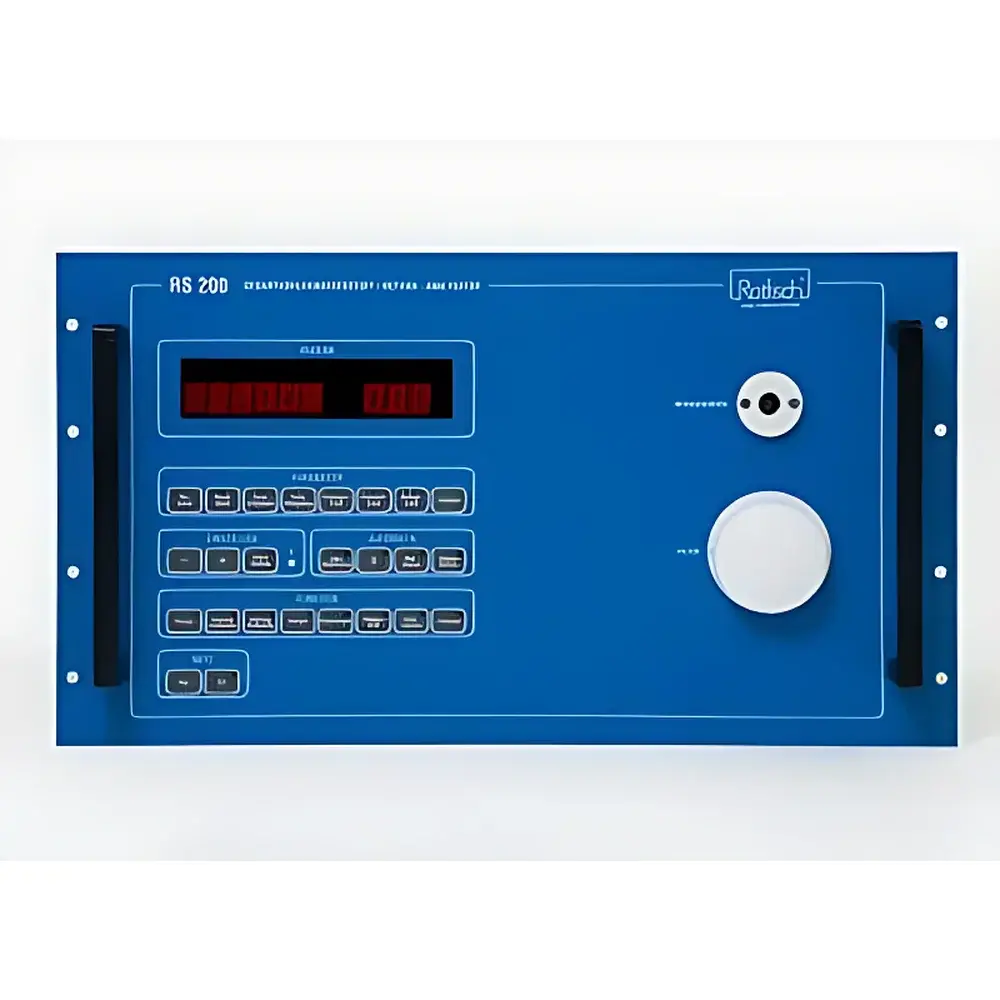
Ratfisch RS200 Methane & Total Hydrocarbon Online Analyzer
| Brand | Ratfisch |
|---|---|
| Origin | Germany |
| Model | RS200 |
| Instrument Type | Online Analyzer |
| Typical Configuration | TVOC Analyzer |
| Measurement Range | 0–1000 ppm |
| Resolution | 0.01 ppm |
| Accuracy | < ±2% of full scale |
| Response Time (T90) | < 5 s |
Overview
The Ratfisch RS200 Methane & Total Hydrocarbon Online Analyzer is a high-stability, catalytic flame ionization-based gas analyzer engineered for continuous, real-time quantification of methane (CH₄) and total hydrocarbons (THC) in industrial exhaust streams, biogas upgrading lines, landfill gas monitoring stations, and environmental compliance applications. Operating on the principle of catalytic combustion followed by flame ionization detection (FID), the RS200 delivers trace-level sensitivity with robust interference rejection—particularly against CO₂, H₂O vapor, and non-hydrocarbon background gases—through its temperature-controlled catalytic converter (maintained at +450 °C) and heated sample path architecture. Unlike conventional FID systems requiring ambient-temperature sampling, the RS200 integrates fully heated sample handling—from inlet filter to detector chamber—with adjustable thermal setpoints from +45 °C to +200 °C, eliminating condensation-induced drift and enabling reliable measurement of high-boiling-point VOCs and semi-volatiles in humid or variable-temperature process streams.
Key Features
- Fully heated sample path and catalytic conversion zone (up to +200 °C), minimizing adsorption losses and water condensation artifacts
- Integrated catalytic converter stabilized at +450 °C for selective oxidation of non-methane hydrocarbons prior to FID detection
- Auto-switching between CH₄-specific and THC measurement modes via software-configurable catalytic bypass logic
- Programmable multi-range operation (0–10 ppm / 0–100 ppm / 0–1000 ppm) with automatic span/zero calibration sequencing
- Real-time diagnostic monitoring of critical operational parameters: hydrogen fuel pressure, combustion air flow, flame status, heater temperature, and sample line integrity
- Flame-out detection with automatic fuel cutoff and alarm-triggered system shutdown to ensure safety compliance
- Modular hardware design supporting optional internal zero-air and synthetic air supply modules for unattended calibration cycles
- Industrial-grade 19-inch rack-mount enclosure (267 mm H × 500 mm D) with IP20-rated front panel and EMI-shielded electronics
Sample Compatibility & Compliance
The RS200 is validated for use with gas matrices containing up to 15% v/v CO₂, ≤80% relative humidity (non-condensing), and particulate loadings compatible with its 4 µm stainless-steel inlet filter (100 cm² surface area). It meets EN 15267-3 (QAL1 certification framework for automated measuring systems) and supports compliance with EU IED (Industrial Emissions Directive) Annex VIII monitoring requirements for THC emissions from waste incineration and chemical manufacturing. Its analog output signals (0–10 V and 4–20 mA) are compatible with SCADA, DCS, and EPA Method 25A-compliant data acquisition systems. The analyzer’s firmware includes audit-trail logging per FDA 21 CFR Part 11 guidelines when paired with optional certified data acquisition software, supporting GLP/GMP-aligned validation protocols.
Software & Data Management
The RS200 operates with embedded firmware supporting local parameter configuration via front-panel keypad and LED display (5½-digit measurement readout, 3-digit status codes). Optional PC-based configuration and data logging software provides remote setup, trend visualization, calibration history archiving, and export to CSV/Excel formats. All calibration events—including zero/span adjustments, catalytic converter health checks, and flame stability diagnostics—are timestamped and stored with operator ID and reason-for-change metadata. Data retention supports ≥30 days of second-by-second measurements at default logging intervals, extendable via external SD card or network-connected historian systems.
Applications
- Continuous emission monitoring (CEMS) of methane and non-methane hydrocarbons from wastewater treatment plants and anaerobic digesters
- Process control in biogas upgrading facilities (e.g., pressure swing adsorption and membrane separation units)
- Regulatory reporting for VOC abatement systems under US EPA 40 CFR Part 60 Subpart JJJJ and EU BREF documents
- In-line quality assurance during solvent recovery and thermal oxidizer performance verification
- Research-grade hydrocarbon speciation support when integrated with GC pre-separation modules (via optional analog trigger interface)
FAQ
Does the RS200 require external zero gas or calibration standards?
No—the RS200 can operate with internal zero-air generation (optional module); however, periodic span calibration using certified CH₄-in-air or propane-in-air standards is required per EN 14181 QA/QC protocols.
What maintenance intervals are recommended for long-term stability?
Catalytic converter inspection every 6 months; inlet filter replacement every 3 months under typical landfill gas conditions; FID jet cleaning every 12 months.
Can the RS200 distinguish between methane and other hydrocarbons without GC separation?
Yes—via catalytic converter bypass mode (for CH₄-only) and active conversion mode (for THC), leveraging differential reactivity at +450 °C; it does not provide compound-specific identification.
Is the analyzer suitable for outdoor installation?
It is designed for indoor rack-mounted deployment within climate-controlled environments (5–35 °C ambient); outdoor use requires NEMA 4X-rated enclosure integration and external heating/cooling management.
How is data integrity ensured during power interruptions?
Non-volatile memory retains configuration and last 72 hours of logged data; optional UPS integration maintains uptime during brief outages and enables graceful shutdown.
Related Products







