
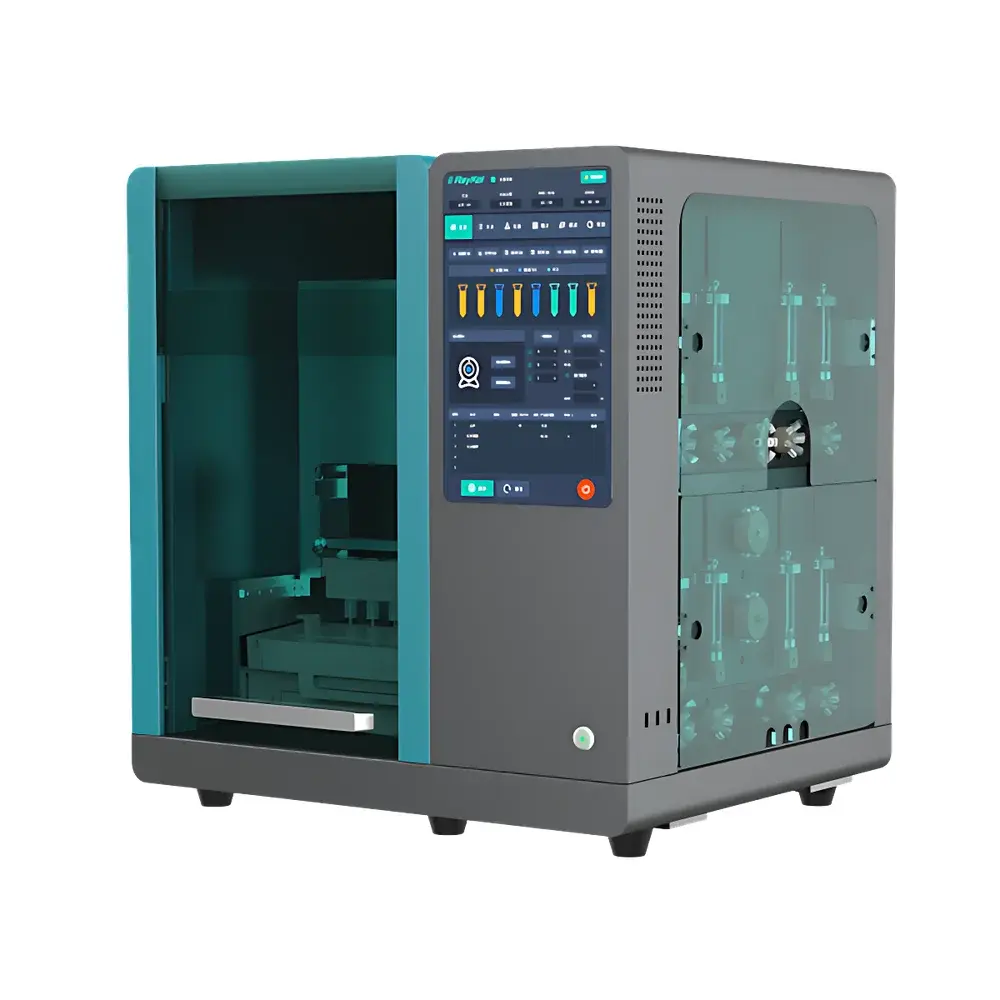
Raykol ASPE Automated Solid Phase Extraction System
| Brand | Raykol |
|---|---|
| Origin | Fujian, China |
| Manufacturer Type | Direct Manufacturer |
| Country of Origin | China |
| Model | ASPE |
| Automation Level | Fully Automatic |
| Number of Channels | Multi-channel |
| Cartridge/Membrane Compatibility | Universal (Cartridge & Membrane) |
| Flow Rate Control | 0.1 mL/min |
| Solvent Selection Capacity | 8 Solvents |
| Sample Capacity | 8 Samples |
| Sample Loading Volume | >10 mL |
| Wetted Materials | PTFE, 316L Stainless Steel, Borosilicate Glass |
Overview
The Raykol ASPE Automated Solid Phase Extraction System is an engineered solution for high-throughput, reproducible sample preparation in environmental water analysis laboratories. Designed specifically for the extraction and concentration of trace organic contaminants from large-volume aqueous matrices—including drinking water, surface water, groundwater, wastewater, and source water—the ASPE system implements vacuum-assisted solid-phase extraction (SPE) with precise fluidic control and full process automation. Its architecture follows the fundamental principles of sorbent-based retention and selective elution, where analytes are retained on functionalized sorbent media (e.g., C18, silica, or ion-exchange phases), followed by sequential washing and elution under programmable pressure and flow conditions. This ensures consistent mass transfer kinetics across all channels, minimizing inter-sample variability and supporting compliance-driven workflows in regulated testing environments.
Key Features
- Fully automated SPE workflow: integrates filtration, column conditioning, sample loading, solvent rinsing, drying, elution, evaporation, solvent exchange, and final reconstitution—without manual intervention.
- Independent per-channel pump-and-valve architecture: each of the 8 parallel processing positions operates with dedicated fluidic control, eliminating cross-talk and ensuring identical residence times, flow profiles, and pressure gradients across all samples.
- Precision pin-seal cartridge interface: low-point insertion sealing minimizes air entrapment within SPE cartridges, enabling laminar, bubble-free flow through packed beds and delivering superior reproducibility in analyte recovery and breakthrough behavior.
- Light-shielded enclosure: opaque housing prevents photodegradation of light-sensitive analytes (e.g., certain pesticides, pharmaceuticals, and endocrine disruptors) during extended processing cycles.
- Sealed negative-pressure concentration chamber: maintains controlled vacuum and temperature during solvent evaporation, preventing condensation ingress—even under high-humidity lab conditions—and preserving analyte integrity during volume reduction.
- Universal media compatibility: supports standard SPE cartridges (1–20 mL volumes) and membrane discs (25 mm and 47 mm diameters), accommodating method flexibility across EPA, ISO, and national standard protocols.
- Integrated anhydrous sodium sulfate (Na₂SO₄) column module: enables real-time water removal from eluates prior to concentration, eliminating manual desiccant handling and reducing risk of emulsion formation or analyte loss.
- Multi-rack fraction collection: configurable multi-position collector allows staggered or segmented eluate capture—critical for method development, fractionation studies, or co-elution resolution.
- Automated solvent exchange: programmable post-evaporation solvent replacement (e.g., hexane → ethyl acetate → methanol) supports derivatization readiness or LC-MS compatibility without operator input.
Sample Compatibility & Compliance
The ASPE system is validated for use with a broad spectrum of environmental water matrices, including turbid, colored, or particulate-laden samples requiring pre-filtration. Its wetted path materials—PTFE, 316L stainless steel, and borosilicate glass—are chemically inert toward common organic solvents (e.g., methanol, acetonitrile, dichloromethane, ethyl acetate) and resistant to corrosion from acidic or basic wash solutions. The system supports method alignment with multiple regulatory frameworks: it facilitates sample preparation per GB 5749–2006 (Drinking Water Hygiene Standard), CJ/T 141–2018 (Urban Water Quality Testing Methods), and GB 3838–2002 (Surface Water Environmental Quality Standards). While not inherently 21 CFR Part 11 compliant out-of-the-box, its software architecture permits integration with LIMS and audit-trail-enabled data systems when deployed in GLP/GMP-aligned laboratories.
Software & Data Management
The ASPE is operated via a touchscreen HMI with intuitive, icon-driven workflow programming. Method templates can be saved, duplicated, and version-controlled; each run logs timestamped event records—including valve actuation, pressure readings, solvent selection, and cycle completion status. Raw log files export in CSV format for external validation or QA review. Optional Ethernet connectivity enables remote monitoring and centralized instrument fleet management. Though native software does not include electronic signatures or full audit trail functionality, its deterministic execution sequence and parameter logging support retrospective verification and method traceability in quality-controlled environments.
Applications
- Pre-concentration of semi-volatile and non-volatile organic pollutants (e.g., PAHs, PCBs, organochlorine pesticides, pharmaceutical residues) from 10–1000 mL water samples.
- Support for EPA Methods 508.1, 525.3, and 8270D in municipal and third-party environmental labs.
- High-reproducibility sample prep for LC-MS/MS, GC-MS, and GC-ECD quantification where inter-run precision ≤5% RSD is required.
- Method development for novel SPE sorbents or hybrid membrane-cartridge approaches under variable pH or ionic strength conditions.
- Automated batch processing in routine monitoring programs—reducing hands-on time by >70% compared to manual SPE.
FAQ
What types of SPE cartridges and membranes are supported?
The ASPE accommodates standard polypropylene or glass SPE cartridges (1 mL, 3 mL, 6 mL, 12 mL, and 20 mL formats) and hydrophilic/hydrophobic membrane discs (25 mm and 47 mm diameters), with adjustable height positioning and seal-force calibration.
Can the system handle viscous or suspended samples?
Yes—integrated inline filtration (optional 0.45 µm or 0.22 µm syringe filters) precedes loading; turbid samples may be pre-centrifuged or gravity-filtered externally before introduction.
Is method validation documentation available?
Raykol provides instrument qualification documents (IQ/OQ templates), performance verification protocols, and typical recovery data for common analyte classes upon request—intended for internal lab validation against user-defined acceptance criteria.
How is maintenance performed on the fluidic system?
All wetted components—including PTFE tubing, stainless-steel manifolds, and cartridge seals—are field-replaceable using standard tools; preventive maintenance intervals are defined in the operation manual based on solvent exposure and daily throughput.
Does the ASPE support unattended overnight operation?
Yes—fully autonomous runtime exceeds 16 hours with proper solvent reservoir sizing and collection rack configuration; system halts safely upon detection of low solvent level, full waste container, or open chamber door.
Related Products



