
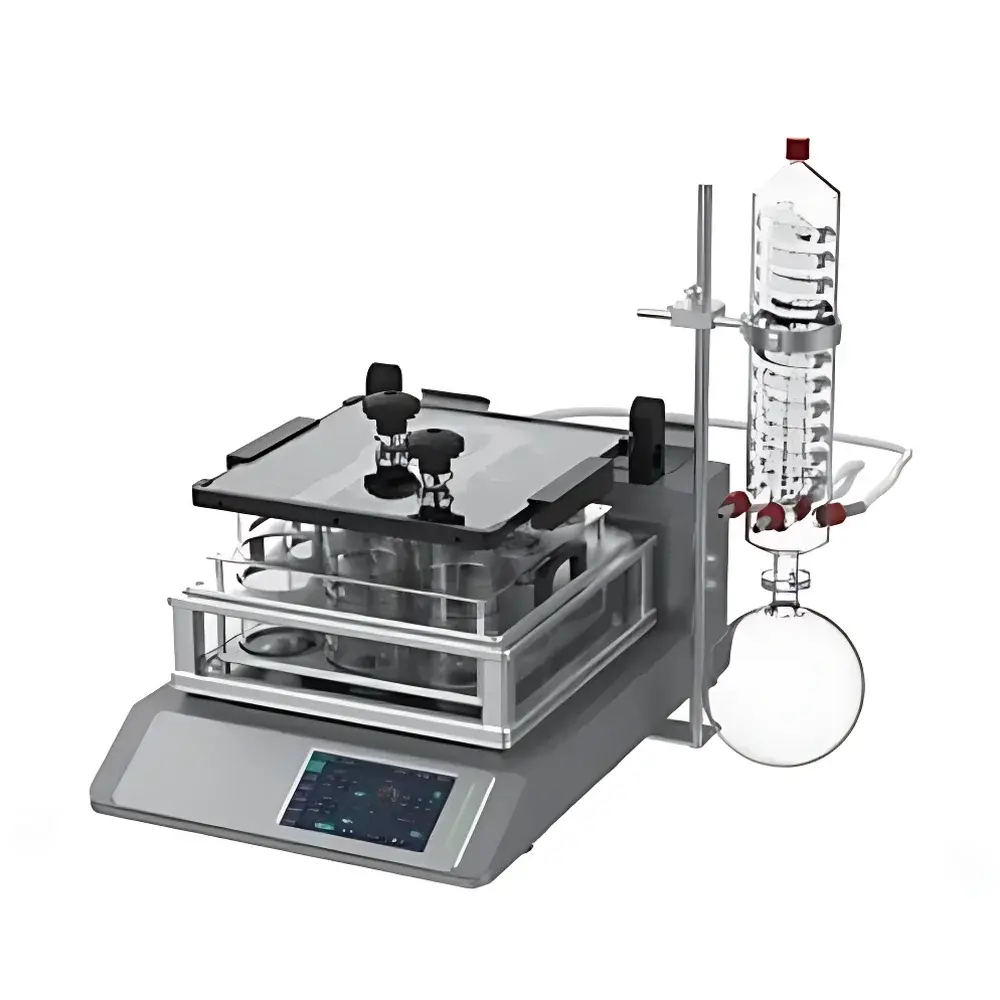
Raykol FOC 9 High-Throughput Oil Concentrator
| Brand | Raykol |
|---|---|
| Origin | Fujian, China |
| Manufacturer Type | Original Equipment Manufacturer (OEM) |
| Country of Origin | China |
| Model | FOC 9 |
| Instrument Type | Vacuum Centrifugal Concentrator |
| Temperature Range | Ambient to 80 °C |
| Temperature Control Accuracy | ±1 °C |
| Sample Capacity per Run | 1–200 mL |
| Operating Vacuum Range | 20–90 kPa |
| Heating Medium | Water Bath |
| Evaporation Principle | Low-Pressure Parallel Solvent Evaporation (Petroleum Ether) |
| Sealing System | Removable Heated Lid with Condensate Prevention |
| Solvent Resistance | PTFE-Sealed Components & Corrosion-Resistant Recovery Pathway |
| Optional Modules | IR Sensor Module, Reflux Kit, Auto Drain/Refill, LED Illumination, Motorized Vacuum Lid |
Overview
The Raykol FOC 9 High-Throughput Oil Concentrator is an engineered solution for parallel solvent removal in food quality control laboratories, specifically designed to support standardized lipid oxidation analysis. It operates on the principle of low-pressure, water-bath–assisted evaporation—leveraging controlled vacuum (20–90 kPa) to accelerate the removal of low-boiling solvents such as petroleum ether without thermal degradation of acid-sensitive analytes. Unlike conventional rotary evaporators or single-channel nitrogen blow-down systems, the FOC 9 integrates a digitally regulated vacuum manifold with uniform temperature distribution across a modular water bath platform. This architecture ensures reproducible evaporation kinetics across all sample positions—critical when preparing extracts for acid value (AV) and peroxide value (PV) quantification per GB 5009.227–2016 and GB 5009.229–2016. The system avoids co-distillation artifacts by maintaining vacuum stability within ±0.5 kPa via ceramic pressure transducers, thereby preserving volatile fatty acids and hydroperoxide intermediates during concentration.
Key Features
- Digital vacuum regulation with real-time feedback from high-stability ceramic sensors—enabling consistent pressure setpoints across all channels to ensure inter-sample comparability.
- Heated, quick-release lid with integrated temperature control to prevent condensation and minimize analyte re-deposition during solvent removal.
- Orbital shaking mechanism (30–120 rpm, adjustable) that enhances convective heat transfer and suppresses localized boiling—reducing risk of splashing or target loss in low-viscosity lipid extracts.
- PTFE-lined solvent recovery pathway and corrosion-resistant chamber components—validated for repeated exposure to halogenated solvents, petroleum ether, and ethyl acetate under GLP-compliant usage conditions.
- Triple-sided transparent water bath enclosure with integrated LED illumination—facilitating visual monitoring of evaporation endpoints without interrupting vacuum integrity.
- Modular expansion capability including IR-based endpoint detection, reflux-compatible adapters, automated water drainage/refill, and motorized vacuum lid actuation—all controllable via the same interface.
Sample Compatibility & Compliance
The FOC 9 accommodates standard 12–24 mm OD glass tubes, screw-cap vials, and custom racks compatible with common extraction workflows (e.g., AOAC 993.21, ISO 6886:2016). Its 1–200 mL per-position capacity supports both small-volume QC replicates and larger-scale screening batches. All wetted materials comply with USP Class VI biocompatibility requirements, and the sealed recovery system meets EPA Method 3510C solvent containment specifications. The instrument’s vacuum and temperature logging functionality supports audit-ready data capture aligned with FDA 21 CFR Part 11 Annex 11 expectations when paired with validated software configurations.
Software & Data Management
The embedded graphical user interface provides method-driven operation with preloaded protocols for GB 5009-series lipid analyses. Each method stores vacuum ramp profiles, temperature gradients, shaking parameters, and endpoint criteria—including optional IR sensor-triggered shutdown. Audit trails record operator ID, timestamp, parameter changes, and alarm events. Raw data exports are generated in CSV format; optional integration with LIMS platforms is supported via RS-232 and Ethernet interfaces. Firmware updates maintain alignment with evolving national standard revisions—including traceable calibration logs compliant with ISO/IEC 17025 clause 6.4.10.
Applications
- Concentration of lipid extracts prior to titrimetric acid value determination (GB 5009.229–2016).
- Preparative cleanup of peroxide-containing samples prior to iodometric quantification (GB 5009.227–2016).
- Parallel evaporation in multi-lab proficiency testing schemes for edible oil stability assessment.
- High-throughput sample prep for LC-MS analysis of oxidized lipid species (e.g., 4-HNE, MDA adducts) where solvent residue must be minimized.
- Method development for accelerated rancidity studies under controlled O2/light exposure followed by quantitative AV/PV tracking.
FAQ
What vacuum range is recommended for petroleum ether removal without target compound loss?
A stable vacuum between 40–60 kPa is optimal for petroleum ether (BP 40–60 °C) at 45 °C bath temperature—balancing evaporation rate and analyte integrity.
Can the FOC 9 handle chlorinated solvents such as chloroform or dichloromethane?
Yes—provided the PTFE-sealed recovery path is used and exhaust is routed to a certified fume hood; continuous operation with DCM requires active cooling of the condenser coil.
Is temperature calibration traceable to NIST standards?
Factory calibration certificates include NIST-traceable references for both bath and lid sensors; field verification kits are available upon request.
How does the orbital shaking improve reproducibility compared to static heating?
Shaking eliminates thermal boundary layers, reduces localized superheating, and ensures uniform solvent surface renewal—critical for achieving <±3% RSD in triplicate AV extractions.
Does the system support 21 CFR Part 11 compliance out-of-the-box?
Electronic signatures, audit trail export, and role-based access control require configuration with Raykol’s validated LabManager Pro software package—available as an add-on module.



