
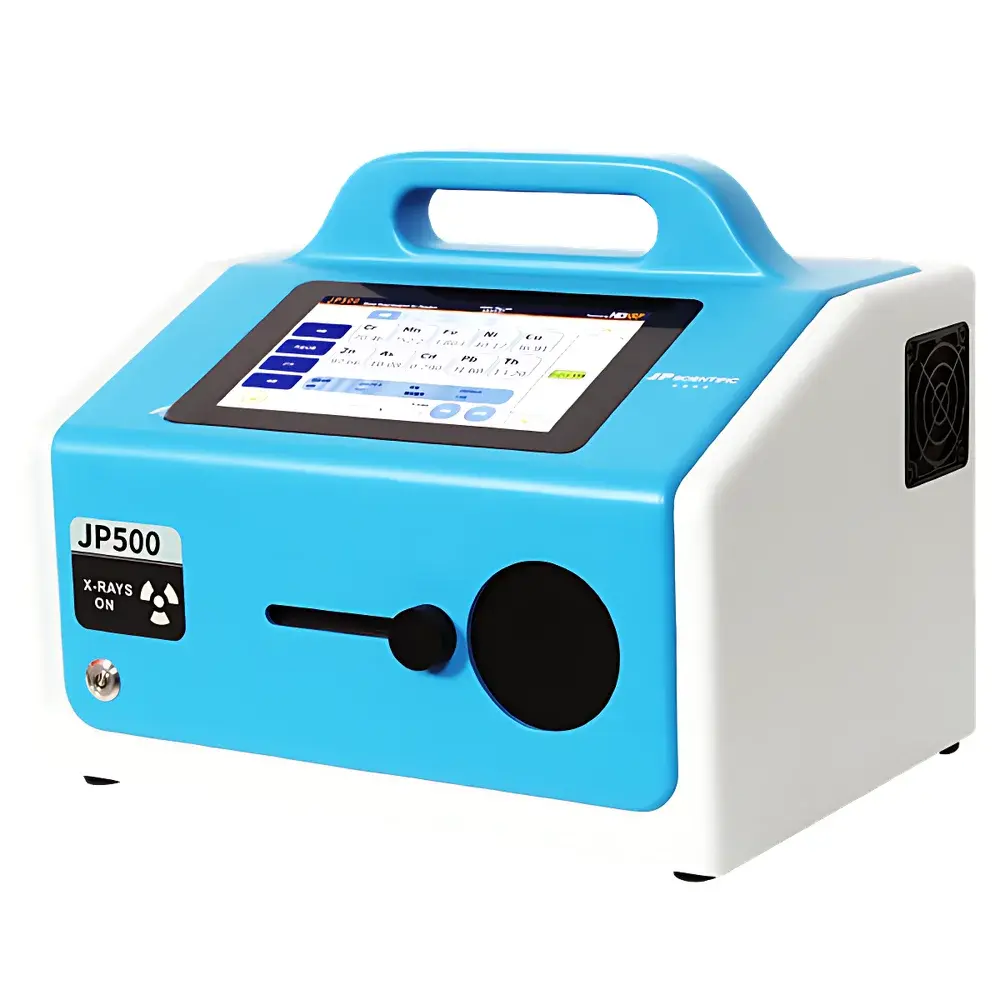
Raykol JP500 High-Precision Energy Dispersive X-Ray Fluorescence Spectrometer
| Brand | Raykol |
|---|---|
| Origin | Jiangsu, China |
| Manufacturer Type | Direct Manufacturer |
| Product Category | Domestic |
| Model | JP500 |
| Application Form Factor | Handheld / Portable |
| Industry Use | General-Purpose |
| Elemental Range | Al to U |
| Quantification Range | 0.03 ppm – 100% |
| Energy Resolution | <140 eV (at Mn Kα) |
| Relative Standard Deviation (RSD) | ≤0.08% for major elements |
| Detector | High-Performance Silicon Drift Detector (SDD) |
Overview
The Raykol JP500 is a field-deployable, high-precision energy dispersive X-ray fluorescence (ED-XRF) spectrometer engineered for rapid, non-destructive elemental analysis of solid, powdered, and liquid samples. Unlike conventional benchtop ED-XRF systems, the JP500 integrates monochromatic excitation via a doubly curved crystal (DCC) optic—effectively filtering the X-ray tube output to deliver intense, narrow-band excitation energy—thereby significantly enhancing peak-to-background ratio and lowering detection limits. This monochromatic excitation architecture, combined with a fast-response silicon drift detector (SDD) and fundamental parameter (FP)-based quantification software, enables laboratory-grade accuracy in a portable platform. The instrument operates on the principle of secondary X-ray emission: when sample atoms are irradiated with high-energy X-rays, inner-shell electrons are ejected; subsequent electron transitions emit characteristic fluorescent X-rays whose energies identify elements and intensities quantify concentrations. Designed for regulatory compliance and field operability, the JP500 supports ISO 12847, ASTM E1621, and USP / guidelines for elemental impurities in food, pharmaceuticals, and environmental matrices.
Key Features
- Monochromatic excitation using a doubly curved crystal (DCC) optic—reduces spectral background and improves signal-to-noise ratio by up to 5× compared to polychromatic excitation
- High-resolution SDD detector with <140 eV energy resolution at Mn Kα (5.9 keV), enabling precise peak separation for adjacent elements (e.g., As/K, Pb/S, Ni/Co)
- Quantitative accuracy validated against certified reference materials (CRMs); relative error ≤±3% for Cd, Pb, As, Se, and Hg across food and water matrices
- No sample digestion required—direct analysis of ground grains, slurried soils, filtered water, or clarified oils in under 2 minutes
- Robust thermal management system ensures stable performance from –5 °C to 50 °C ambient, with internal temperature compensation for detector gain and peak position
- Compliance-ready firmware with audit trail, user access levels, and electronic signature support aligned with FDA 21 CFR Part 11 and GLP/GMP documentation requirements
Sample Compatibility & Compliance
The JP500 accommodates heterogeneous and matrix-diverse samples without homogenization beyond basic grinding or filtration. It has been validated for direct analysis of rice flour (for Se, Pb, As), vegetable tissue digests (as-is slurries), edible oil filtrates (Pb, Ni, Fe), municipal wastewater (Cd, Cr, Cu), and gasoline (Mn, Fe, Pb). Sample forms include solids (pellets, powders), suspensions ( 0.999), and precision (RSD ≤ 0.08% for 10 replicate measurements of CRM NIST SRM 2711a).
Software & Data Management
The proprietary Raykol AnalyzePro™ software provides full spectral acquisition, real-time deconvolution, FP-based quantification, and customizable reporting. It includes preloaded method templates for food safety (Codex Alimentarius MLs), drinking water (EPA 6010D), and pharmacopeial testing (USP ). Raw spectra and processed results are stored in encrypted SQLite databases with time-stamped metadata, operator ID, GPS coordinates (when enabled), and instrument calibration logs. Export formats include CSV, PDF analytical reports, and XML-compatible structured data for LIMS integration. Software updates are delivered via secure HTTPS with cryptographic signature verification.
Applications
- Rapid screening of rice, wheat, and legumes for selenium biofortification and heavy metal contamination (As, Cd, Pb)
- Field-level assessment of irrigation water, sediment cores, and industrial effluents for regulated metals (Cr(VI), Hg, Ni)
- Quality control of edible oils and biodiesel for catalyst residues (Ni, V, Na) and wear metals (Fe, Cu)
- Pharmaceutical excipient testing per ICH Q3D for elemental impurities (Co, Mo, Tl, V)
- Geological survey support—soil and ore slurry analysis for base and precious metals (Cu, Zn, Pb, Au surrogate via Sb)
- Recycling industry sorting—identification and grading of alloy scrap (stainless steel, aluminum alloys, brass)
FAQ
Does the JP500 require external gas cooling or vacuum pumping?
No. The SDD detector uses Peltier thermoelectric cooling and operates stably at ambient pressure without helium purge or vacuum maintenance.
Can it quantify light elements such as Mg, Al, and Si?
Yes—the monochromatic excitation enhances sensitivity for elements from Al (Z=13) upward; Mg (Z=12) is detectable but not routinely quantified due to air absorption and detector window limitations.
Is method transfer possible between JP500 units?
Yes. Calibration models and spectral libraries are exportable and interoperable across JP500 instruments, provided detector response and excitation geometry are verified during installation.
What is the typical detection limit for lead in rice flour?
Under 30-second measurement, LOD for Pb is 0.12 ppm (dry weight basis) using a 1 g pressed pellet; sub-ppm quantification is achievable with 120 s acquisition.
How is instrument performance verified in the field?
A built-in check source (⁵⁵Fe) enables daily energy calibration and resolution verification; optional CRM check standards (e.g., NIST SRM 2783) support ongoing accuracy monitoring.
Related Products




