
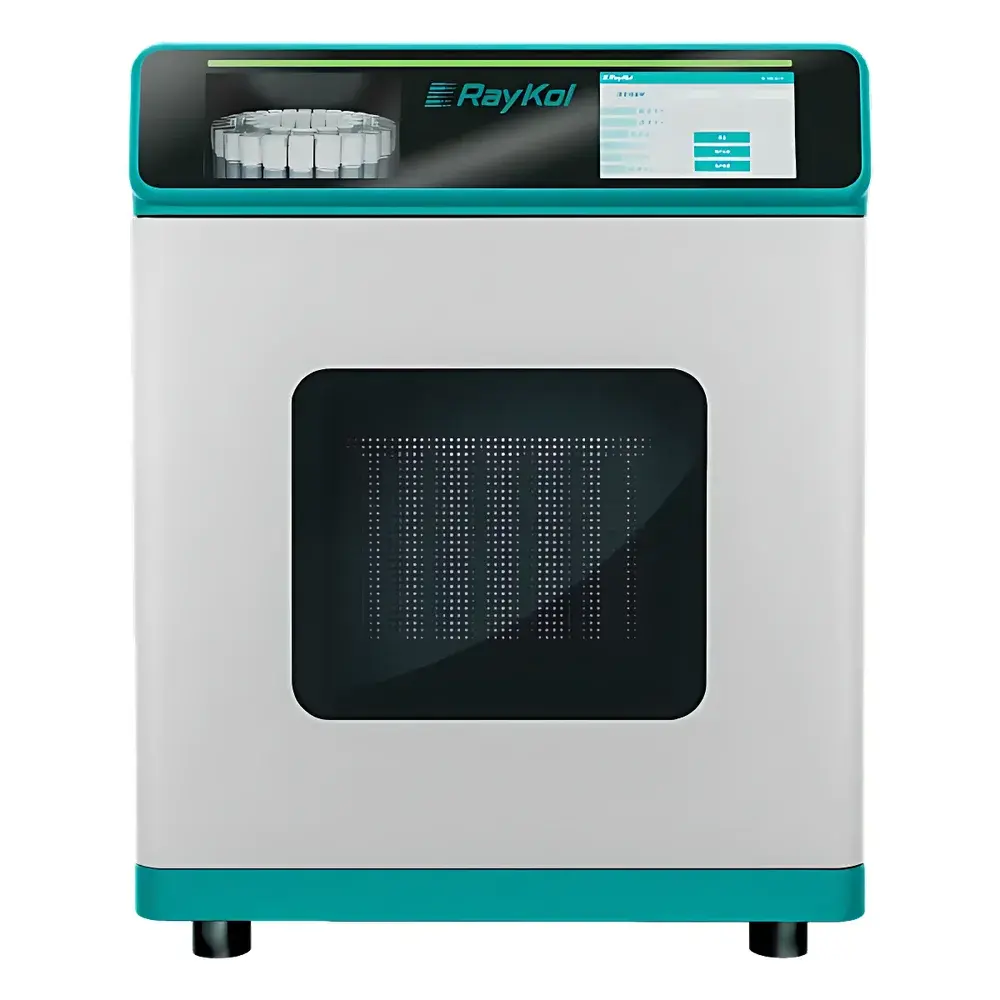
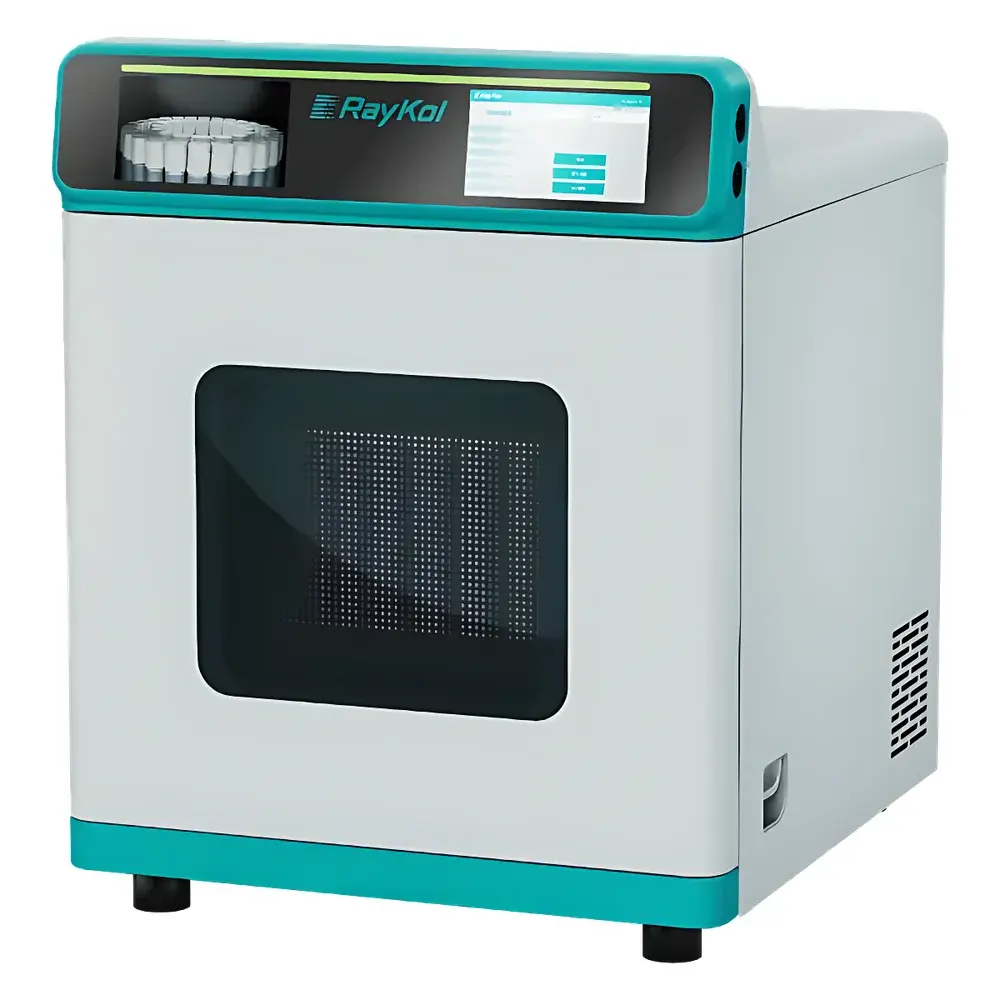
Raykol XT-iMD Sealed Intelligent Microwave Digestion and Extraction System
| Brand | Raykol |
|---|---|
| Origin | Shanghai, China |
| Manufacturer Type | Direct Manufacturer |
| Country of Origin | Domestic (China) |
| Model | XT-iMD |
| Price Range | USD 28,000 – 112,000 |
| Cavity Class | Industrial-Grade |
| Sample Capacity | 42 positions per batch |
| Microwave Source | 2450 MHz variable-frequency magnetron with high-energy microwave field generation |
| Max Temperature | 300 °C |
| Temperature Measurement Accuracy | ±0.1 °C |
| Temperature Control Stability | ±1 °C |
| Temperature Uniformity | ±1 °C |
| Max Pressure | 6 MPa |
Overview
The Raykol XT-iMD Sealed Intelligent Microwave Digestion and Extraction System is an industrial-grade sample preparation platform engineered for precision, reproducibility, and operational safety in regulated laboratory environments. It operates on the principle of controlled microwave-assisted thermal decomposition and solvent extraction, leveraging resonant dielectric heating at 2450 MHz to rapidly elevate temperature and pressure within sealed vessels. Unlike conventional open-vessel or single-point monitored systems, the XT-iMD integrates real-time, multi-parameter monitoring across all 42 sample positions—enabling uniform, method-robust digestion of heterogeneous matrices including environmental soils, biological tissues, polymers, and mineral-rich geological samples. Its architecture conforms to core design principles outlined in ISO/IEC 17025 for testing laboratories and supports compliance workflows aligned with EPA Methods 3050B, 3051A, 3052, and ASTM D5511 for solid waste characterization.
Key Features
- Multi-Point Real-Time Monitoring: Dual-sensor architecture combines mid-infrared (MIR) non-contact temperature sensing—capable of penetrating TFM-lined vessels—with high-resolution optical distance measurement for true pressure mapping across all 42 positions.
- Microwave Field Optimization: Proprietary microwave focusing technology delivers enhanced energy density and spatial uniformity, reducing average digestion cycle time by up to 40% compared to standard multimode cavities.
- Industrial Cavity Design: Reinforced stainless-steel cavity with corrosion-resistant coating, side-opening blast-proof door, and pressure-actuated self-sealing latch mechanism meeting EN 61000-6-3 EMC and EN 61000-6-4 immunity standards.
- Intelligent Safety Architecture: Ten independent active and passive safeguards—including overpressure rupture disc activation, thermal cutoff, microwave leakage interlock, and real-time cavity video surveillance—fully documented in the system’s audit trail.
- Energy-Efficient Operation: Adaptive power modulation dynamically adjusts magnetron output based on real-time thermal load, minimizing idle consumption without compromising ramp rate or hold stability.
- Human-Centric Interface: 10.1-inch capacitive touchscreen with GLP-compliant method editor, automatic vessel recognition (via RFID or optical barcode), and remote supervision via secure cloud-connected mobile application.
Sample Compatibility & Compliance
The XT-iMD accommodates standard and custom TFM, PTFE, and quartz-based digestion vessels (up to 100 mL capacity) and supports simultaneous processing of diverse sample types—including silicate-rich sediments, lipid-dense food composites, halogenated plastics, and acid-resistant metal alloys. All temperature and pressure data are timestamped, digitally signed, and stored with full metadata (operator ID, method version, calibration log). The system’s firmware and software architecture comply with FDA 21 CFR Part 11 requirements for electronic records and signatures, including role-based access control, audit trail retention (>10 years), and immutable data export (CSV, PDF, XML). Documentation packages include IQ/OQ/PQ protocols, traceable calibration certificates (NIST-traceable reference standards), and ISO 9001-certified manufacturing records.
Software & Data Management
Raykol SmartPrep™ Software v4.2 provides a validated, standalone platform for method development, execution, and reporting. It features automated sequence scheduling, dynamic parameter adjustment during runs (e.g., adaptive hold time extension upon deviation detection), and integrated uncertainty calculation per ISO/IEC Guide 98-3 (GUM). Raw sensor data—including MIR spectral intensity profiles, optical displacement waveforms, and RF power harmonics—is archived in vendor-neutral HDF5 format. Export modules support LIMS integration via ASTM E1384-compliant HL7 messaging and direct upload to ELN platforms (e.g., LabArchives, Benchling) using RESTful API endpoints. All software updates undergo formal change control per ICH Q9 and are accompanied by impact assessments and re-validation reports.
Applications
- Environmental analysis: Total metal recovery from EPA SW-846 Method 3052 digests (soils, sludges, fly ash)
- Food & feed safety: As, Cd, Pb, Hg quantification per EU Commission Regulation (EC) No 1881/2006 using ICP-MS-ready digests
- Polymer & plastic testing: Halogen screening (Cl, Br) and additive leaching studies under ASTM D5511/D5512 conditions
- Geological exploration: Rare earth element (REE) and PGE dissolution from refractory silicates and carbonates
- Cosmetic product compliance: Heavy metal profiling per ASEAN Cosmetic Directive Annex II and US FDA guidance for lead in lipstick
- Metallurgical QC: Alloy homogeneity assessment and inclusion analysis via acid digestion prior to OES or GD-MS
FAQ
Does the XT-iMD support unattended overnight operation?
Yes—when configured with validated cooling protocols and monitored via SmartPrep™ remote alerting, the system supports fully autonomous batch processing with pre-set safety escalation thresholds.
Is method transfer possible between XT-iMD and other Raykol microwave platforms?
Method files (.rmp) are backward-compatible across Raykol’s i-Series platforms; however, validation per ICH Q5A is required when migrating to hardware variants with different cavity geometry or sensor configurations.
How is temperature accuracy verified during routine use?
The MIR sensor undergoes daily auto-calibration against an internal blackbody reference; annual verification uses NIST-traceable IR thermometers (±0.05 °C uncertainty) per ISO/IEC 17025 Clause 6.5.
Can the system be integrated into a centralized laboratory automation network?
Yes—via optional Ethernet/IP or Modbus TCP gateway module, enabling synchronization with robotic sample handlers, autosamplers, and central MES systems under ISA-88/ISA-95 frameworks.
What documentation is provided for regulatory audits?
Full GxP package includes Design Qualification (DQ), Installation/Operational/Performance Qualification (IQ/OQ/PQ) reports, software validation summary, cybersecurity risk assessment (per IEC 62443-3-2), and raw data integrity statement.



