
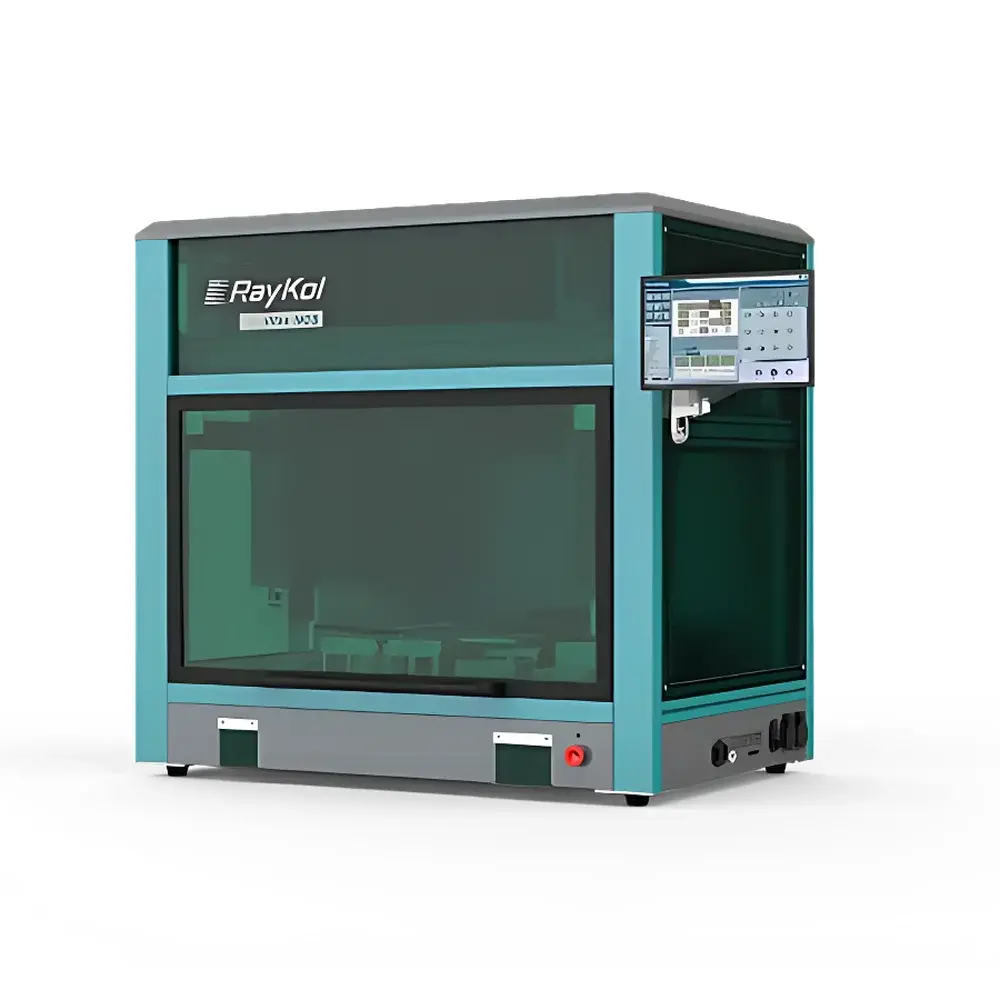
Raykol Vitae 180 NGS Library Preparation Workstation
| Brand | Raykol |
|---|---|
| Origin | Guangdong, China |
| Manufacturer Type | Authorized Distributor |
| Product Category | Domestic |
| Model | Vitae 180 NGS |
| Instrument Type | NGS Library Construction System |
| Library Construction Method | Hybridization-Based Target Enrichment (Capture) |
| Supported Plate Format | SBS-compliant 384-well plates |
| Throughput | 1–32 samples per run |
| Dimensions (W×D×H) | 1200 mm × 750 mm × 1085 mm |
| Weight | 120 kg |
| Integrated Thermal Cycler | Yes (desktop, with sealing and heated lid) |
| Onboard Modules | PCR heating block, PCR cooling block, reagent cold storage (4 °C), magnetic plate holder, plate vortexer, UV sterilization lamp (optional), HEPA filtration (positive/negative pressure, optional) |
Overview
The Raykol Vitae 180 NGS Library Preparation Workstation is an integrated, benchtop automation platform engineered for reproducible, walk-away execution of next-generation sequencing (NGS) library construction workflows—specifically hybridization-based target enrichment protocols. It operates on the principle of precise liquid handling combined with thermally controlled reaction environments and magnetic bead-based nucleic acid purification. Designed for mid-throughput laboratories performing clinical or translational genomics applications—including hereditary disease screening, oncology liquid biopsy, non-invasive prenatal testing (NIPT), and pathogen detection—the system eliminates manual pipetting variability and reduces hands-on time while maintaining strict adherence to workflow integrity. Its architecture supports end-to-end automation from fragmentation and end-repair through adapter ligation, size selection, PCR amplification, and hybridization capture—all within a single instrument footprint.
Key Features
- Multi-channel liquid handling system featuring dual independent pipetting heads: an 8-channel head with individual channel actuation for accurate master mix preparation and dispensing; and a 32-channel head optimized for high-efficiency bead-based washes, supernatant aspiration, and homogenization steps.
- Expanded deck layout accommodating up to 18 SBS-standard positions for functional modules (e.g., thermal cycler, magnetic rack, vortexer) plus 9 additional SBS slots dedicated to reagent and consumable storage—enabling full-run setup without manual intervention.
- Integrated desktop thermal cycler with programmable ramp rates, heated lid, and automated film sealing—eliminating external PCR instrument dependency and ensuring consistent amplification conditions across runs.
- Modular temperature control: independently regulated PCR heating block (up to 99 °C), Peltier-based cooling block (down to 4 °C), and dedicated 4 °C reagent cold storage compartment to preserve enzyme and oligonucleotide stability during extended protocols.
- Optional biosafety enhancements: UV-C germicidal lamp for chamber decontamination between runs; configurable positive- or negative-pressure HEPA filtration system to mitigate cross-contamination risk in shared lab environments.
- One-touch operation via preloaded, version-controlled protocol files—each validated against reference standards per ISO/IEC 17025 and aligned with CLIA/CAP pre-analytical requirements for clinical NGS workflows.
Sample Compatibility & Compliance
The Vitae 180 supports input nucleic acids including genomic DNA, FFPE-derived DNA, cfDNA, and RNA (with compatible library prep kits). It is compatible with major commercial NGS library construction kits requiring enzymatic fragmentation, end-polishing, A-tailing, adapter ligation, and hybridization capture (e.g., Illumina TruSight, IDT xGen, Agilent SureSelect). All onboard modules meet IEC 61000-6-2 (EMC immunity) and IEC 61010-1 (safety) standards. The software architecture supports audit trail generation, electronic signatures, and user-access controls compliant with FDA 21 CFR Part 11 and ISO 13485 quality management system requirements for IVD-related development and validation activities.
Software & Data Management
The workstation runs Raykol’s proprietary VitaeControl™ software—a Windows-based interface supporting drag-and-drop protocol building, real-time status monitoring, and event logging with timestamped metadata. Each run generates a structured output file containing instrument parameters, error logs, and module-specific performance metrics (e.g., pipette calibration history, thermal ramp fidelity, magnetic separation dwell times). Data export conforms to MIAME and MINSEQE reporting guidelines. Remote diagnostics and firmware updates are supported over secure TLS-encrypted connections. For LIMS integration, the system provides HL7 and ASTM E1384-compliant API endpoints.
Applications
- Automated DNA library construction for whole-exome sequencing (WES), targeted gene panels, and low-input cfDNA profiling.
- Hybridization capture workflows requiring stringent temperature staging during probe hybridization, wash stringency control, and post-capture amplification.
- Standardized preparation of matched tumor-normal pairs in oncology biomarker discovery pipelines.
- High-fidelity library prep under GLP conditions for companion diagnostic assay development and regulatory submissions.
- Scalable deployment in centralized core facilities serving multiple research groups with heterogeneous kit preferences and QC requirements.
FAQ
Does the Vitae 180 support dual-indexed library preparation?
Yes—it accommodates dual-indexing strategies using either single- or dual-barcode adapters via programmable multi-step dispense routines.
Can third-party reagents and consumables be used?
Yes, provided they conform to SBS 384-well dimensional specifications and are validated for compatibility with magnetic bead chemistry and thermal cycling profiles.
Is the thermal cycler module upgradeable to support fast-cycling protocols?
The embedded cycler supports ramp rates up to 4.0 °C/s and is firmware-upgradable to align with evolving kit manufacturer specifications.
What level of maintenance is required for long-term operational reliability?
Preventive maintenance includes quarterly calibration of pipetting accuracy (per ISO 8655), annual HEPA filter replacement (if installed), and biannual verification of thermal block uniformity across all wells.
How does the system ensure traceability for clinical use?
Each run records operator ID, protocol version, lot numbers of critical reagents, environmental sensor data (temperature/humidity), and deviation flags—exportable as PDF or CSV for regulatory review.




