
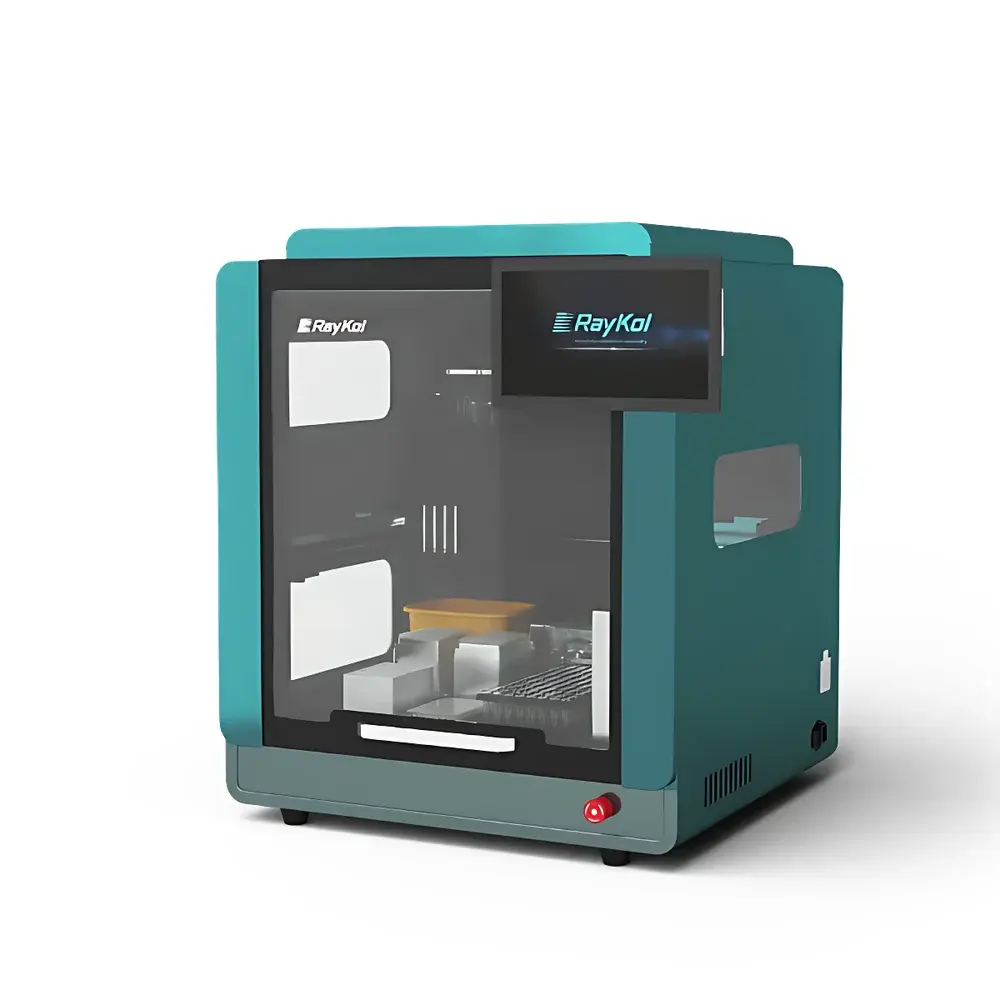
Raykol Vitae Lids EP Fully Automated EP Tube Capping/Decapping and Liquid Handling Workstation
| Brand | Raykol |
|---|---|
| Origin | Fujian, China |
| Model | Vitae Lids EP |
| Instrument Type | Benchtop |
| Function Modules | Automated Capping/Decapping, Precision Liquid Handling |
| Sample Throughput | 8 tubes per cycle (parallel capping/decapping) |
| Pipetting Range | 1–1000 µL |
| Pipetting Speed | ≤15 minutes for full capping/decapping and liquid transfer of 96 EP tubes (4-channel mode) |
| Pipetting Accuracy | ±0.1% of set volume (at ≥100 µL), compliant with ISO 8655-6 |
| Channel Configuration | 2–4 independent robotic pipetting channels |
| Deck Layout | 4 standard SBS-compliant positions for racks, plates, and reagent reservoirs |
| Optional Feature | Integrated 2D barcode scanner for sample traceability |
Overview
The Raykol Vitae Lids EP is a benchtop fully automated liquid handling workstation engineered specifically for high-integrity capping, decapping, and precise aliquoting of clinical and biobank samples stored in 1.5–2.0 mL microcentrifuge (EP) tubes. It operates on a dual-mechanism architecture: a dedicated 8-position parallel capping/decapping module ensures simultaneous lid manipulation across eight EP tubes—eliminating sequential bottlenecks—while a synchronized 2–4 channel positive-displacement or air-displacement pipetting system executes volumetric transfers under programmable conditions. Designed for pre-analytical workflow standardization, the system supports direct transfer from individual EP tubes to SBS-format 96-well deep-well plates (for metabolite extraction), PCR plates (for downstream amplification), or secondary EP tube arrays. Its mechanical design adheres to ISO 13485-aligned manufacturing practices, and its operational logic is structured to support GLP-compliant sample tracking when integrated with laboratory information management systems (LIMS).
Key Features
- Parallel 8-tube capping/decapping module enabling simultaneous lid actuation—reducing cycle time by >60% compared to single-tube mechanisms
- Modular 2–4 channel pipetting arm with independent Z-axis control and tip ejection calibration, supporting both low-volume (1–10 µL) and high-volume (100–1000 µL) transfers
- Benchtop footprint (W × D × H: 650 × 600 × 520 mm) optimized for ISO Class 5–7 cleanroom-compatible lab environments
- Four standardized SBS-compliant deck positions accommodating universal tube racks (e.g., 8 × 12 format), 96-well deep-well plates, PCR plates, and reagent reservoirs
- Integrated force-sensing mechanism in the capping module ensures consistent torque application (0.15–0.25 N·m range), preventing tube deformation or seal failure during repeated cycles
- Optional 2D barcode reader (mounted overhead or side-mounted) enables real-time sample ID capture, linking physical tube IDs to digital protocol logs
Sample Compatibility & Compliance
The Vitae Lids EP accommodates standard conical-bottom and flat-bottom 1.5 mL and 2.0 mL polypropylene EP tubes from major suppliers (e.g., Eppendorf, Axygen, Thermo Fisher). It maintains compatibility with capped tubes featuring screw-threaded lids (including snap-cap variants with reinforced sealing ribs) and supports both ambient and refrigerated (4 °C) tube storage configurations via optional chilled deck integration. All fluidic components contacting samples are certified DNase/RNase-free and autoclavable. The system meets essential requirements for IVD pre-analytical automation under ISO 15189:2022 Annex A.3 (pre-examination processes) and supports audit-ready documentation for FDA 21 CFR Part 11 compliance when deployed with validated electronic signature and audit trail modules.
Software & Data Management
Operation is managed through Raykol’s proprietary VitaeControl software—a Windows-based GUI with drag-and-drop protocol builder, real-time motion visualization, and version-controlled method libraries. Each run generates a timestamped .csv log file containing tube position mapping, lid status (open/closed), pipetted volume per well, tip usage history, and error codes (e.g., “lid jam,” “tip drop failure”). Raw data exports are compatible with common LIMS APIs (HL7 v2.x, ASTM E1384) and support CSV-to-Excel transformation for QC reporting. Software validation packages—including IQ/OQ documentation templates and performance verification checklists—are provided for GxP-regulated labs.
Applications
- Biobanking: High-fidelity redistribution of plasma, serum, urine, and CSF samples into master/slave plates while preserving integrity of freeze-thaw-sensitive analytes
- Clinical metabolomics: Aliquoting of thawed specimens into deep-well plates for solid-phase extraction (SPE) or protein precipitation workflows
- Molecular diagnostics: Preparation of template DNA/RNA stocks for qPCR, ddPCR, and NGS library prep—minimizing cross-contamination risk via tip-based fluidic isolation
- Reference material preparation: Generation of calibrated dilution series across multiple concentration levels using serial transfer protocols
- QC/QA batch processing: Replicate dispensing of control materials across assay plates to assess inter-run precision (CV ≤1.2% at 200 µL)
FAQ
What types of EP tubes are supported?
Standard 1.5 mL and 2.0 mL polypropylene microcentrifuge tubes with threaded screw caps (pitch: 10–12 mm) from Eppendorf, Axygen, Thermo Scientific, and comparable OEM formats.
Can the system integrate with existing LIMS or ELN platforms?
Yes—via configurable RESTful API endpoints and pre-built HL7/ASTM E1384 message translators; validation support documentation is included.
Is calibration required before first use?
Factory calibration certificates (gravimetrically verified per ISO 8655-6) are supplied; user-performed periodic verification is recommended every 3 months or after 500 operational cycles.
Does the workstation support cold-chain sample handling?
The base configuration operates at ambient temperature; optional Peltier-cooled deck (4 ± 1 °C) and insulated tube rack adapters are available as add-on modules.
How is tip contamination prevented during multi-sample runs?
Each channel uses disposable filtered tips; the software enforces mandatory tip change between samples unless explicitly overridden in validated “no-tip-change” protocols for identical matrix transfers.





