
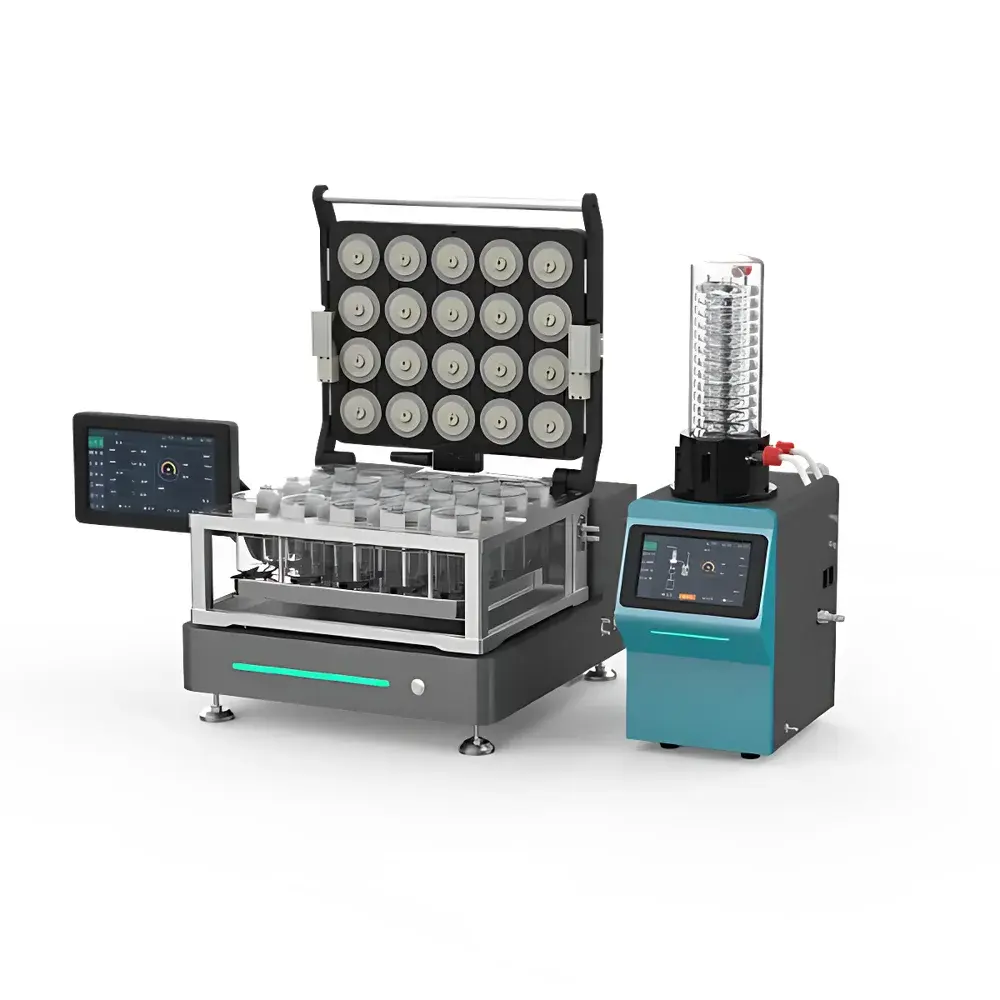
Raykol MPE Pro High-Throughput Vacuum Parallel Concentrator
| Brand | Raykol |
|---|---|
| Origin | Fujian, China |
| Manufacturer Type | Original Equipment Manufacturer (OEM) |
| Country of Origin | China |
| Model | MPE Pro |
| Instrument Type | Vacuum Parallel Concentrator |
| Temperature Range | 0 °C to 40 °C |
Overview
The Raykol MPE Pro High-Throughput Vacuum Parallel Concentrator is an engineered solution for automated, reproducible solvent removal across multiple samples under controlled vacuum and temperature conditions. It operates on the principle of vacuum-assisted evaporation—reducing ambient pressure above liquid surfaces to lower boiling points while maintaining sample integrity through precise thermal and pressure regulation. Designed for laboratories performing routine extraction and cleanup workflows in environmental, food, pharmaceutical, and textile testing, the MPE Pro integrates parallel processing capability with intelligent endpoint detection and closed-loop condensate recovery. Its architecture supports GLP-compliant operation by minimizing manual intervention, ensuring traceable process parameters, and enabling audit-ready data capture when paired with compliant software.
Key Features
- Three-step operational workflow: Place sample vials → Flip down the concentric sealing lid → Initiate run — eliminating manual valve adjustments or vacuum calibration.
- Independent pneumatic channel control per position, allowing flexible configuration of active channels (1–24 positions) without cross-contamination or pressure interference.
- Auto-sealing mechanism with lid-integrated gasket compression, activated via motorized flip-lid actuation and verified by positional feedback sensors.
- Optical liquid-level sensing system continuously monitors solvent volume reduction in real time, triggering automatic termination upon reaching user-defined residual volume thresholds.
- Multi-mode vacuum control: Manual mode for rapid setup; Programmed mode for time-based pressure ramps; Variable-frequency pump mode for dynamic gradient pressure profiles—enabling gentle concentration of thermolabile analytes such as pesticides, dioxins, and azo dyes.
- Dual-stage condensation system featuring a primary 3 L solvent collection flask and a secondary high-capacity (>5 L) cold trap assembly with Peltier cooling, achieving >98% solvent recovery efficiency across volatile organic solvents (e.g., hexane, acetone, ethyl acetate).
Sample Compatibility & Compliance
The MPE Pro accommodates standard 12–15 mL glass test tubes, 16 mm OD centrifuge tubes, and optional adapter plates for 96-well formats. It is validated for use with aqueous, acidic, basic, and organic matrices encountered in regulated analytical methods. The system complies with key method requirements referenced in ISO/IEC 17025-accredited laboratories, including USP , EPA Method 8270D, and Chinese Pharmacopoeia 2020 Edition General Chapter 2341 (Fifth Method). Pressure and temperature logs are timestamped and exportable in CSV format, supporting FDA 21 CFR Part 11 compliance when used with validated LIMS or ELN integration.
Software & Data Management
The embedded touchscreen interface provides intuitive method creation, real-time vacuum/temperature monitoring, and event logging (lid actuation, pressure transitions, endpoint confirmation). All method parameters—including target vacuum setpoints, ramp rates, hold times, and termination criteria—are stored with user ID and timestamp metadata. Audit trails record operator actions, parameter changes, and system alerts. Data export supports USB transfer or network upload to centralized laboratory informatics systems. Optional software modules enable remote monitoring via Ethernet/Wi-Fi and integration with electronic lab notebooks compliant with ALCOA+ principles.
Applications
The MPE Pro is routinely deployed in multi-residue analysis workflows requiring parallel concentration prior to GC-MS, LC-MS/MS, or HPLC quantification. It supports method-specific applications including: pesticide residue analysis per GB 23200.8–2016 and HJ 834–2017; dioxin congener isolation per HJ 77.2–2008 and HJ 77.3–2008; peroxide value and acid value determination per GB 5009.227–2016 and GB 5009.229–2016; and banned azo dye screening per GB/T 17592–2011 and EN 14362–2017. Its gradient vacuum capability ensures minimal analyte degradation during concentration of semi-volatile compounds from soil, sediment, food homogenates, and textile extracts.
FAQ
What vacuum control strategies does the MPE Pro support?
It offers three selectable modes: manual (fixed setpoint), programmed (time-dependent stepwise pressure reduction), and variable-frequency (continuous gradient adjustment via integrated inverter-driven vacuum pump).
Can I interrupt and resume a run without compromising data integrity?
Yes—pause/resume functionality preserves all active parameters and timestamps; the system reinitializes vacuum and temperature stabilization upon restart.
Is the condensate recovery system compatible with chlorinated solvents?
The cold trap and collection flasks are constructed from borosilicate glass and PTFE-sealed components, rated for intermittent use with dichloromethane and chloroform under controlled temperature conditions.
How is endpoint detection validated across different matrix types?
Liquid-level sensing is calibrated using reference standards of known density and surface tension; users may apply matrix-matched correction factors within the method editor.
Does the system meet electromagnetic compatibility (EMC) and electrical safety standards for international deployment?
It conforms to IEC 61326-1 (measurement equipment EMC) and IEC 61010-1 (safety requirements for laboratory electrical equipment), with CE marking and RoHS certification documented in the technical file.
Related Products



