
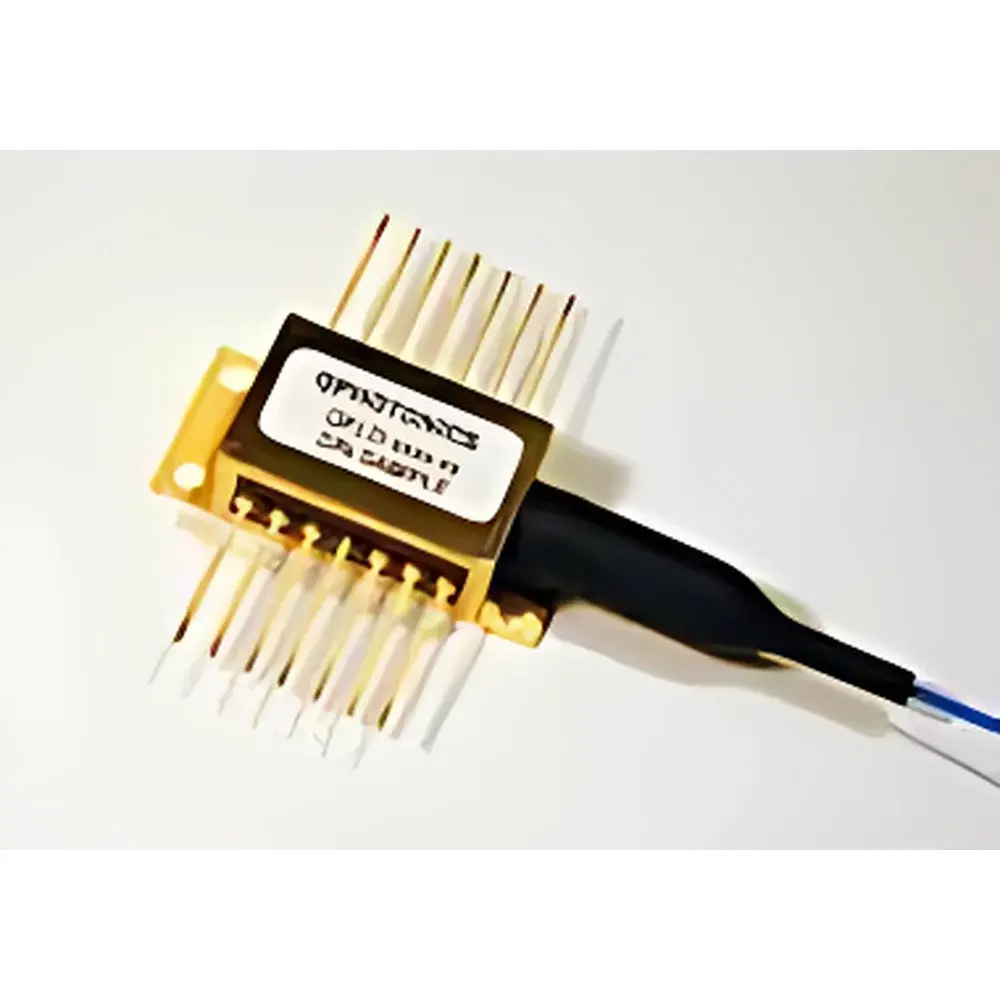
Rayscience QFLD-1550-100S Single-Mode Fiber-Coupled Fabry–Pérot Laser Diode
| Brand | Rayscience |
|---|---|
| Model | QFLD-1550-100S |
| Emission Wavelength | 1550 nm |
| Output Power | 100 mW (CW) |
| Spectral Linewidth | < 3 nm (typ.) |
| Operating Temperature Range | –40 °C to +50 °C |
| Wavelength Drift Coefficient | 0.5 nm/°C |
| Rise Time | 0.5 ns |
| Fiber Type | SMF-28e+ single-mode fiber pigtail |
| Connector Options | FC/PC or FC/APC (optional) |
| Integrated Components | TEC and thermistor |
| Monitor Photodiode | Not included |
Overview
The Rayscience QFLD-1550-100S is a continuous-wave (CW) or pulsed single-transverse-mode Fabry–Pérot (FP) laser diode, engineered for stable, narrow-spectrum emission at 1550 nm in the C-band of optical communications. Designed for integration into fiber-optic test systems, interferometric sensors, and time-domain reflectometry (OTDR) platforms, this device leverages a monolithic semiconductor gain medium with anti-reflection coated facets to suppress higher-order longitudinal modes while maintaining low threshold current and high slope efficiency. Its spectral output exhibits typical full-width-at-half-maximum (FWHM) linewidths under 3 nm—suitable for applications requiring moderate coherence length without the complexity or cost of distributed feedback (DFB) or external cavity configurations. The laser operates across an extended industrial temperature range (–40 °C to +50 °C), enabled by an integrated thermoelectric cooler (TEC) and precision-matched NTC thermistor for active thermal stabilization. Unlike monitor photodiode-equipped variants, the QFLD-1550-100S omits internal optical power sensing to maximize coupling efficiency and minimize back-reflection sensitivity—making it especially appropriate for low-noise coherent detection paths and polarization-maintaining fiber interfaces.
Key Features
- Single transverse mode FP cavity architecture optimized for spatial beam quality and coupling efficiency into standard SMF-28e+ fiber
- 1550 nm center wavelength with 0.5 nm/°C temperature-dependent drift coefficient—enabling predictable thermal tuning for calibration traceability
- Sub-nanosecond electrical rise time (0.5 ns) supporting high-speed pulsed operation in time-resolved measurements
- Integrated TEC and thermistor enabling closed-loop temperature control with ±0.1 °C stability under constant-current drive conditions
- Fiber-pigtailed configuration with factory-optimized fusion splice to minimize insertion loss (< 1.5 dB typical)
- Optional FC/PC or FC/APC physical contact connectors to mitigate back-reflection in sensitive interferometric setups
- No built-in monitor photodiode—reducing optical feedback susceptibility and simplifying driver design for low-noise biasing
Sample Compatibility & Compliance
The QFLD-1550-100S is compatible with standard single-mode optical fibers (ITU-T G.652.D compliant), including polarization-maintaining (PM) variants when spliced using mode-field matching techniques. It meets IEC 60825-1:2014 Class 3B laser safety requirements when operated within specified current and temperature limits. While not certified to ISO/IEC 17025 for metrological traceability, its thermal and spectral behavior conforms to common validation practices used in telecom component qualification per Telcordia GR-468-CORE and ITU-T G.694.1 wavelength grid alignment protocols. No regulatory compliance documentation (e.g., CE, FDA, RoHS) is provided by the manufacturer; end users are responsible for system-level conformity assessment prior to deployment in medical, aerospace, or regulated industrial environments.
Software & Data Management
As a driver-dependent analog source, the QFLD-1550-100S does not embed firmware or onboard digital interfaces. Integration requires external laser diode drivers capable of precision current control (±0.1% setpoint accuracy), TEC controllers with PID tuning capability, and optional analog voltage inputs for temperature setpoint modulation. System-level data logging—such as optical power vs. current (L-I), wavelength vs. temperature (λ-T), and thermal transient response—is typically managed via third-party DAQ hardware (e.g., National Instruments PXI or Keysight DAQ970A) synchronized with LabVIEW, Python (PyVISA), or MATLAB-based acquisition scripts. Audit trails, calibration history, and parameter versioning must be implemented at the host software layer to satisfy GLP/GMP-aligned workflows; no native 21 CFR Part 11 electronic signature or audit trail functionality is present on the device itself.
Applications
- Optical time-domain reflectometry (OTDR) seed sources for fault localization in long-haul fiber networks
- Low-coherence interferometry in fiber Bragg grating (FBG) sensor interrogation systems
- Seed lasers for erbium-doped fiber amplifiers (EDFAs) in CATV and passive optical network (PON) test benches
- Calibration references in wavelength-division multiplexing (WDM) channel characterization
- Time-of-flight (ToF) LiDAR modules where pulse fidelity and thermal stability outweigh absolute wavelength accuracy
- Research-grade setups involving stimulated Brillouin scattering (SBS) threshold studies or nonlinear frequency conversion seeding
FAQ
Does the QFLD-1550-100S include a monitor photodiode?
No. This model intentionally omits an integrated monitor photodiode to reduce optical feedback sensitivity and improve forward coupling efficiency into the pigtail fiber. External power monitoring must be performed using a calibrated tap coupler and photodetector.
What is the maximum allowable drive current for stable operation?
The absolute maximum forward current is specified by Rayscience as 220 mA at 25 °C case temperature. Derating is required above 25 °C per the datasheet’s thermal resistance curve; sustained operation above 180 mA without active TEC cooling may compromise lifetime reliability.
Can the laser be operated in pulsed mode with arbitrary waveform generators?
Yes—provided the driver supports fast current switching (< 1 ns edge rate) and includes protection against voltage overshoot and reverse-bias transients. Pulse widths below 10 ns require impedance-matched cabling and careful grounding to avoid ringing-induced facet damage.
Is the FC/APC connector option polarization-maintaining?
No. The standard FC/APC variant uses non-PM fiber. For polarization-sensitive applications, custom PM-fiber pigtails with rotated slow-axis alignment and APC termination are available upon special order—subject to minimum batch quantities and extended lead times.




