
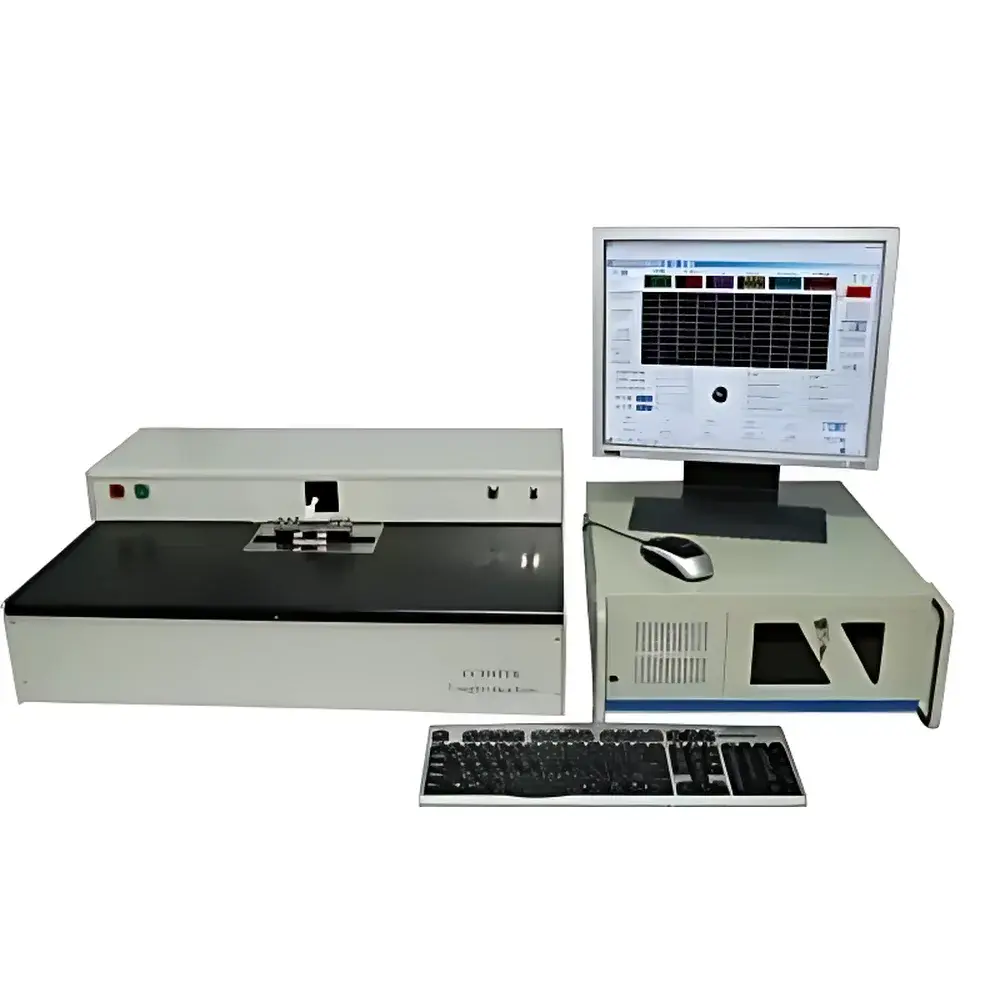
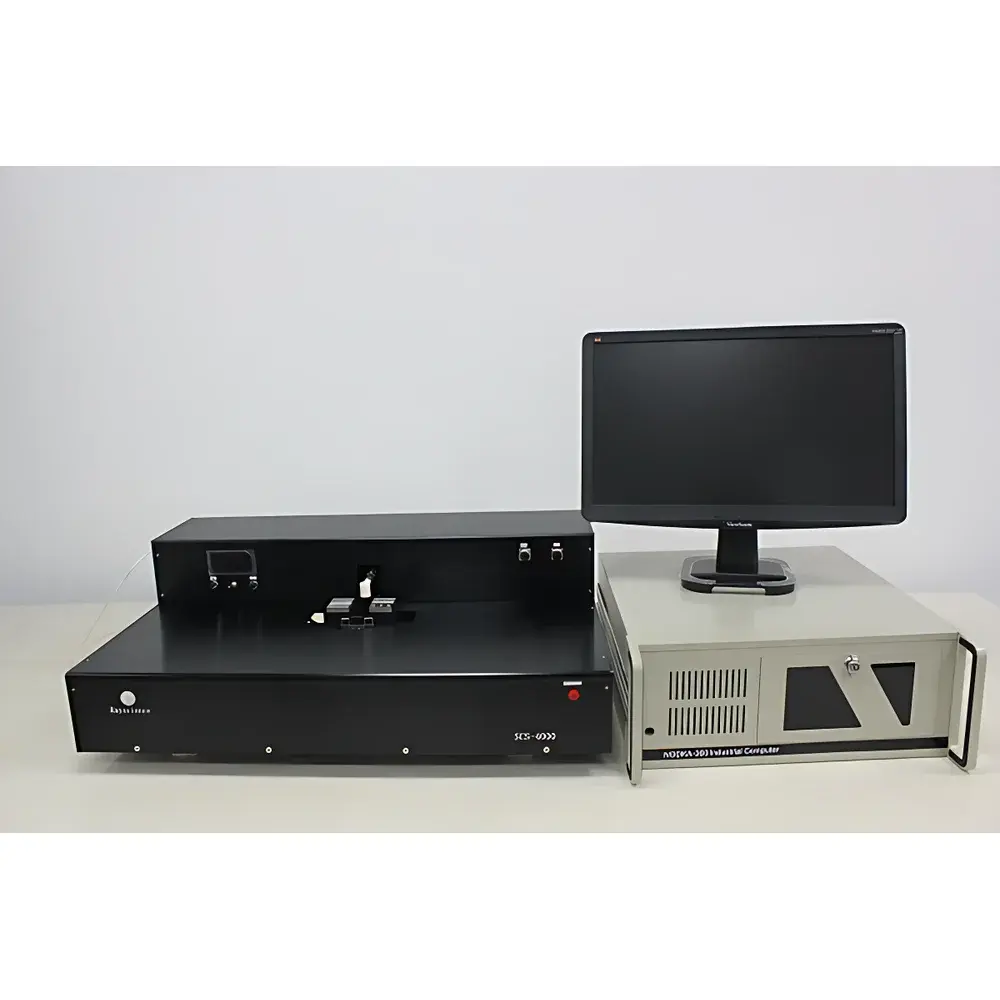
Rayscience SCS-4000-B Large-Core Fiber Fusion Tapering System
| Brand | Rayscience |
|---|---|
| Origin | Shanghai, China |
| Model | SCS-4000-B |
| Product Type | Motorized Translation Stage |
| Compatible Fiber Core/Cladding Diameters | 105/125 µm, 200/220 µm, 400/440 µm, 600/660 µm |
| Numerical Aperture Range | 0.11–0.48 |
| Taper Configuration Support | N×1 (N = 2–7) and (N+1)×1 architectures |
| Heating Source | Hydrogen-Oxygen Flame |
| Control Interface | PC-based Timing Sequencer |
| Power Handling Capacity | Watt-level (scale-dependent on fiber core diameter and NA) |
Overview
The Rayscience SCS-4000-B Large-Core Fiber Fusion Tapering System is a precision-engineered platform designed for the reproducible fabrication of multimode fiber combiners and splitters via controlled flame-based fusion tapering. Unlike conventional single-mode tapering systems optimized for sub-micron mode field control, the SCS-4000-B is specifically architected for large-core fibers—supporting core diameters from 105 µm up to 600 µm and numerical apertures ranging from 0.11 to 0.48. Its operational principle relies on synchronized axial translation and thermal modulation: hydrogen-oxygen flame heating induces localized softening of the fused fiber bundle, while motorized translation stages precisely govern draw speed, tension, and flame positioning in real time. This enables deterministic control over taper transition length, waist geometry, and mode mixing behavior—critical parameters governing insertion loss, coupling uniformity, and power handling capability in high-brightness laser delivery systems.
Key Features
- Motorized dual-axis translation stages with sub-micron positional resolution and programmable velocity profiles (0.1–50 µm/s range), enabling repeatable taper profile generation across diverse core geometries.
- Integrated hydrogen-oxygen flame delivery system with digitally regulated mass flow controllers (MFCs) for precise stoichiometric tuning—ensuring stable flame temperature (~2000 °C) and minimal carbon deposition on fiber surfaces.
- Dedicated fiber clamping fixtures engineered for mechanical stability during high-tension draw processes; modular design accommodates 105/125 µm through 600/660 µm fiber bundles without retooling.
- PC-based timing sequencer software supporting customizable process recipes—including multi-segment draw profiles, flame dwell time modulation, and real-time feedback integration (e.g., via pyrometer or imaging sensor inputs).
- Expandable architecture supporting both standard N×1 configurations (N = 2–7) and advanced (N+1)×1 topologies—enabling asymmetric power splitting, pump-signal combiner integration, or redundant path redundancy schemes.
Sample Compatibility & Compliance
The SCS-4000-B is validated for use with silica-based multimode fibers compliant with IEC 60793-2-10 and Telcordia GR-20-CORE specifications. It accommodates industry-standard large-core fiber formats including 105/125 µm (NA 0.22), 200/220 µm (NA 0.22 or 0.37), 400/440 µm (NA 0.37 or 0.48), and 600/660 µm (NA 0.48). All motion control firmware adheres to IEC 61800-5-1 functional safety requirements for adjustable speed drives. The system supports GLP-compliant operation through audit-trail-enabled recipe logging, user access levels, and timestamped process parameter archives—facilitating traceability in R&D and pre-production environments subject to ISO/IEC 17025 or internal quality management protocols.
Software & Data Management
Control and monitoring are executed via Rayscience’s proprietary TaperPro v3.2 software suite, running on Windows 10/11 x64 platforms. The interface provides real-time visualization of stage position, flame gas flow rates, draw speed, and optional external sensor inputs (e.g., infrared pyrometer output). Process data—including all setpoints, actual trajectories, and alarm events—is logged in HDF5 format with metadata embedding (user ID, timestamp, fiber ID, recipe version). Export options include CSV for statistical process control (SPC) analysis and XML for integration into laboratory information management systems (LIMS). Software architecture conforms to FDA 21 CFR Part 11 requirements for electronic records and signatures when deployed with appropriate IT validation documentation.
Applications
- Fabrication of high-power fiber laser combiners for industrial cutting/welding systems operating at kW-class CW output.
- Development of pump combiners for cladding-pumped Yb-doped fiber amplifiers requiring low-loss, high-NA tolerance.
- R&D of specialty beam homogenizers and mode scramblers used in optical coherence tomography (OCT) source calibration.
- Prototyping of (N+1)×1 architectures for fault-tolerant fiber delivery networks in defense and aerospace laser systems.
- Process qualification studies for ISO 9001-certified photonics component manufacturers seeking repeatability certification under IEC 61300-2-44 (tensile strength) and IEC 61300-2-17 (temperature cycling).
FAQ
What fiber types and coatings are compatible with the SCS-4000-B?
Standard acrylate-, polyimide-, and metal-coated silica multimode fibers are supported. Bare-fiber handling requires optional vacuum chucks; polymer-coated fibers necessitate flame proximity optimization to avoid coating degradation.
Can the system be integrated with in-situ optical monitoring?
Yes—dedicated SMA ports and TTL synchronization outputs enable integration with broadband spectrometers, CCD-based imaging systems, or photodiode arrays for real-time transmission monitoring during taper draw.
Is remote operation and automation possible?
The system supports TCP/IP-based command protocol (SCPI-compliant) for integration into automated test benches and factory-floor MES environments.
Does Rayscience provide application support for custom taper designs?
Yes—application engineering services include taper modeling (using BeamPROP or MODE Solutions), recipe development, and on-site process validation, aligned with customer-defined performance targets (e.g., ≤0.3 dB excess loss at 1070 nm).
What maintenance intervals are recommended for the hydrogen-oxygen subsystem?
Mass flow controllers require annual calibration; flame nozzles should be inspected and cleaned after every 200 operational hours; hydrogen line filters must be replaced per manufacturer specifications (typically every 6 months under continuous use).




