
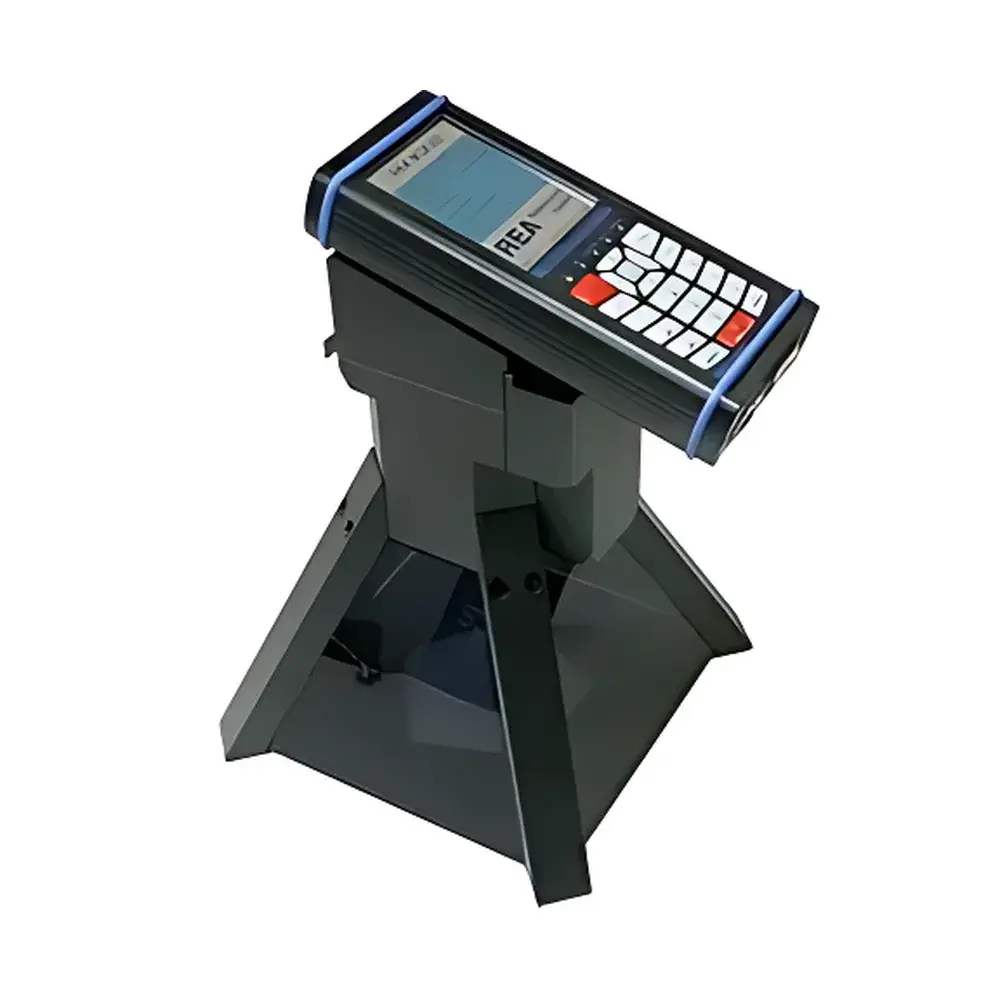
REA MLV-2D Matrix & Linear Barcode Verification System
| Brand | REA |
|---|---|
| Origin | Germany |
| Model | MLV-2D |
| Sensor Resolution | 1280 × 1024 |
| Display | 320 × 240 color LCD |
| Illumination | Red LED (660 nm) or White LED (4000 K) |
| Adjustable Angles | 10° and/or 45° |
| Measurement Areas | 18 × 14 mm, 39 × 31 mm, 56 × 45 mm, or 92 × 52 mm |
| Minimum Module Size | 0.08 mm |
| Compliance | ISO/IEC 15415, ISO/IEC TR 29158 (AIM DPM), ISO/IEC 15416, ANSI X3.182, GS1 General Specifications |
| Operating System | Embedded Linux |
| Processor | ARM9 32-bit |
| RAM/Flash | 32 MB / 32 MB |
| Power | PoE (IEEE 802.3af) via RJ45 |
| Dimensions | 203 × 203 × 300 mm |
| Weight | 1.2 kg |
Overview
The REA MLV-2D is a high-precision, standards-compliant barcode verification system engineered for objective, repeatable assessment of both 2D matrix codes (e.g., DataMatrix, QR Code, GS1 DataMatrix, DPM-matrix) and linear barcodes (e.g., Code 128, GS1-128, EAN-13, ITF-14) in industrial, pharmaceutical, and logistics environments. Unlike basic scanners, the MLV-2D functions as a metrological verification instrument — applying defined optical geometry, calibrated illumination, and standardized decoding algorithms to quantify symbol quality against internationally recognized conformance criteria. Its core measurement principle follows ISO/IEC 15426-1 (for 1D) and ISO/IEC 15426-2 (for 2D), ensuring traceable, auditable results suitable for quality assurance, regulatory submissions, and process validation. The system employs a fixed-focus, high-resolution CMOS imaging sensor (1280 × 1024 pixels) housed in a light-shielded enclosure to eliminate ambient interference — a critical requirement for reliable DPM (Direct Part Marking) evaluation on metallic, anodized, or laser-etched surfaces.
Key Features
- Standards-based verification: Fully compliant with ISO/IEC 15415 (2D), ISO/IEC TR 29158 (AIM DPM), ISO/IEC 15416 (1D), ANSI X3.182, and GS1 General Specifications.
- Configurable illumination: Selectable red (660 nm) or white (4000 K) LED sources, with incident angles of 10° or 45° — programmable per test to match substrate reflectivity and marking method (e.g., dot peen vs. laser etch).
- Modular optical design: Interchangeable camera modules with pre-calibrated focal length and aperture; four field-of-view options (18 × 14 mm to 92 × 52 mm) support verification across diverse label sizes and part geometries.
- Embedded real-time operation: ARM9 32-bit processor running embedded Linux, 32 MB RAM/flash, integrated real-time clock, and PoE-powered operation (IEEE 802.3af) — eliminating external power adapters and enabling seamless integration into factory networks.
- On-device visualization: Integrated 320 × 240 color LCD displays pass/fail status, grade (A–F), individual parameter scores (e.g., contrast, modulation, decodability), and decoded data — without requiring host software.
- Hardware-level quality indicators: Dedicated green/yellow/red LEDs provide immediate visual feedback for Pass / Warning / Fail outcomes, supporting rapid line-side decision-making.
Sample Compatibility & Compliance
The MLV-2D accommodates a broad range of symbologies and substrates, including high-contrast printed labels, low-contrast direct-part marks (DPM) on automotive components, medical devices, and aerospace parts, and variable-data GS1-encoded packaging. Its optical shielding and controlled illumination ensure stable performance under non-ideal ambient conditions — essential for shop-floor deployment. Regulatory alignment extends beyond ISO standards: verification reports generated by TransWin32 software include full audit trails, timestamped results, operator ID fields, and configurable digital signatures — supporting GLP/GMP documentation requirements and FDA 21 CFR Part 11 readiness when deployed with appropriate IT controls. All firmware and calibration parameters are stored internally and retained across power cycles, preserving measurement integrity during routine maintenance or relocation.
Software & Data Management
The MLV-2D operates natively via its embedded interface but integrates fully with REA’s TransWin32 verification software (Windows-based). TransWin32 enables advanced configuration, batch reporting, statistical process control (SPC) charting, and export to CSV, PDF, or XML formats — compatible with MES and QMS platforms. Reports include full ISO parameter breakdowns (e.g., Symbol Contrast, Cell Modulation, Grid Distortion, Decodability), decoded content, image capture, and pass/fail summary per GS1 or ISO grading rules. Network communication uses standard TCP/IP over RJ45, allowing remote configuration, firmware updates, and centralized result aggregation across multi-site deployments. No proprietary drivers or middleware are required — the device appears as a standard network endpoint with HTTP and FTP server capabilities.
Applications
- Pharmaceutical packaging verification: Ensuring GS1 DataMatrix compliance on secondary packaging per EU FMD and US DSCSA requirements.
- Automotive supplier audits: Validating DPM codes on engine blocks, brake calipers, and transmission housings per AIAG B-17 and OEM-specific DPM specifications.
- Medical device UDI compliance: Verifying permanent 2D markings on surgical instruments and implants according to ISO/IEC TR 29158 and FDA UDI rule Annex A.
- Electronics manufacturing: Confirming solder paste stencil readability and PCB component labeling accuracy prior to AOI and functional testing.
- Logistics and warehousing: Pre-shipment verification of GS1-128 shipping labels and pallet identifiers to prevent ASN rejection at distribution centers.
FAQ
Does the MLV-2D require annual recalibration?
No — the system uses factory-calibrated, fixed-focus optics and stable LED sources. REA recommends periodic verification using NIST-traceable test targets (e.g., ISO/IEC 15415 verification cards), which can be performed in-house. Full recalibration is only necessary after physical impact or environmental exposure exceeding IP-rated limits.
Can it verify codes marked with laser annealing on stainless steel?
Yes — the 10° illumination angle and red LED source optimize contrast detection on low-reflectance, thermally altered surfaces common in medical device DPM applications.
Is TransWin32 software included with the instrument?
Yes — a single-user license is supplied with each MLV-2D unit. Volume licensing and enterprise deployment options (e.g., concurrent user servers, API integration) are available upon request.
What network security protocols does it support?
The device supports static IP assignment, DHCP, DNS, and basic HTTP authentication. For environments requiring TLS or VLAN segmentation, it operates transparently behind enterprise firewalls and proxy servers without embedded encryption dependencies.
How is firmware updated?
Updates are delivered as signed binary files via FTP or HTTP upload through TransWin32 or directly via browser interface. Each update includes version logging, rollback capability, and checksum validation to ensure integrity.



