
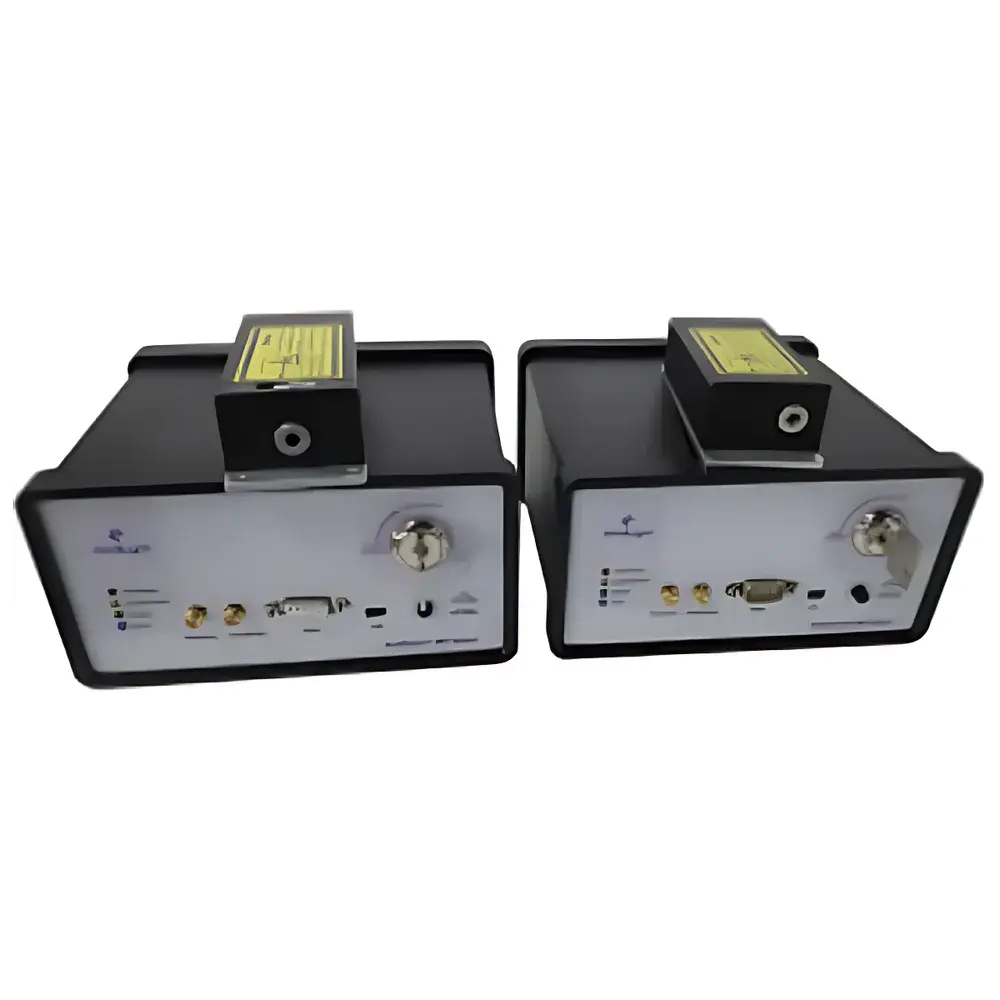
RealLight MCJ Series 1-ns Subnanosecond Passively Q-Switched Microchip Laser
| Brand | RealLight |
|---|---|
| Origin | Beijing, China |
| Model | MCJ Series |
| Wavelengths | 1030 nm / 515 nm / 343 nm / 257 nm |
| Pulse Width | ≤800 ps (typ.) |
| Repetition Rate | up to 2 kHz |
| Pulse Energy | up to 100 µJ |
| Average Power | up to 100 mW |
| Beam Mode | TEM₀₀ |
| Beam Divergence (full angle, 1/e²) | ≤6 mrad (horizontal), ≤6 mrad (vertical) |
| Polarization Ratio | >100:1 |
| Power Stability (8 h) | ±3% |
| Trigger Interface | TTL 5 V, SMA |
| Power Input | 100–240 VAC, 50/60 Hz |
| Control Interface | RS232, USB |
| System Power Consumption | ≤15 W |
| Laser Head Dimensions (W×H×L) | 45 × 30 × 120 mm |
| Power Supply Dimensions (W×H×L) | 168 × 88 × 140 mm |
| Operating Temperature | 15–35 °C |
| Storage Temperature | 0–60 °C |
| Integrated Sealed Module | Yes |
| Optional Built-in Beam Expander | Available (divergence <2 mrad) |
Overview
The RealLight MCJ Series is a family of passively Q-switched, diode-pumped solid-state (DPSS) microchip lasers engineered for high temporal fidelity and spatial coherence in demanding scientific and industrial applications. Based on monolithic Nd:YAG or Nd:YVO₄ gain media with saturable absorber integration, the MCJ architecture delivers transform-limited subnanosecond pulses without trailing edge artifacts—enabling precise time-resolved measurements where pulse purity and shot-to-shot stability are critical. Each variant operates at harmonically related wavelengths: fundamental 1030 nm (Nd-doped), second-harmonic 515 nm, third-harmonic 343 nm, and fourth-harmonic 257 nm—achieved via intracavity or external nonlinear frequency conversion. The laser head features a fully sealed, alignment-free optical cavity with integrated pump diode and crystal assembly, minimizing sensitivity to thermal drift and mechanical perturbation. This robust monolithic design supports OEM integration into compact instruments such as time-of-flight spectrometers, LIBS systems, and fluorescence lifetime analyzers.
Key Features
- Subnanosecond pulse generation: typical pulse width ≤800 ps across all wavelengths, with near-Fourier-transform-limited temporal profiles
- High pulse energy stability: ≤±3% RMS power fluctuation over 8-hour continuous operation, verified under controlled ambient conditions (23 ±1 °C)
- TEM₀₀ spatial mode with M² < 1.1, ensuring diffraction-limited focusing for high-intensity applications
- Compact, modular form factor: laser head dimensions of only 45 × 30 × 120 mm facilitate integration into space-constrained platforms
- Dual triggering capability: configurable rising-edge TTL input (for repetition rates 20 kHz), compatible with standard DAQ systems
- Hermetically sealed internal module enables customer-side secondary development—including fiber coupling, spectral filtering, or custom harmonic extraction
- Optional integrated beam expander available to reduce full-angle divergence to <2 mrad (1/e²), supporting long-working-distance applications
Sample Compatibility & Compliance
The MCJ Series is designed for use with optically transparent, reflective, or scattering samples in both free-space and fiber-coupled configurations. Its narrow linewidth (100 kW at 100 µJ/800 ps) make it suitable for nonlinear excitation, ablation threshold studies, and plasma generation. While not classified as a medical device, the system complies with IEC 60825-1:2014 Class 4 laser safety requirements when operated within specified enclosure and interlock configurations. All models meet CE marking directives for electromagnetic compatibility (EN 55032, EN 55035) and low-voltage safety (EN 62368-1). For regulated environments—including GLP-compliant analytical labs or ISO 17025-accredited testing facilities—the laser supports audit-ready operation via RS232/USB logging of trigger timestamps, output energy estimates (via internal photodiode feedback), and thermal status reporting.
Software & Data Management
The MCJ Series includes RealLight’s proprietary LaserControl Suite—a cross-platform application (Windows/macOS/Linux) for remote parameter configuration, real-time monitoring, and event logging. Through USB or RS232, users can adjust repetition rate (in 1-Hz increments), enable/disable external triggering, and query internal diagnostics including diode temperature, crystal temperature, and pulse count. All communication follows a documented ASCII command protocol, enabling seamless integration with LabVIEW, Python (PySerial), MATLAB, or custom C++ instrument control frameworks. Audit trails include timestamped command history and system state snapshots, supporting compliance with FDA 21 CFR Part 11 requirements when deployed with appropriate electronic signature and access control layers. Firmware updates are delivered via signed binary packages with SHA-256 verification.
Applications
- Time-resolved spectroscopy: Pump-probe experiments requiring <1 ns jitter and high pulse-to-pulse consistency
- Laser-induced breakdown spectroscopy (LIBS): High peak intensity at 257 nm and 343 nm enables efficient ablation of dielectric and metallic targets
- Fluorescence lifetime imaging (FLIM): 1030 nm and 515 nm variants serve as stable excitation sources for TCSPC systems
- Micro-machining and surface texturing: Sub-µm feature resolution enabled by diffraction-limited focusing and minimal thermal load
- LIDAR and rangefinding: High-repetition-rate operation at 1030 nm supports multi-kilometer atmospheric backscatter profiling
- Optical parametric oscillator (OPO) pumping: Stable single-longitudinal-mode seeding for tunable mid-IR generation
FAQ
What is the maximum achievable pulse energy at 257 nm?
At 257 nm, the MCJ-257-1-008 model delivers up to 8 µJ per pulse at 1 kHz repetition rate. Pulse energy scales linearly with average power up to the thermal limits of the nonlinear crystal.
Can the laser be synchronized with external equipment such as ICCD cameras or streak cameras?
Yes—TTL-compatible trigger output (5 V, 50 Ω) provides <1 ns jitter relative to pulse emission, with programmable delay (0–10 ms, 100-ps resolution) via software control.
Is wavelength tuning possible within a given MCJ model?
No—each MCJ variant is fixed-wavelength by design. Tunability requires external OPO or difference-frequency generation stages.
Does the system support analog modulation of pulse energy or repetition rate?
No—repetition rate and pulse energy are digitally set via serial interface. Analog modulation is not supported due to the passive Q-switching mechanism.
What maintenance is required during normal operation?
None beyond periodic cleaning of output window optics using certified laser-grade solvents and lint-free wipes. No consumables, alignments, or recalibrations are needed under specified environmental conditions.





