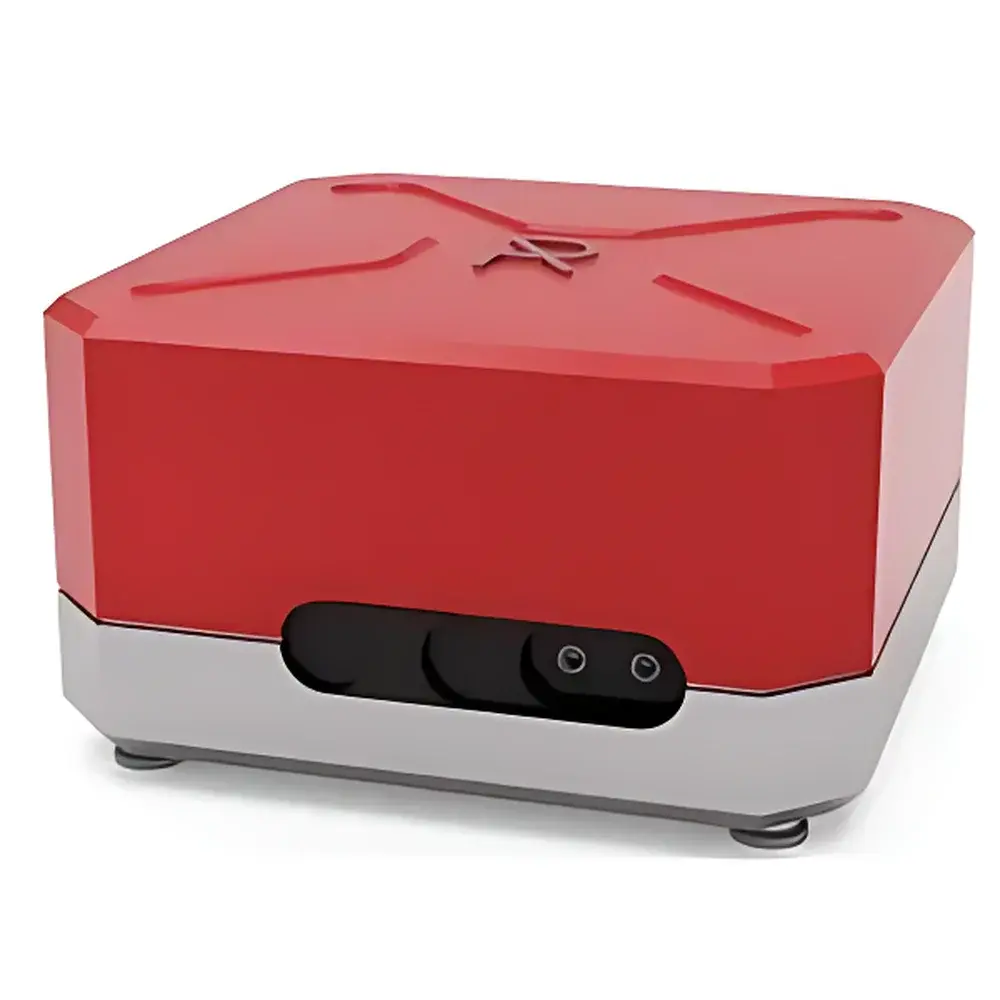
refined-laser CRS Dual-Color Fiber Laser System for Coherent Raman Microscopy
| Origin | Germany |
|---|---|
| Manufacturer Type | Authorized Distributor |
| Origin Category | Imported |
| Model | refinede laser |
| Instrument Classification | Upright/Inverted Integrated Microscope |
| Price Range | USD 1–2,999 |
Overview
The refined-laser CRS Dual-Color Fiber Laser System is an engineered solution for coherent Raman scattering (CRS) microscopy—specifically optimized for label-free, chemically selective imaging of biological tissues and live cells. Unlike fluorescence-based modalities, CRS relies on inelastic scattering from molecular vibrational modes, enabling direct visualization of endogenous biomolecules—including lipids, proteins, and nucleic acids—without exogenous dyes or genetic labeling. This system implements a fully fiber-integrated, dual-wavelength pulsed laser architecture based on photonic crystal fiber (PCF)-driven wavelength conversion, delivering synchronized, time-overlapped picosecond pulses at two independently tunable near-infrared wavelengths. Its design adheres to the physical requirements of both coherent anti-Stokes Raman scattering (CARS) and stimulated Raman scattering (SRS) modalities, supporting high-fidelity vibrational contrast with minimal thermal load and no mechanical delay lines.
Key Features
- Fully fiber-coupled architecture: Eliminates free-space alignment; enables robust, maintenance-free operation under variable environmental conditions.
- Sub-5 ms wavelength tuning: Achieves rapid spectral switching across the 700–1100 nm range via PCF-based parametric generation—enabling real-time multi-vibrational imaging at up to 100 user-defined Raman shifts per second.
- Passively stabilized polarization-maintaining (PM) fiber delivery: Ensures consistent temporal overlap (<100 fs jitter) between pump and Stokes beams—critical for CARS phase matching and SRS background suppression.
- Compact, shock-resistant enclosure: Validated for mechanical shock resistance up to 25 m/s²; suitable for integration into mobile or clinical-grade imaging platforms without optical tables.
- Plug-and-play compatibility: Designed as a turnkey laser engine for OEM integration with commercial laser scanning microscopes (e.g., Zeiss LSM, Nikon A1R, Leica SP8), supporting standard TTL and analog synchronization interfaces.
- Air-cooled laser head: No external chiller required; operational noise <45 dB(A); footprint <280 × 220 × 120 mm.
Sample Compatibility & Compliance
The system supports native imaging of unstained, unfixed, and live biological specimens—including primary neurons, organoids, skin explants, and zebrafish embryos—without phototoxicity or bleaching artifacts. Its non-ionizing NIR excitation (typically 750–1050 nm) complies with ISO 60825-1:2014 Class 4 laser safety standards when integrated with appropriate interlocks and beam containment. For regulated environments, the laser’s deterministic pulse timing and stable output power enable traceable calibration against NIST-traceable Raman standards (e.g., cyclohexane, polystyrene). While not inherently GLP/GMP-certified, the system’s deterministic behavior and firmware-logged operational parameters support audit-ready documentation workflows aligned with FDA 21 CFR Part 11 requirements when deployed within validated microscope platforms.
Software & Data Management
The refined-laser system interfaces via USB 2.0 and Ethernet with third-party acquisition software (e.g., LabVIEW, MATLAB, Python-based ScanImage or Napari plugins). All tuning parameters—including central wavelength, pulse energy, repetition rate (fixed at 80 MHz), and inter-pulse delay—are programmable through a RESTful API. Real-time monitoring of output power stability (±1.5% RMS over 8 hours) and internal temperature is logged to CSV-compatible diagnostic files. Optional synchronization modules provide hardware-triggered timestamping compatible with high-speed sCMOS detectors and resonant scanners, ensuring sub-pixel registration accuracy across multi-channel vibrational acquisitions.
Applications
- Lipid metabolism studies: Quantitative SRS imaging of neutral lipid droplets in adipocytes and hepatocytes, enabling dynamic tracking of lipolysis and esterification at single-cell resolution.
- Drug distribution kinetics: Label-free mapping of small-molecule transport across stratified epithelia—e.g., differential penetration of DMSO vs. retinoic acid through murine stratum corneum—supporting preclinical transdermal formulation development.
- Neurodegenerative pathology: Simultaneous CARS (CH₂ stretch, 2845 cm⁻¹) and TPEF (NADH, 460 nm) imaging to correlate lipid accumulation with mitochondrial redox state in Alzheimer’s disease models.
- Intraoperative guidance: Real-time CRS imaging during ex vivo tissue resection to distinguish tumor margins based on intrinsic protein/lipid ratios—validated in glioblastoma and basal cell carcinoma specimens.
- Developmental biology: Long-term time-lapse SRS imaging of lipid droplet dynamics in zebrafish yolk syncytial layer, revealing spatiotemporal regulation of embryonic energy metabolism.
FAQ
Is this laser system compatible with existing confocal or multiphoton microscopes?
Yes—it delivers collimated, polarization-maintained, fiber-coupled output compatible with standard dichroic mirrors and scan head inputs. Integration requires only alignment of the fiber tip to the microscope’s laser port and configuration of TTL sync signals.
What Raman shifts can be accessed with this system?
The system covers vibrational bands from ~500 cm⁻¹ (C–C stretch) to ~3100 cm⁻¹ (C–H stretch) via continuous tuning of pump and Stokes wavelengths, with optimal signal-to-noise in the 2700–3000 cm⁻¹ region relevant to lipid and protein detection.
Does the system include beam delivery optics or microscope integration support?
No—the refined-laser unit is a laser engine only. Full microscope integration—including objective selection, detector coupling, and spectral filtering—is performed by the end-user or OEM partner.
Can the system be used for both CARS and SRS simultaneously?
It supports either modality, but not concurrently: CARS requires precise phase matching and background suppression optics, while SRS demands balanced detection and lock-in amplification. Switching between modes requires reconfiguration of the detection path.
What maintenance is required for long-term operation?
None beyond periodic inspection of fiber connectors and cleaning of protective windows. The all-fiber design eliminates alignment drift, thermal lensing, or moving parts—typical mean time between failures exceeds 20,000 hours.
Related Products