
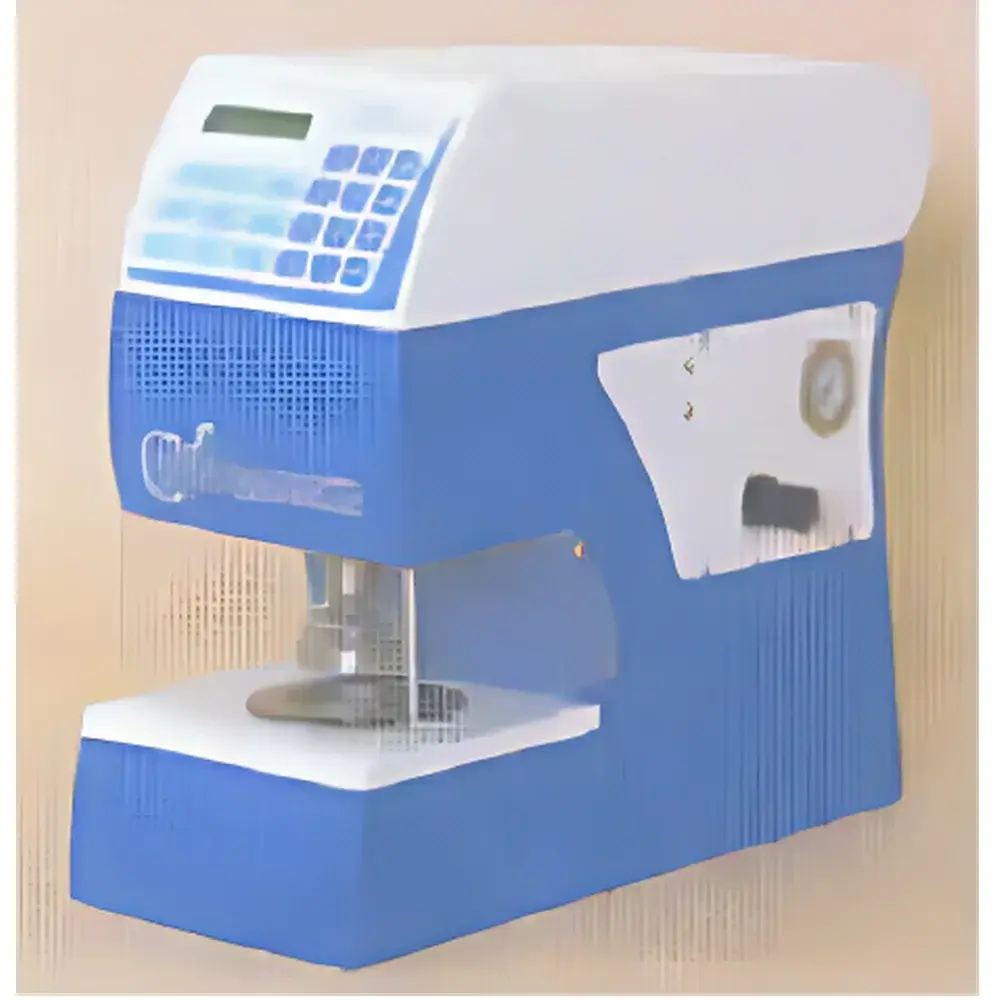
Regmed MTA-2000C Bursting Strength Tester
| Origin | Spain |
|---|---|
| Manufacturer Type | Authorized Distributor |
| Origin Category | Imported Instrument |
| Model | MTA-2000C |
| Pricing | Available Upon Request |
Overview
The Regmed MTA-2000C Bursting Strength Tester is a precision-engineered instrument designed for the quantitative determination of bursting strength in paper, board, and corrugated packaging materials. It operates on the principle of hydraulic pressure application through a flexible diaphragm (elastomeric rubber membrane), which uniformly transmits force to a clamped circular specimen until rupture occurs. This method conforms to fundamental physical testing paradigms defined in international standards—including ISO 2758 (paper), ISO 2759 (corrugated fiberboard), TAPPI T-403 and T-810, NBR 7150 and NBR 13149, and SCAN P24—ensuring metrological traceability and inter-laboratory comparability. The MTA-2000C integrates a closed-loop hydraulic system with pneumatic clamping, eliminating manual torque variability and enhancing repeatability across operator shifts. Its architecture prioritizes mechanical stability, thermal drift mitigation, and long-term calibration integrity—critical attributes for QC laboratories operating under GLP or GMP frameworks.
Key Features
- Integrated microprocessor-controlled test sequence with embedded firmware; no external PC required for routine operation
- Dual-mode pressure actuation: programmable burst threshold (20–100% of full-scale) with real-time pressure ramp monitoring
- Pneumatically actuated clamping system delivering consistent 430 kPa clamping pressure, minimizing specimen slippage and edge deformation
- High-fidelity pressure transducer with 0.01 kPa resolution and calibrated range of 70–1350 kPa, traceable to national metrology institutes
- Compliant elastomeric diaphragm (30 ± 10 kPa deflection per 9 mm displacement) meeting ISO 2758 Annex A requirements for membrane compliance verification
- Mechanically interlocked safety guard with dual-sensor inhibition—halts pressurization immediately upon lid opening
- RS-232 serial interface and parallel printer port supporting ASTM E1382-compliant data export for audit-ready reporting
- On-device statistical engine: calculates mean, standard deviation, coefficient of variation, and min/max values across up to 99 test cycles
Sample Compatibility & Compliance
The MTA-2000C accommodates standard test specimens of 100 mm diameter (per ISO 2758) or 140 mm (per ISO 2759), with automatic centering alignment ensured by concentric clamping geometry. It supports both single-ply and multi-ply substrates—including coated papers, linerboards, test liners, and recycled fiberboards—without adjustment. All mechanical and electronic components comply with IEC 61000-6-2 (immunity) and IEC 61000-6-4 (emissions) for industrial environments. The instrument’s design and validation documentation align with ISO/IEC 17025 clause 6.4.10 (equipment verification) and support FDA 21 CFR Part 11 readiness when paired with Regmed’s optional validated software module (MTA-SW-LAB v3.2). Calibration procedures follow ISO 9556 and are compatible with accredited third-party service providers.
Software & Data Management
While functional as a standalone unit, the MTA-2000C supports bidirectional communication via RS-232 for integration into centralized LIMS or MES platforms. Its native firmware enables user-defined test protocols, including pre-test dwell time, ramp rate selection, and pass/fail criteria based on configurable bursting strength thresholds. Exported ASCII data files include timestamp, operator ID, specimen ID, raw pressure curve (sampled at 100 Hz), burst point, and statistical summary—structured to meet internal SOPs and external regulatory submission requirements (e.g., ISO 9001 Clause 8.5.2, USP ). Audit trails are retained locally for ≥12 months, with optional encrypted SD card logging for extended retention.
Applications
This tester serves critical quality assurance functions across packaging R&D, production line release testing, supplier qualification, and regulatory compliance verification. Typical use cases include: evaluating pulp refining efficiency via correlation between burst index and freeness (CSF); validating recycled fiber performance after multiple repulping cycles; assessing coating adhesion integrity under hydrostatic stress; benchmarking sustainable packaging alternatives (e.g., molded fiber trays, bamboo-based boards); and generating technical dossiers for FSC or PEFC chain-of-custody certification. Its reproducibility (CV ≤ 1.8% per ISO 2758 interlaboratory studies) makes it suitable for round-robin testing programs coordinated by TAPPI or CEPI.
FAQ
What standards does the MTA-2000C directly support?
ISO 2758, ISO 2759, TAPPI T-403, TAPPI T-810, NBR 7150, NBR 13149, and SCAN P24.
Is the hydraulic fluid included with shipment?
Yes—250 mL of certified silicone oil (ISO VG 10 grade, viscosity stable from −20 °C to +120 °C) is supplied with each unit.
Can the instrument be recalibrated in-house?
Yes—using Regmed’s NIST-traceable pressure reference kit (PCK-MTA-2000, sold separately) and built-in calibration mode accessible via service menu.
What safety certifications apply to the MTA-2000C?
CE marked per Machinery Directive 2006/42/EC and Low Voltage Directive 2014/35/EU; meets EN 61000-1-2 for electromagnetic compatibility.
Does the device support GLP-compliant electronic signatures?
When operated with Regmed’s optional MTA-SW-LAB v3.2 software and Windows-based host system, full 21 CFR Part 11 compliance—including role-based access control and immutable audit logs—is achievable.





