
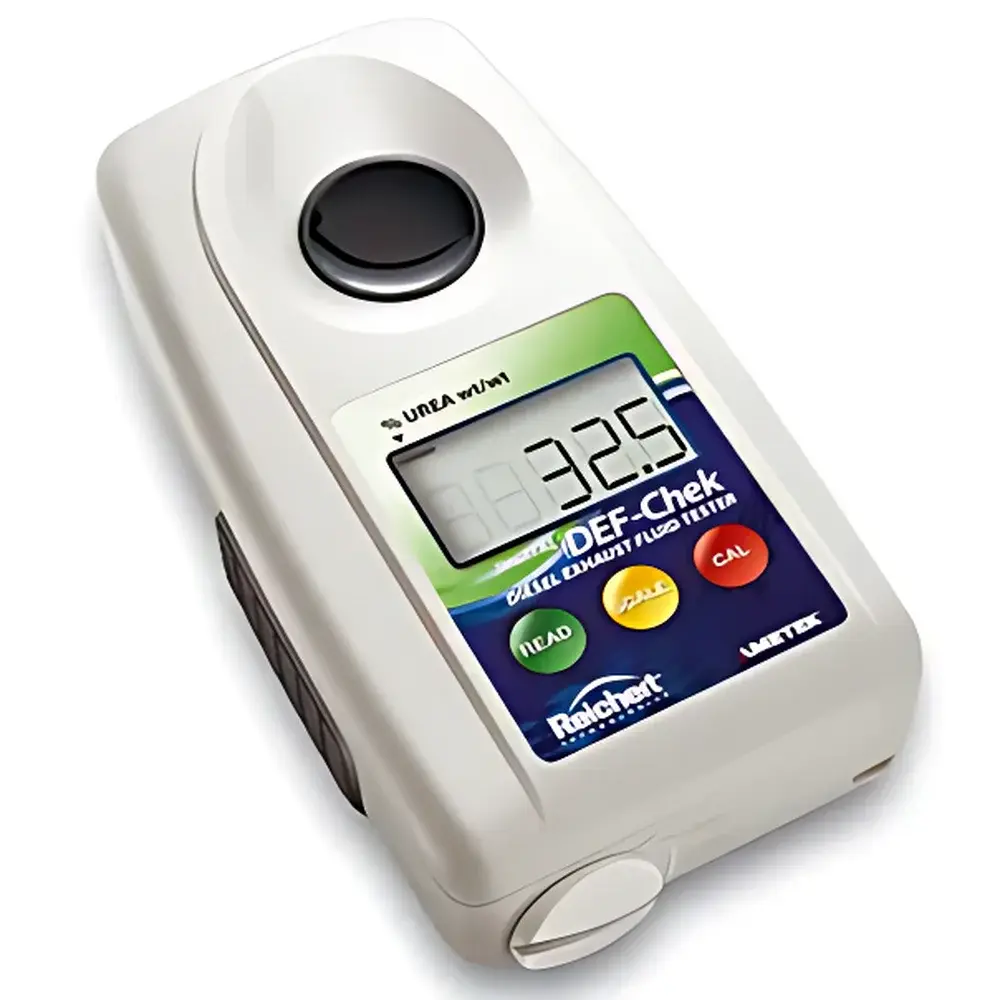
Reichert DEF-Chek Digital Handheld Refractometer for Diesel Exhaust Fluid (DEF) Analysis
| Brand | Reichert |
|---|---|
| Origin | USA |
| Model | DEF-Chek |
| Product Type | Handheld Digital Refractometer |
| Temperature Compensation | Automatic (ATC, 20 °C reference) |
| Display | Digital LCD |
| Measurement Range | 0.0 – 50.0% w/w urea in deionized water |
| Accuracy | ±0.1% w/w |
| Light Source | 589 nm LED (sodium-D line equivalent) |
| Dimensions | 54 × 27 × 100 mm |
| Compliance | Designed for ASTM D7596, ISO 22241-2, and US EPA/ULEV regulatory verification protocols |
Overview
The Reichert DEF-Chek is a purpose-engineered handheld digital refractometer optimized exclusively for the rapid, field-deployable quantification of urea concentration in Diesel Exhaust Fluid (DEF). It operates on the fundamental optical principle of critical angle refractometry: as light passes from a high-refractive-index prism into a DEF sample, the angle at which total internal reflection occurs correlates directly with the solution’s refractive index—and thus, its urea mass fraction (w/w %). Calibrated specifically to the sodium-D wavelength (589 nm), the instrument delivers traceable, repeatable measurements aligned with the thermodynamic behavior of aqueous urea solutions across ambient operating temperatures. Its design addresses a critical metrological requirement in modern emissions control: maintaining DEF composition at precisely 32.5% ± 0.5% w/w urea, as mandated by ISO 22241-1 and enforced under U.S. EPA Tier 4 Final, EU Euro VI, and Japanese MLIT regulations. Deviation outside this tolerance compromises Selective Catalytic Reduction (SCR) catalyst efficiency, risks ammonia slip, and may trigger onboard diagnostic (OBD) fault codes or non-compliance penalties.
Key Features
- Optimized optical path with temperature-stabilized sapphire prism and 589 nm monochromatic LED illumination—minimizing spectral drift and ensuring compliance with ISO 22241-2 spectral requirements.
- Automatic Temperature Compensation (ATC) referenced to 20 °C, compensating for thermal expansion effects across typical field conditions (10–40 °C) without manual recalibration.
- Digital LCD display with 0.1% resolution and ±0.1% w/w accuracy—validated against NIST-traceable urea standard solutions per ASTM D7596 Annex A1.
- Compact, ruggedized housing (54 × 27 × 100 mm) with IP65-rated sealing—suitable for shop-floor, depot, and roadside use in high-vibration, dust-prone environments.
- One-button operation with <5-second measurement cycle—enabling high-throughput verification during DEF dispensing, bulk storage receipt, or post-refill quality checks.
- No consumables or reagents required; calibration verified using deionized water (nD = 1.3330 at 20 °C) prior to each shift or after thermal shock.
Sample Compatibility & Compliance
The DEF-Chek is validated for direct measurement of commercially supplied DEF formulations—including AdBlue®, ARLA 32®, AUS-32®, and generic ISO 22241-compliant fluids—without dilution or pretreatment. It rejects interference from common contaminants (e.g., glycols, surfactants, or metal ions) below threshold levels defined in ISO 22241-3. The device meets functional requirements outlined in ISO 22241-2 (Section 6.3.2) for field-use refractometers and supports GLP-aligned documentation when paired with external logging systems. While not a certified metrology standard itself, its measurement uncertainty budget (<0.15% w/w expanded uncertainty, k=2) satisfies the verification hierarchy specified in EPA 40 CFR Part 1065 for in-service DEF quality assurance.
Software & Data Management
The DEF-Chek operates as a standalone instrument with no embedded software or connectivity. However, its deterministic analog-to-digital conversion architecture ensures full auditability: all readings are stable, non-volatile, and human-readable within 3 seconds of sample application. For regulated environments requiring electronic records, users may integrate manual entry into LIMS or QMS platforms compliant with FDA 21 CFR Part 11 (via secure, time-stamped logbooks) or ISO/IEC 17025 documentation workflows. Calibration history, operator ID, and ambient temperature can be recorded alongside each measurement to satisfy traceability requirements in GMP-aligned fleet maintenance programs.
Applications
- Pre-dispensing verification at DEF bulk terminals and retail fuel stations.
- Incoming goods inspection at vehicle OEM assembly plants and Tier-1 SCR system suppliers.
- On-vehicle DEF tank audits during routine service intervals (e.g., Class 8 truck fleets, municipal bus depots).
- Field troubleshooting of SCR-related NOx conversion inefficiencies or urea crystallization events.
- Training and certification labs delivering ISO 22241 competency modules for diesel technicians.
- Third-party testing laboratories performing conformity assessments per EN 15971 or JIS K 2250.
FAQ
Does the DEF-Chek require periodic factory recalibration?
No—its solid-state optical design and ATC algorithm eliminate drift-related recalibration needs. Users verify calibration daily using deionized water before first use.
Can it measure DEF contaminated with diesel fuel or engine oil?
No. Hydrocarbon contamination alters refractive index nonlinearly and invalidates the urea calibration curve. Samples must be optically clear and free of phase separation.
Is the 589 nm LED source stable over time?
Yes. The LED’s spectral half-width (10,000 measurement cycles without recalibration.
How does it comply with ISO 22241-2’s “reference method” requirement?
It serves as a field screening tool aligned with the refractometric reference method (Annex B), not a replacement for laboratory-grade HPLC or titration—but provides sufficient accuracy for pass/fail decisions at specification limits.
What is the minimum sample volume required?
Approximately 0.05 mL—sufficient to cover the prism surface completely without overflow or air gaps.




