
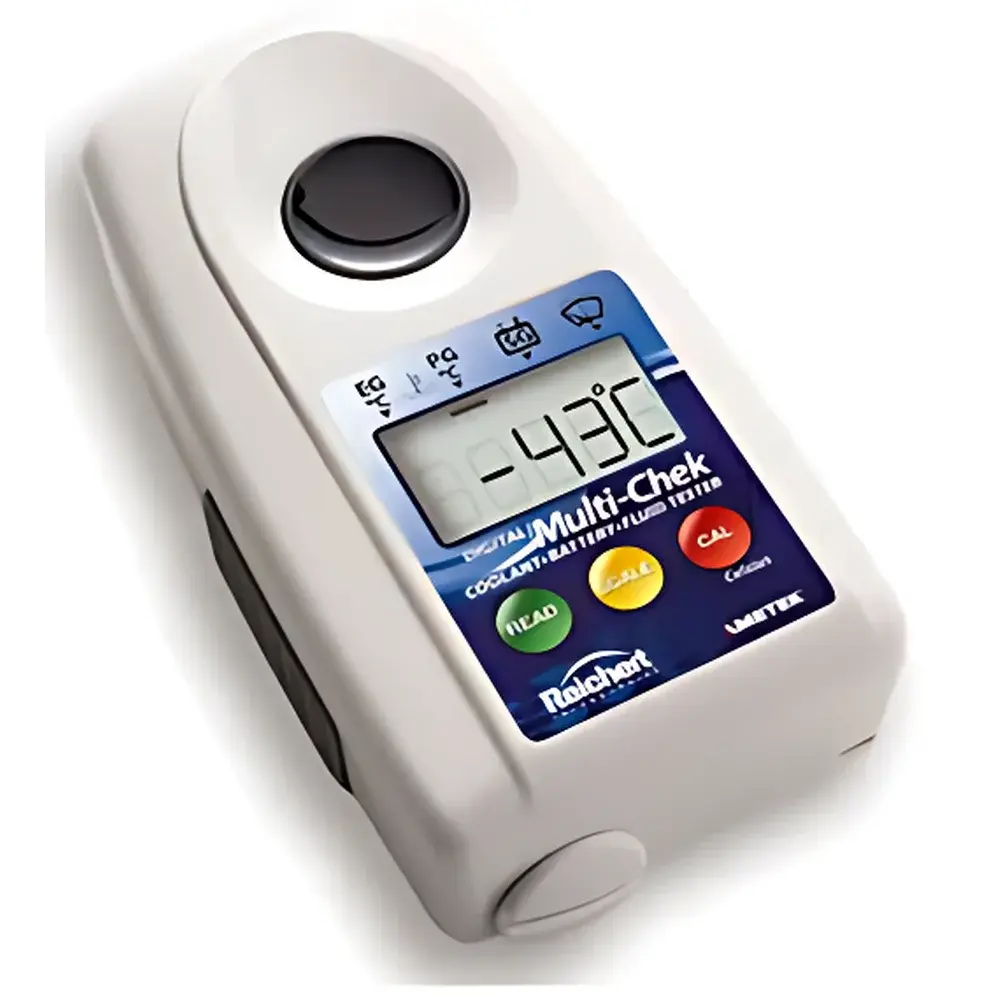
Reichert Multi-Chek Digital Handheld Coolant Refractometer
| Brand | Reichert |
|---|---|
| Origin | USA |
| Model | Multi-Chek |
| Type | Handheld Digital Refractometer |
| Temperature Control | Yes (ATC) |
| Display | Digital LCD |
| Measurement Range | EG freeze point: 0 to –57 °C |
| PG freeze point | 0 to –51 °C |
| Battery electrolyte SG | 1.000–1.463 |
| Windshield washer fluid freeze point | 0 to –54 °C |
| Accuracy | ±0.3 °C (EG/PG), ±0.003 SG (battery), ±1 °C (washer fluid) |
| Light Source | 589 nm LED |
| ATC Reference | 20 °C |
| IP Rating | IP65 |
| Compliance | CE, RoHS, WEEE |
| Power | 2 × AAA batteries (included) |
| Battery Life | ~10,000 measurements |
| Dimensions | 54 × 27 × 100 mm |
| Weight | 100 g |
Overview
The Reichert Multi-Chek Digital Handheld Coolant Refractometer is a precision optical instrument engineered for rapid, field-deployable analysis of automotive and industrial fluid formulations. Based on the fundamental principle of critical-angle refractometry, it quantifies the refractive index of transparent liquids—directly correlating to solute concentration and freezing point depression in aqueous glycol solutions. Unlike empirical tools such as hydrometers or test strips, the Multi-Chek applies temperature-compensated optical measurement at a standardized sodium-D wavelength (589 nm), ensuring traceable, repeatable results across diverse coolant chemistries—including ethylene glycol (EG), propylene glycol (PG), battery electrolytes, and windshield washer fluids. Its solid-state LED illumination, integrated automatic temperature compensation (ATC) referenced to 20 °C, and ruggedized optical path eliminate operator-dependent variables common in analog refractometers. Designed for frontline technical use in service bays, fleet maintenance centers, and quality control labs, the device delivers laboratory-grade reliability without requiring calibration fluids or external power sources.
Key Features
- Dual-glycol capability: Simultaneous calibrated scales for ethylene glycol (EG) freeze point: 0 to –57 °C and propylene glycol (PG) freeze point: 0 to –51 °C, both with ±0.3 °C accuracy.
- Battery electrolyte mode: Measures specific gravity (SG) from 1.000 to 1.463 with ±0.003 SG resolution—fully aligned with SAE J2347 and ASTM D3242 standards for lead-acid battery state-of-charge assessment.
- Windshield washer fluid mode: Dedicated scale for freeze point determination (0 to –54 °C, ±1 °C), supporting ISO 6976-compliant winterization verification.
- True automatic temperature compensation (ATC): Solid-state thermistor network dynamically corrects refractive index readings in real time, referenced to 20 °C per ISO 21748 and ASTM D115.
- Ruggedized field design: IP65-rated enclosure ensures resistance to dust ingress and low-pressure water jets; rubberized grip and detachable neck strap enhance ergonomics during extended use.
- Low-power architecture: Operates on two standard AAA batteries (included), supporting up to 10,000 measurements before replacement; auto-sleep mode activates after 90 seconds of inactivity.
Sample Compatibility & Compliance
The Multi-Chek is validated for use with homogeneous, non-turbid aqueous solutions commonly found in automotive and light-industrial applications. It accepts samples as small as 0.05 mL applied directly to the sapphire prism surface. Compatibility includes ethylene glycol–water and propylene glycol–water mixtures (up to 70% v/v), sulfuric acid–water electrolytes (1.000–1.463 SG), and methanol/isopropanol–water windshield washer formulations. The instrument conforms to CE marking requirements under the EU Electromagnetic Compatibility Directive 2014/30/EU and Low Voltage Directive 2014/35/EU. It meets RoHS 2011/65/EU restrictions on hazardous substances and WEEE 2012/19/EU take-back obligations. While not FDA 21 CFR Part 11–certified (as it generates no electronic records), its measurement traceability aligns with GLP principles for field-based QC documentation.
Software & Data Management
The Multi-Chek is a standalone, embedded-system instrument with no onboard data logging, Bluetooth, or USB connectivity. All measurements are displayed in real time on a high-contrast monochrome LCD and must be manually recorded. This architecture eliminates firmware update dependencies, cybersecurity exposure, or validation overhead associated with connected devices—making it suitable for regulated environments where audit trails rely on paper-based or LIMS-integrated manual entry. Calibration is performed using deionized water (refractive index = 1.3330 at 20 °C), satisfying ISO 17025 clause 6.6.2 for periodic verification of optical instruments. A factory calibration certificate is available upon request (traceable to NIST SRM 1706).
Applications
- Automotive service: Verification of EG/PG coolant concentration prior to seasonal servicing; detection of dilution or glycol degradation in radiator systems.
- Fleet maintenance: Routine screening of battery electrolyte SG to identify sulfation risk or water loss in starter batteries.
- Aerospace ground support: Pre-flight validation of de-icing fluid concentration consistency per SAE ARP4757.
- Industrial HVAC: Monitoring glycol concentration in chilled water loops to prevent freeze damage and corrosion acceleration.
- Aftermarket parts distribution: Technical support tool for verifying OEM coolant specifications during warranty claim assessments.
FAQ
Does the Multi-Chek require recalibration between measurements?
No. Once calibrated with deionized water at ambient temperature, the ATC system maintains accuracy across its operational range (10–40 °C). Recalibration is only necessary if the prism surface is scratched or contaminated.
Can it measure non-aqueous coolants such as silicone-oil-based formulations?
No. The instrument’s calibration curves are mathematically derived for aqueous glycol and electrolyte systems. Non-polar or highly viscous fluids will yield invalid refractive index values.
Is the 589 nm LED source stable over the instrument’s lifetime?
Yes. The gallium arsenide phosphide (GaAsP) LED exhibits <0.5% intensity drift over 50,000 hours, exceeding the typical service life of the device.
What does IP65 rating mean for daily workshop use?
It certifies full protection against dust ingress and resistance to water projected from a nozzle at low pressure (12.5 L/min at 30 kPa, 3 m distance)—suitable for wash-down environments but not submersion.
How does ATC differ from manual temperature correction?
ATC uses an embedded thermistor array to adjust the refractive index calculation in real time, eliminating the need for post-measurement lookup tables or user interpolation—reducing error potential by >70% compared to uncorrected analog refractometers.





