
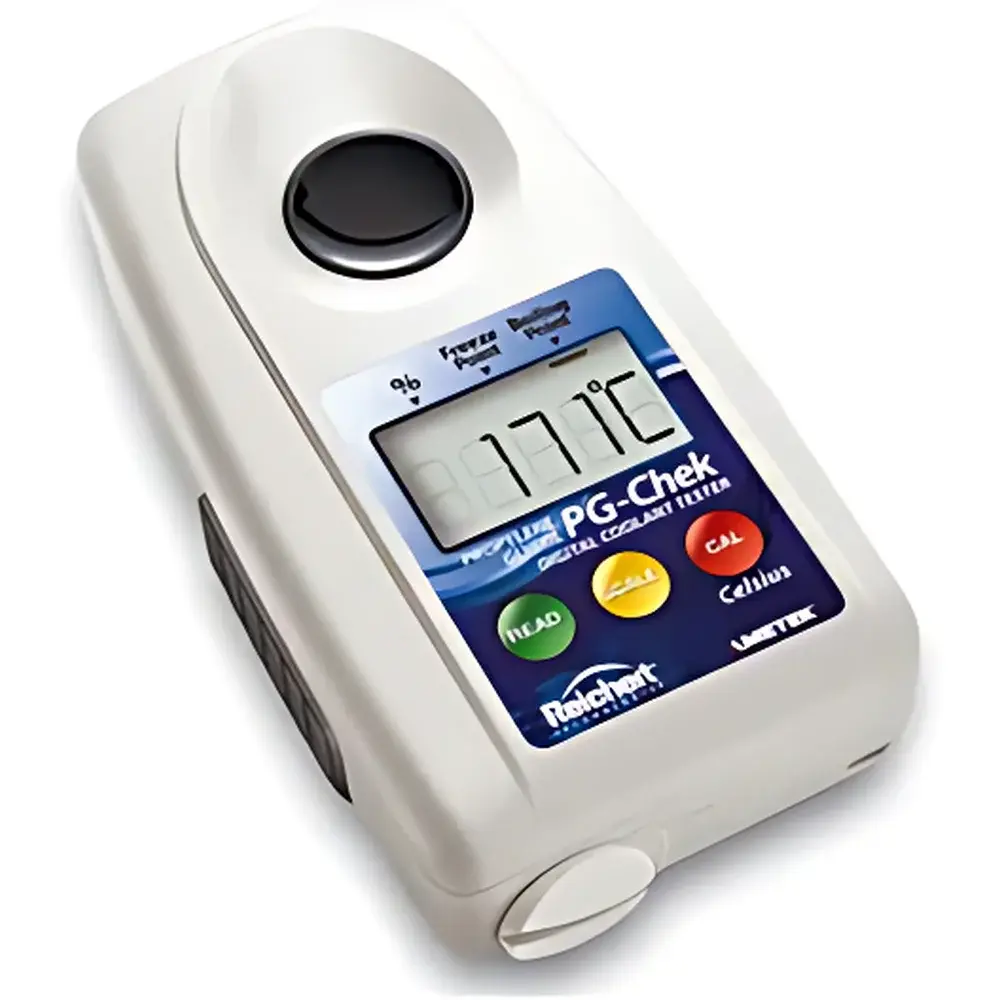
Reichert PG-Chek Digital Handheld Refractometer for Propylene Glycol Coolant Analysis
| Brand | Reichert |
|---|---|
| Origin | USA |
| Model | PG-Chek |
| Type | Handheld Digital Refractometer |
| Temperature Control | Yes (ATC) |
| Display | Digital LCD |
| Measurement Range | 0–95% PG concentration |
| Accuracy | ±0.2% PG |
| Ice Point Range | 0–51°C (±0.6°C) |
| Boiling Point Range | 117–174°C (±0.6°C) |
| Light Source | 589 nm LED |
| ATC Reference | 20°C |
| IP Rating | IP65 |
| Compliance | CE, RoHS, WEEE |
| Power | 2×AAA batteries (included) |
| Battery Life | ~10,000 measurements |
| Dimensions | 54 × 27 × 100 mm |
| Weight | 100 g |
Overview
The Reichert PG-Chek is a purpose-engineered handheld digital refractometer designed exclusively for the rapid, field-deployable quantification of propylene glycol (PG) concentration in industrial and automotive coolant formulations. Unlike generic refractometers or hydrometers, the PG-Chek employs Abbe-type optical refraction principles calibrated specifically to the refractive index–concentration relationship of aqueous PG solutions across a validated range of 0–95% w/w. Its integrated algorithm converts measured refractive index into three critical thermodynamic parameters in real time: PG mass concentration (%), freezing point (°C), and boiling point (°C). This tri-parameter output enables maintenance technicians, HVAC engineers, and fire suppression system inspectors to assess coolant performance, corrosion inhibition integrity, and freeze/boil protection margins without laboratory-grade infrastructure. The instrument operates on the principle of total internal reflection at the prism–sample interface, with light emitted from a stabilized 589 nm LED (sodium D-line equivalent) ensuring spectral consistency aligned with ISO 21748 and ASTM D1152 standards for refractive index measurement.
Key Features
- Dedicated PG calibration curve embedded in firmware—no user-defined calibration required for standard coolant matrices
- Automatic Temperature Compensation (ATC) referenced to 20°C, utilizing high-stability thermistor feedback to correct for sample temperature drift between 10–40°C
- IP65-rated enclosure with rubberized grip and removable neck strap for rugged field use in workshops, data centers, or fire pump rooms
- High-contrast digital LCD display with backlighting for low-light environments; dual-unit readout (%, °C ice point, °C boiling point) simultaneously visible
- Self-cleaning prism surface with hydrophobic coating minimizes residue carryover between samples; compatible with standard lens cleaning tissue and isopropyl alcohol
- Low-power architecture supporting >10,000 measurements per battery set; auto-sleep mode engages after 90 seconds of inactivity
Sample Compatibility & Compliance
The PG-Chek is validated for use with aqueous propylene glycol solutions containing common inhibitors (e.g., silicates, phosphates, organic acids) at concentrations typical of OEM-recommended coolants (e.g., Cummins, Caterpillar, Carrier). It is not intended for ethylene glycol (EG), glycerol, or multi-component antifreeze blends lacking PG dominance. In fire protection applications, the device supports NFPA 13 and NFPA 25 compliance verification by confirming PG concentration ≤38% v/v in wet-pipe sprinkler system antifreeze solutions—ensuring freeze-point depression remains within safety margins while avoiding excessive viscosity or microbiological risk. Device conformity includes CE marking under the EU Electromagnetic Compatibility Directive 2014/30/EU, RoHS 2011/65/EU restriction compliance, and WEEE 2012/19/EU end-of-life handling provisions.
Software & Data Management
The PG-Chek operates as a standalone instrument with no external software dependency. All calibration constants, temperature compensation coefficients, and PG-specific conversion algorithms are factory-programmed and non-user-modifiable—ensuring metrological traceability and eliminating configuration errors. Audit-ready operation is supported via built-in timestamp-free measurement logging (no memory storage), consistent with GLP-aligned manual recordkeeping practices. While the unit does not generate electronic audit trails or support FDA 21 CFR Part 11 compliance directly, its fixed calibration and deterministic output enable full documentation in paper-based or LIMS-integrated workflows where instrument ID, operator, date, and result are manually entered.
Applications
- Routine verification of PG concentration in engine coolant service intervals for heavy-duty diesel and natural gas power generation units
- Commissioning and annual inspection of chilled water systems in commercial HVAC installations
- NFPA-mandated antifreeze concentration checks in wet-pipe fire sprinkler systems located in unheated spaces (e.g., parking garages, warehouses)
- Quality assurance sampling during PG coolant blending operations at distribution centers or fleet maintenance depots
- Troubleshooting unexpected freeze-up events by cross-referencing measured ice point against ambient operating conditions
FAQ
Does the PG-Chek require recalibration before each use?
No. The instrument features factory-set calibration verified against NIST-traceable PG reference standards. Only periodic verification using deionized water (expected reading: 0.0% PG) is recommended per ASTM D1152 Section 8.2.
Can it measure ethylene glycol (EG) concentration?
No. The optical path and algorithm are optimized exclusively for propylene glycol. Using it for EG yields non-linear, non-validated results and voids accuracy specifications.
Is the prism resistant to corrosion from acidic coolants?
Yes. The sapphire-coated BK7 glass prism exhibits high resistance to pH 4–10 coolant formulations when cleaned promptly after use per manufacturer guidelines.
What is the minimum sample volume required?
Approximately 0.05 mL—sufficient to cover the prism surface fully without overflow. Capillary action ensures reliable film formation even with viscous 60% PG solutions.
How does ATC affect measurement uncertainty?
ATC reduces temperature-induced refractive index deviation by >92% within the 10–40°C range. Residual uncertainty attributable to thermal effects is included in the stated ±0.6°C ice/boil point tolerance.




