
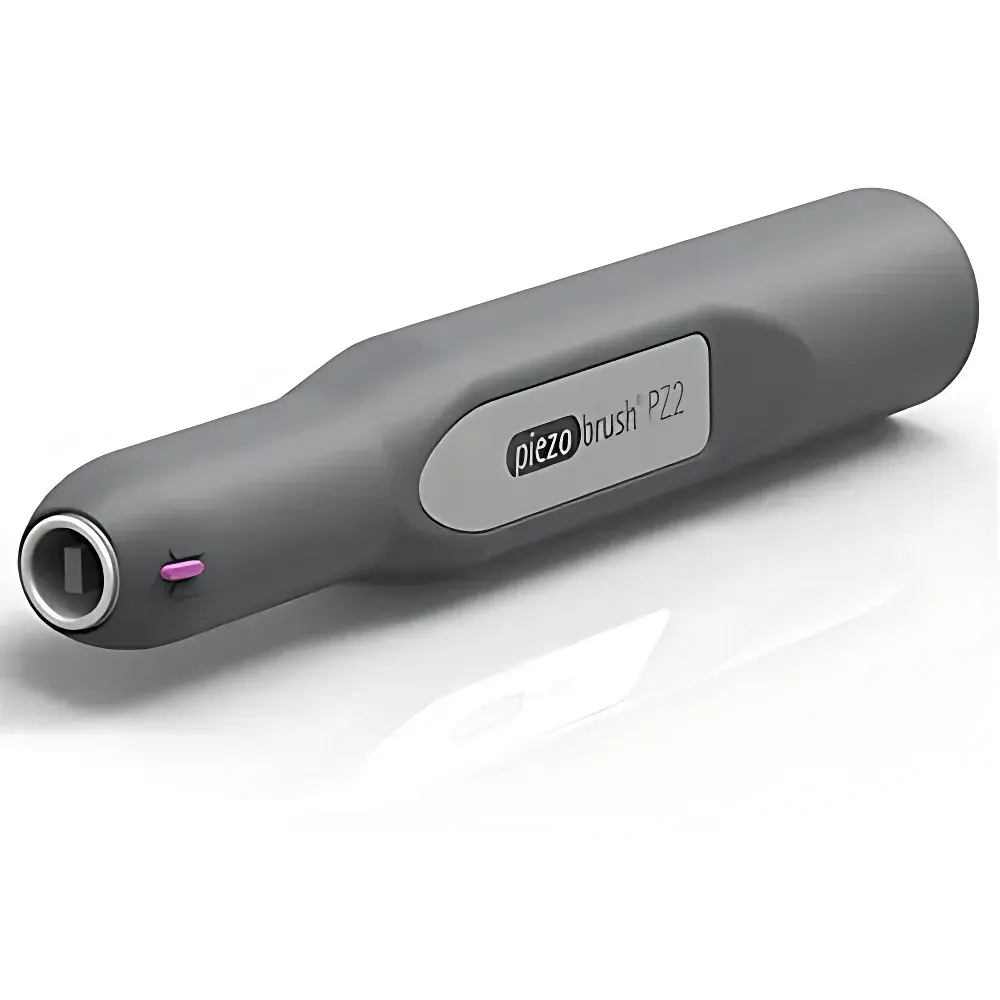
Relyon piezobrush® PZ2 Portable Handheld Plasma Surface Treater
| Brand | Relyon |
|---|---|
| Origin | Germany |
| Model | PZ2 |
| RF Frequency | 80 kHz |
| Power Output | 30 W |
| Dimensions | 4 × 20 × 3 cm |
| Weight | 180 g |
| Operating Voltage | 110–240 V AC / 50–60 Hz, 15 V DC |
| Plasma Temperature | <50 °C |
| Working Distance | 2–10 mm |
| Treatment Width | 5–20 mm |
| Gas Supply | Single-channel (ambient air or optional external He/N₂/Ar, 0.5–3.0 L/min) |
| Control | Fully automatic |
Overview
The Relyon piezobrush® PZ2 is a compact, handheld plasma surface treatment system engineered for precision surface activation and functionalization in laboratory, prototyping, and low-volume production environments. Unlike conventional low-pressure plasma systems requiring vacuum chambers and complex gas manifolds, the PZ2 operates at atmospheric pressure using piezoelectric direct discharge (PDD®) technology — a proprietary solid-state plasma generation method developed by RELYON Plasma GmbH. This technology leverages a high-voltage piezoelectric transformer to generate localized, non-thermal plasma directly from ambient air or externally supplied process gases (e.g., helium, nitrogen, argon). The resulting cold plasma contains reactive oxygen and nitrogen species (ROS/RNS), UV photons, and energetic electrons — all capable of cleaving weak boundary layers, oxidizing hydrocarbon contaminants, and introducing polar functional groups (e.g., –OH, –COOH, –C=O) onto polymer, metal, ceramic, and composite surfaces. With a maximum operating temperature below 50 °C and no thermal damage to heat-sensitive substrates (e.g., PET, polycarbonate, paper, wood, or biological films), the PZ2 enables reproducible, solvent-free surface conditioning without altering bulk material properties.
Key Features
- Patented PDD® (Piezoelectric Direct Discharge) technology: Solid-state, electrode-less plasma generation with no consumable electrodes or high-voltage cables — ensuring long-term reliability and zero maintenance.
- Ultra-low power consumption: Rated at 30 W max; compatible with standard lab-grade AC mains (110–240 V, 50–60 Hz) and regulated 15 V DC input for mobile or benchtop integration.
- Ergonomic handheld design: Weighing only 180 g with dimensions of 4 × 20 × 3 cm — optimized for precise manual operation in confined spaces, micro-assembly stations, or field-deployable applications.
- Multi-nozzle modularity: Interchangeable nozzle systems — Standard (for insulators: plastics, composites), Near-field (for conductors: metals, CFRP), and Hybrid Needle (for targeted treatment of micro-grooves, capillaries, or recessed features).
- Real-time automatic control: Integrated microcontroller regulates discharge stability, pulse repetition rate, and gas flow synchronization (when external supply is used), eliminating manual tuning.
Sample Compatibility & Compliance
The PZ2 is validated for surface modification of diverse substrate classes including thermoplastics (PP, PE, ABS, PC, PET), elastomers, glass, aluminum, stainless steel, carbon fiber-reinforced polymers (CFRP), and biodegradable films. It supports compliance-critical workflows: surface activation prior to adhesive bonding meets ASTM D4541 (pull-off adhesion strength) and ISO 8510-2 (peel testing); cleaning efficacy aligns with ISO 14644-1 (cleanroom particulate control) and USP (surface cleanliness for pharmaceutical contact materials). While not a medical device itself, its use in dental laboratories, microfluidic chip fabrication, and diagnostic sensor preparation adheres to GLP principles and supports FDA 21 CFR Part 11–compliant documentation when integrated with validated data acquisition software.
Software & Data Management
The PZ2 operates as a standalone unit with embedded firmware — no host PC required for basic functionality. For traceable process validation, it supports optional digital interface modules (RS-232 or USB-C) enabling integration with third-party LabVIEW, Python-based logging tools, or LIMS platforms. All operational parameters — treatment duration, trigger events, nozzle type ID, and (if equipped) mass flow controller readings — can be timestamped and exported in CSV format. Audit trails are retained locally on non-volatile memory, supporting GMP-aligned record retention policies and retrospective process review.
Applications
- Adhesion promotion: Enhancing epoxy, cyanoacrylate, and UV-curable adhesive bond strength on polypropylene automotive trim, medical device housings, and 3D-printed ABS assemblies.
- Microfabrication pre-treatment: Improving photoresist adhesion on silicon wafers and PDMS molds; enabling uniform metallization of flexible electronics substrates.
- Biomedical surface engineering: Activating PET membranes for cell culture scaffolds; functionalizing glass slides for antibody immobilization in immunoassays.
- Conservation science: Gentle removal of organic soiling layers from historical paper artifacts and wooden model prototypes without cellulose degradation.
- Quality assurance: In-line verification of surface energy via dyne solution testing before printing, coating, or laminating — supporting ISO 8296 and ASTM D2578 standards.
FAQ
What gases can be used with the PZ2?
Ambient air is sufficient for most surface activation tasks. Optional external gases include helium, nitrogen, and argon — delivered at 0.5–3.0 L/min via the Hybrid Needle nozzle adapter.
Is the PZ2 suitable for treating heat-sensitive polymers?
Yes. The non-thermal plasma maintains substrate temperatures below 50 °C, making it safe for PET, PLA, TPU, and thin-film laminates.
Does the PZ2 require calibration or periodic maintenance?
No. The PDD® architecture has no wear-prone electrodes or replaceable consumables. Performance remains stable over >10,000 hours of cumulative operation.
Can the PZ2 be integrated into automated workstations?
Yes — via programmable TTL trigger input and analog/digital feedback signals. Custom mounting brackets and pneumatic coupling kits are available upon request.
How does the PZ2 compare to corona or DBD plasma systems?
Unlike corona (which generates ozone-rich, filamentary discharges) or dielectric barrier discharge (DBD) systems (requiring grounded counter-electrodes), the PZ2 delivers uniform, diffuse plasma with higher ROS density and lower electromagnetic interference — critical for electronics assembly and cleanroom use.



