
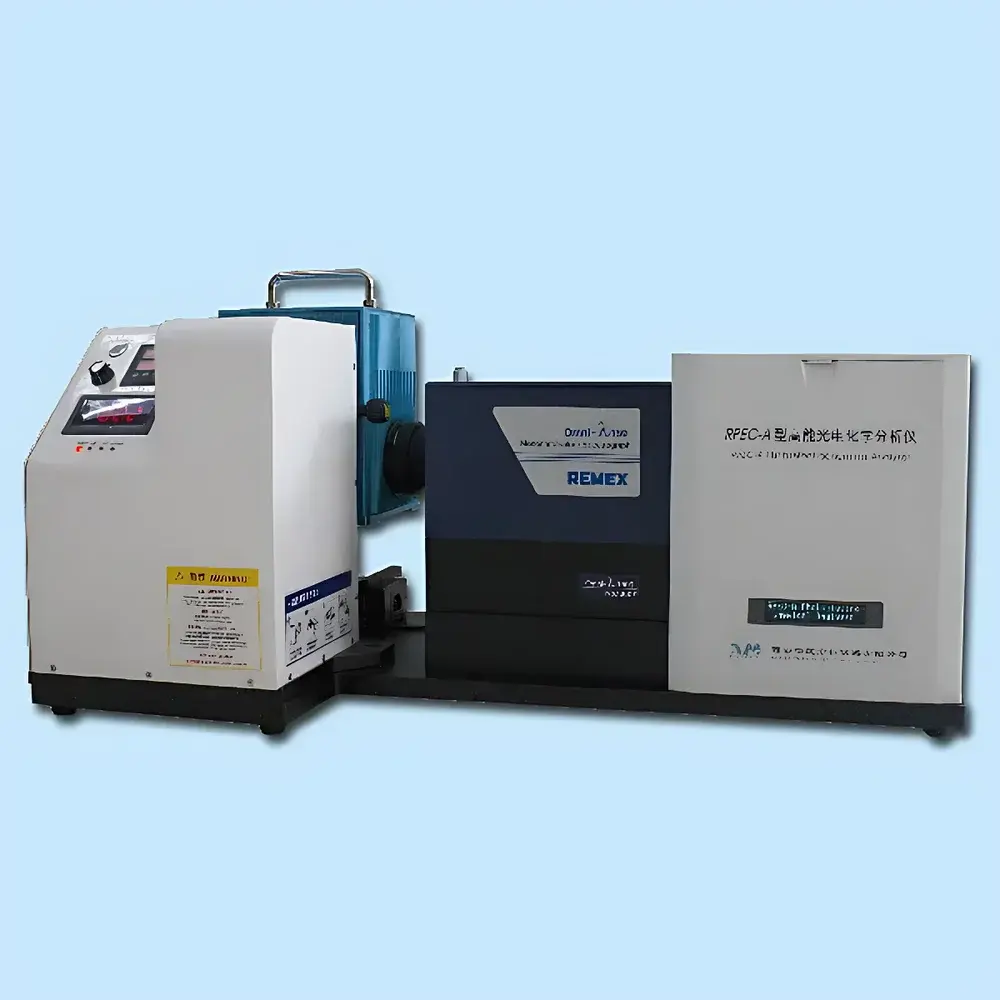
REMEX RPEC-A High-Energy Photoelectrochemical Analyzer
| Brand | REMEX (Xi’an Remex Instrument Co., Ltd.) |
|---|---|
| Origin | Shaanxi, China |
| Model | RPEC-A |
| Light Source | 300 W Xenon Arc Lamp |
| Spectral Range | 200–1000 nm |
| Wavelength Accuracy | ±0.25 nm |
| Wavelength Repeatability | ±0.1 nm |
| Minimum Wavelength Step | 0.01 nm |
| Spectral Bandwidth | 0.054–16.2 nm (adjustable slit: 10 µm–3 mm) |
| Electrochemical Potential Range | −10 V to +10 V |
| Current Range | ±250 mA |
| Sensitivity | 1 × 10⁻⁹ A to 1 × 10⁻² A (8 decades) |
| Input Bias Current | <50 pA |
| Scan Rate | 0.001–65 V/s |
| Reference Electrode Input Impedance | 10 MΩ |
| Operating System | Windows-based Dedicated Software |
Overview
The REMEX RPEC-A High-Energy Photoelectrochemical Analyzer is a fully integrated, computer-controlled instrumentation platform engineered for quantitative photoelectrochemical (PEC) characterization of semiconductor materials, molecular photosensitizers, and biological redox systems. It operates on the fundamental principle of light-induced charge separation at electrode–electrolyte interfaces: upon monochromatic or broadband illumination (200–1000 nm), photoexcited species—such as metal oxides, perovskites, organic dyes, or DNA–protein complexes—generate transient or steady-state photocurrents proportional to their charge-transfer efficiency and interfacial kinetics. Unlike conventional electrochemical methods, the RPEC-A decouples photonic excitation and electronic detection in time-resolved or wavelength-synchronized modes, thereby minimizing capacitive background and enhancing signal-to-noise ratio by up to two orders of magnitude. This enables high-fidelity measurement of photocurrent quantum yield, action spectra, and interfacial electron transfer rates under controlled potential, wavelength, and temporal conditions—critical parameters for solar energy conversion, biosensor development, and mechanistic studies of photoinduced electron transfer.
Key Features
- Fully synchronized optoelectronic architecture integrating a stabilized 300 W xenon arc lamp, high-resolution Czerny–Turner monochromator (focal plane: 25 mm × 10 mm), precision worm-gear wavelength drive (repeatability ±0.1 nm; step resolution 0.01 nm), and a modular potentiostat/galvanostat.
- Simultaneous control of excitation wavelength and working electrode potential with sub-millisecond timing coordination—enabling true time-wavelength-potential correlation.
- Dual-mode spectral acquisition: continuous-wave (CW) photocurrent mapping and pulsed transient photocurrent analysis (TPC) with dark recovery monitoring.
- Adjustable optical configuration: selectable beam geometry (collimated spot: Ø38 mm; focused point source: Ø8 mm; focus adjustment range: 0–40 mm).
- Electrochemical module compliant with standard techniques including cyclic voltammetry (CV), linear sweep voltammetry (LSV), chronoamperometry (CA), and photochronoamperometry—fully programmable via USB 2.0 interface.
- Windows-native software with intuitive workflow builder, real-time data visualization, and export-ready ASCII/CSV output compatible with MATLAB, Origin, and Python-based analysis pipelines.
Sample Compatibility & Compliance
The RPEC-A supports solid-state electrodes (FTO, ITO, Au, Pt, GC), liquid-phase electrolytes (aqueous and non-aqueous), thin-film photoanodes/cathodes, colloidal quantum dots, dye-sensitized assemblies, and immobilized biomolecular layers (e.g., DNA monolayers, redox-labeled proteins). Its design conforms to ISO/IEC 17025 general requirements for calibration and testing laboratories, and its electrochemical module meets ASTM E200–22 specifications for potentiostatic instrumentation. While not certified for GMP or FDA 21 CFR Part 11 out-of-the-box, the software architecture supports audit-trail logging, user-access levels, and electronic signature readiness—facilitating adaptation to GLP-compliant workflows upon site-specific validation.
Software & Data Management
The proprietary REMEX PEC Suite provides deterministic experiment sequencing, multi-dimensional parameter sweeps (λ–EWE–t), and automated baseline subtraction. All raw current–time, current–wavelength, and current–potential datasets are timestamped, metadata-tagged (lamp intensity, slit width, filter status, cell temperature if external sensor connected), and stored in hierarchical HDF5 format. Export modules support direct integration with third-party chemometrics tools and LIMS environments. Batch processing scripts enable reproducible post-acquisition correction for lamp drift, dark current offset, and Faradaic efficiency normalization using internal reference standards.
Applications
- Solar Energy Materials: Action spectrum mapping of photoanodes (e.g., BiVO4, α-Fe2O3, perovskite films) to identify band-edge positions and quantify incident photon-to-current efficiency (IPCE).
- Bioelectrochemistry: Detection of photoinduced DNA damage via guanine oxidation currents; label-free probing of protein–DNA binding affinity through changes in photocurrent amplitude and lifetime.
- Corrosion Science: In-situ monitoring of passive film formation on stainless steels under UV–vis illumination to assess photo-enhanced passivation stability.
- Catalysis Research: Quantifying hole scavenging kinetics in photocatalytic water splitting systems using transient photocurrent decay analysis.
- Device Engineering: Correlating spectral response with electrode microstructure (via SEM/FIB cross-section) to guide nanostructuring strategies for enhanced light harvesting.
FAQ
What is the minimum detectable photocurrent under optimal conditions?
The system achieves a lower limit of detection (LOD) of 1 pA (RMS, 1 Hz bandwidth) when operating in the 1 × 10⁻⁹ A sensitivity range with active guarding and low-noise cabling.
Can the RPEC-A perform time-resolved measurements with microsecond resolution?
No—the electrochemical module’s analog front-end bandwidth is 100 kHz, supporting transient measurements down to ~10 µs resolution; sub-microsecond kinetics require external fast digitizers interfaced via TTL synchronization outputs.
Is the xenon lamp output calibrated traceable to NIST standards?
The lamp spectral irradiance is factory-calibrated using a NIST-traceable silicon photodiode and deuterium/halogen reference sources; full calibration certificates are provided with each instrument shipment.
Does the software support custom waveform generation for advanced photoelectrochemical protocols?
Yes—users may define arbitrary potential waveforms (including staircase, ramp-hold, and multi-step sequences) synchronized with programmable shutter or LED trigger events for hybrid photoelectrochemical–optical experiments.
What maintenance is required for long-term operational stability?
Recommended maintenance includes quarterly alignment verification of the optical path, annual recalibration of the monochromator encoder and potentiostat gain/offset, and replacement of the xenon lamp after 1000 hours of cumulative operation (lamp life is monitored via integrated hour-meter and intensity feedback).
Related Products





