
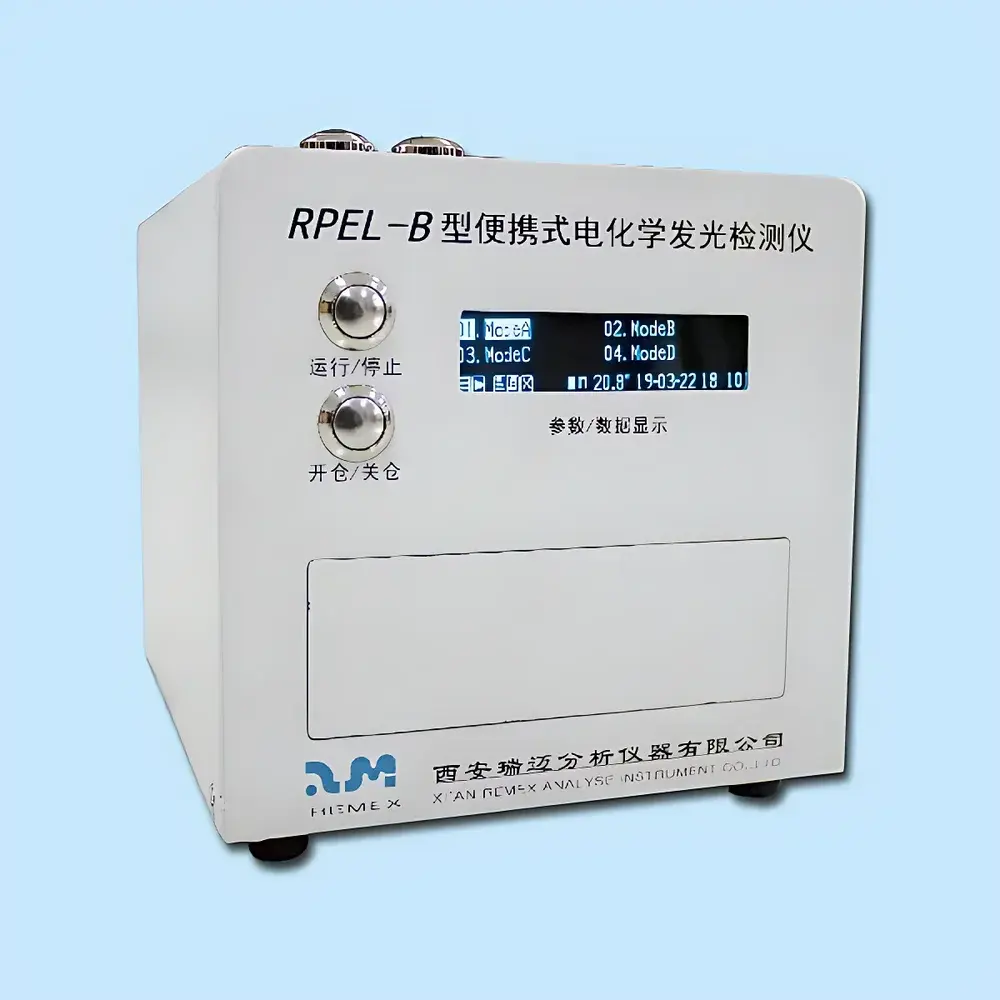
REMEX RPEL-B Portable Electrochemiluminescence Immunoassay Analyzer
| Brand | REMEX (Xi’an Remex) |
|---|---|
| Origin | Shaanxi, China |
| Manufacturer Type | Authorized Distributor |
| Country of Origin | China |
| Model | RPEL-B |
| Pricing | Upon Request |
| Potential Applications | Antigen/Antibody Detection, Pathogen Screening (e.g., Influenza A, HIV, Plague), Small-Molecule Biomarker Analysis (Hormones, Toxins, Glucose, Amino Acids) |
| Operating Modes | Standalone & PC-Connected (USB) |
| Electrode Format | Disposable Screen-Printed Electrodes (WE: Pt, CE: Pt, RE: Ag/AgCl or user-specified) |
| Dimensions | 140 × 110 × 110 mm (L×W×H) |
| Weight | <0.8 kg |
| Battery Life | >10 h continuous operation |
| Data Storage | Up to 1000 assay records |
| Optical Detection Range | 230–920 nm |
| Electrochemical Range | Potential: −3 V to +3 V |
| Current | ±50 mA |
| Scan Rate | 0.001–200 V/s |
| Sampling Rate | 1–200 points/s |
| Dynamic Range | >5 decades |
| Measurement Accuracy | <0.05% FS |
| Interfaces | USB 2.0 (PC control/data transfer), DB9 RS-232 (mini-printer output) |
| Integrated Magnetic Separation Module | Yes |
| Sample Volume | 5–10 µL per test |
| Compatible Substrates | Paper-based chips, ceramic chips, custom solid-phase electrochemiluminescent platforms |
Overview
The REMEX RPEL-B Portable Electrochemiluminescence Immunoassay Analyzer is a compact, field-deployable instrument engineered for quantitative detection of biological and chemical analytes via electrochemiluminescence (ECL). ECL combines the selectivity of immunoaffinity binding with the sensitivity of light emission triggered by controlled electrochemical oxidation or reduction at electrode surfaces—typically using ruthenium(II) tris-bipyridyl ([Ru(bpy)3]2+) or luminol derivatives as labels. The RPEL-B implements a three-electrode configuration (working, counter, and reference) on disposable screen-printed electrodes (SPEs), eliminating manual electrode polishing, cleaning, or regeneration. This architecture ensures high inter-assay reproducibility and minimizes carryover risk—critical for point-of-need testing in resource-limited or mobile laboratory environments. Its integrated magnetic separation module enables on-cartridge sample enrichment without external centrifugation or pipetting steps, supporting rapid (<15 min), low-volume (5–10 µL) assays directly from whole blood, serum, saliva, or environmental swab extracts.
Key Features
- True portable design: weighs under 0.8 kg with integrated rechargeable Li-ion battery supporting >10 hours of continuous operation.
- Disposable SPE compatibility: pre-fabricated electrodes with Pt working and counter electrodes, plus Ag/AgCl (or user-specified) reference electrode—guaranteeing batch-to-batch consistency and eliminating electrode pretreatment.
- Dual-mode operation: standalone mode (on-device parameter recall, real-time display, internal data storage) and PC-connected mode (full remote control via USB, firmware updates, and advanced data export).
- Onboard magnetic separation: integrated permanent magnet array for direct immunomagnetic bead capture and washing—reducing hands-on time and contamination risk.
- Broad optical detection range: 230–920 nm photomultiplier tube (PMT)-based detector optimized for common ECL labels including [Ru(bpy)3]2+, acridinium esters, and luminol derivatives.
- High-fidelity electrochemical control: potentiostat with ±50 mA current range, −3 V to +3 V potential window, scan rates from 0.001 to 200 V/s, and sampling resolution up to 200 points per second.
- Regulatory-ready data handling: timestamped assay records with operator ID tagging; supports audit trail generation for GLP-compliant workflows when used with validated software protocols.
Sample Compatibility & Compliance
The RPEL-B accepts liquid-phase and solid-phase ECL substrates—including paper microfluidic chips, ceramic-based biosensor arrays, and custom-designed lateral-flow or flow-through cartridges. It is compatible with both sandwich and competitive immunoassay formats, as well as nucleic acid hybridization assays employing ECL-labeled probes. All disposable electrodes comply with ISO 15197:2013 requirements for manufacturing consistency and dimensional tolerances. While the instrument itself does not carry CE IVD or FDA 510(k) clearance, its hardware architecture and data structure are designed to support validation under ISO 13485 quality management systems and alignment with CLIA-waived testing principles when deployed with user-validated reagent kits. Firmware supports configurable pass/fail thresholds and QC flagging per test run—facilitating integration into GMP-aligned environmental monitoring or field-deployed biodefense screening programs.
Software & Data Management
The RPEL-B operates with Windows-compatible desktop software (v3.2+) that provides method development, calibration curve fitting (4PL, linear, log-log), and statistical reporting (CV%, LOD/LOQ estimation). Raw ECL intensity vs. time traces, cyclic voltammograms, and amperometric decay profiles are exportable in CSV and native .rpe format. On-device storage retains up to 1000 assay results with full metadata (date/time, operator ID, method name, raw signal values, and calculated concentrations). All stored data are write-protected after acquisition and support password-protected deletion. Software includes optional 21 CFR Part 11 compliance modules—enabling electronic signatures, audit trail logging, and role-based access control when deployed in regulated QC/QA laboratories.
Applications
- Rapid serological screening: detection of IgG/IgM against influenza A (H5N1, H7N9), HIV p24 antigen, Yersinia pestis F1 antigen, and SARS-CoV-2 nucleocapsid protein.
- Point-of-care toxicology: quantification of small-molecule toxins (e.g., aflatoxin B1, ochratoxin A), therapeutic drugs (digoxin, vancomycin), and endogenous biomarkers (cortisol, insulin, C-reactive protein).
- Field-deployable food safety testing: detection of veterinary drug residues (chloramphenicol, sulfonamides), allergens (peanut Ara h 1, milk β-lactoglobulin), and pathogen-derived antigens (Salmonella LPS, E. coli O157:H7 intimin).
- Environmental monitoring: on-site detection of heavy metal ions (Cd2+, Pb2+) via ECL-based aptasensors and pesticide metabolites (e.g., paraoxon) using enzyme-inhibition coupled assays.
- Biodefense and emergency response: portable identification of nerve agents (sarin, VX) and ricin using antibody-conjugated magnetic beads and Ru(bpy)32+-tagged secondary detection.
FAQ
Does the RPEL-B require external calibration standards for each assay?
No—calibration curves can be preloaded and stored onboard or transferred via USB. Users may define multi-point calibrators per assay protocol, and the system supports automatic interpolation during analysis.
Can the instrument be used with non-REMEX electrodes?
Yes—the RPEL-B accepts third-party screen-printed electrodes provided they conform to standard 3-mm diameter contact pads and match the specified electrode material configuration (Pt/Pt/Ag/AgCl or equivalent). Electrical and optical alignment must be verified during initial setup.
Is firmware update capability available in standalone mode?
Firmware updates require PC connection via USB and the official REMEX Configuration Utility. Standalone mode supports only parameter and data management functions.
What is the minimum detectable ECL signal intensity?
System noise floor is <0.5 pA (electrochemical) and <10 photons/sec (optical) under dark conditions—enabling sub-picomolar detection limits when paired with high-efficiency ECL labels and optimized assay chemistry.
How is data integrity ensured during field use?
All measurements include embedded CRC-32 checksums, automatic timestamping (RTC-backed), and immutable record headers. Optional software modules provide digital signature verification and encrypted data export for chain-of-custody documentation.
Related Products





