
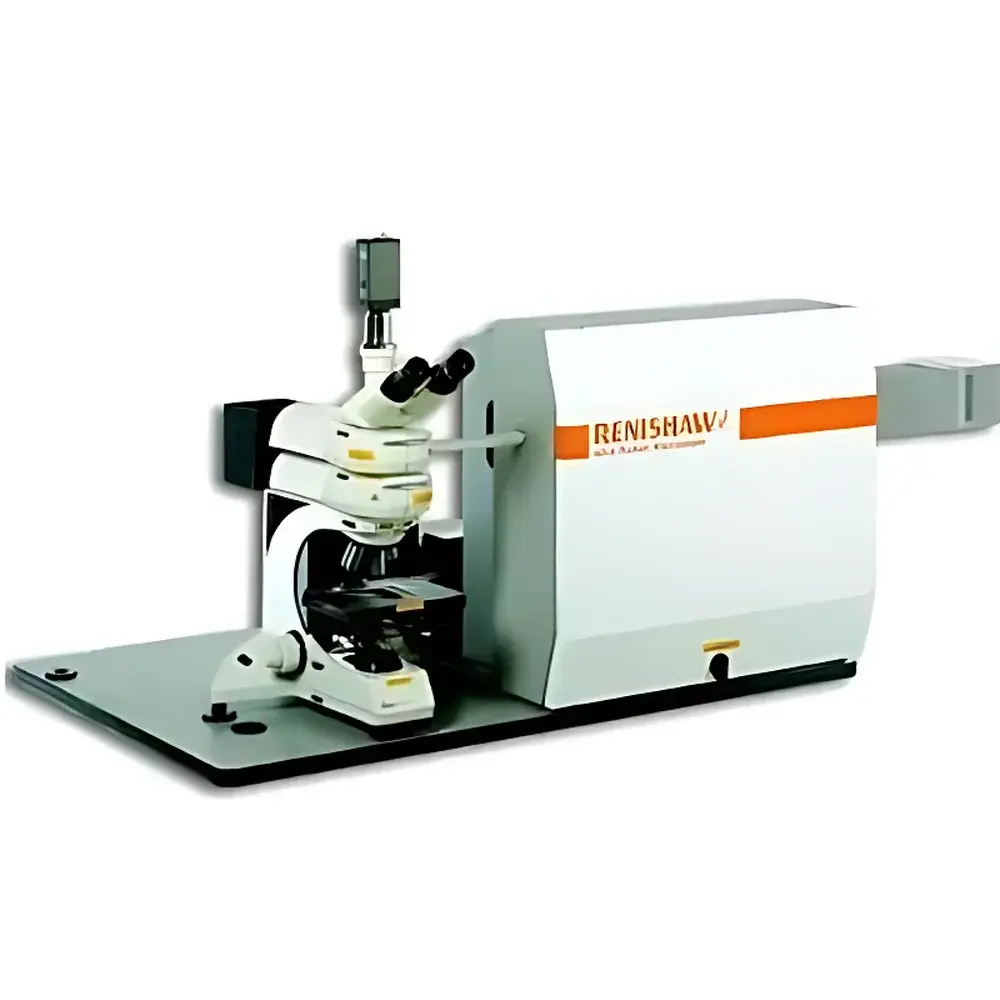
Renishaw inVia-Reflex Fully Automated Confocal Raman Microscope
| Brand | Renishaw |
|---|---|
| Origin | United Kingdom |
| Model | inVia-Reflex |
| Laser Excitation Options | UV–NIR (e.g., 244 nm, 325 nm, 488 nm, 532 nm, 633 nm, 785 nm) |
| Spectral Range | Down to <10 cm⁻¹ (with NExT filter) |
| Spatial Resolution | <1 µm (lateral), sub-micron axial (confocal) |
| Detector | RenCam™ deep-depletion CCD (UV–NIR enhanced, ultra-low noise) |
| Software | WiRE™ 2.0 (21 CFR Part 11 compliant, scriptable, database-integrated) |
| Microscope Platform | Leica research-grade upright microscope |
| Automation Level | Full motorized laser switching, auto-alignment, auto-focus, auto-confocal mode selection, real-time optical feedback calibration |
| Safety Class | Class 1 (fully enclosed beam path, interlocked access) |
Overview
The Renishaw inVia-Reflex Fully Automated Confocal Raman Microscope is a high-performance, research-grade spectroscopic imaging platform engineered for precision molecular characterization at the micro- and nano-scale. Based on confocal Raman spectroscopy—a non-destructive, label-free technique that probes vibrational modes via inelastic scattering of monochromatic light—the system delivers spatially resolved chemical identification, phase mapping, stress/strain analysis, and crystallinity assessment across diverse solid, liquid, and thin-film samples. Its core architecture integrates a Leica research microscope with Renishaw’s proprietary spectrograph, multi-laser excitation pathways, and a thermoelectrically cooled deep-depletion CCD detector. Unlike conventional benchtop Raman systems, the inVia-Reflex implements true confocality through hardware-synchronized pinhole alignment and motorized objective positioning, enabling depth-resolved spectral acquisition with axial resolution optimized for each wavelength. The system operates across ultraviolet (244 nm), visible (488–633 nm), and near-infrared (785 nm) excitation bands—each supported by independently optimized optical trains and automatic recalibration—ensuring maximum throughput and signal fidelity without manual realignment.
Key Features
- Fully automated laser selection and optical path optimization: One-click switching between up to six lasers (e.g., 244, 325, 488, 532, 633, 785 nm), with real-time feedback-controlled collimation and focus adjustment per wavelength.
- Class 1 laser safety architecture: Fully enclosed beam paths, interlocked sample chamber, and automatic beam shutoff ensure compliance with IEC 60825-1; no external laser safety enclosures required.
- Confocal mode automation: Motorized pinhole insertion, objective Z-positioning, and dynamic focus tracking enable seamless transition between widefield white-light imaging and diffraction-limited Raman mapping (<1 µm lateral resolution).
- NExT (Notch Extended Transmission) filter technology: Enables low-wavenumber detection down to <10 cm⁻¹ while maintaining high optical throughput—eliminating trade-offs between spectral range and sensitivity.
- High-stability monolithic baseplate: Integrates microscope, spectrometer, and laser mounts on a single granite-reinforced aluminum platform with precision three-point kinematic mounting for thermal and mechanical stability.
- WiRE™ 2.0 software suite: Native support for 21 CFR Part 11 audit trails, electronic signatures, role-based access control, customizable workflows, and scripting (VBScript/Python API) for method automation and batch processing.
Sample Compatibility & Compliance
The inVia-Reflex accommodates a broad spectrum of sample geometries and environmental conditions. Standard configurations support standard microscope slides, polished wafers, and bulk solids; optional accessories extend capability to large-area substrates (>100 mm), irregular topographies (via fiber-optic probes), cryogenic or variable-temperature stages (−196 °C to +600 °C), electrochemical cells, high-pressure diamond anvil cells (up to 100 GPa), and combined AFM/Raman correlative platforms. All configurations comply with ISO/IEC 17025 requirements for analytical instrument qualification and are routinely deployed in GLP- and GMP-regulated environments—including pharmaceutical polymorph screening (per USP ), semiconductor defect analysis (ASTM F395), and forensic trace evidence characterization (SWGMAT guidelines). The integrated WiRE™ software supports full ALCOA+ data integrity principles and includes built-in calibration verification using internal neon/argon reference sources.
Software & Data Management
WiRE™ 2.0 serves as the unified control, acquisition, and analysis environment. It provides real-time spectral preview during acquisition, multivariate analysis (PCA, cluster mapping, spectral unmixing), quantitative peak fitting (Voigt/Gaussian models), and hyperspectral image reconstruction with pixel-level spectral libraries. Raw data is stored in vendor-neutral HDF5 format with embedded metadata (excitation wavelength, grating position, exposure time, objective NA, confocal aperture setting), ensuring long-term archival integrity and third-party interoperability (e.g., with MATLAB, Python SciPy, or commercial chemometrics packages). Audit trails record every user action—including parameter changes, data exports, and report generation—with timestamps, operator ID, and reason-for-change fields. Validation documentation (IQ/OQ/PQ protocols) and electronic signature templates are provided for regulated laboratory deployment.
Applications
The inVia-Reflex is widely applied in academic, industrial, and regulatory laboratories for: carbon nanomaterial characterization (graphene layer count, defect density via D/G ratio); pharmaceutical solid-state analysis (polymorph distribution, hydrate/dehydrate transitions); semiconductor metrology (dopant profiling, strain mapping in SiGe heterostructures); battery electrode degradation studies (SEI formation, cathode phase evolution); geological mineral identification (in situ fluid inclusion analysis); and art conservation science (pigment stratigraphy, binder aging). Its ability to perform rapid spectral imaging—acquiring full Raman spectra from >10⁴ pixels in under 30 minutes—makes it particularly suited for contamination mapping, failure analysis, and quality assurance in high-throughput manufacturing settings.
FAQ
Does the inVia-Reflex support multiple gratings for simultaneous high-resolution and wide-range spectral acquisition?
Yes—users may install up to three interchangeable holographic or ruled gratings (e.g., 1200, 1800, or 2400 grooves/mm) in a motorized turret; software automatically selects the optimal grating based on requested resolution and spectral window.
Can the system be upgraded from a basic inVia configuration to inVia-Reflex functionality?
Yes—Renishaw offers field-upgrade kits including the Reflex automation module, motorized confocal unit, and WiRE™ 2.0 license, preserving existing optical and detector hardware.
Is UV excitation compatible with standard silica-based optics and detectors?
Yes—the system uses fused silica transmission optics and UV-enhanced RenCam™ CCDs with quartz windows; dedicated UV-grade antireflection coatings minimize losses below 300 nm.
How is spectral calibration maintained over time and temperature drift?
An internal sealed neon/argon lamp provides daily automated wavelength calibration; intensity calibration is performed using NIST-traceable tungsten halogen standards, with corrections applied in real time during acquisition.
What level of technical support and service coverage is available globally?
Renishaw provides factory-certified service engineers across EMEA, North America, and APAC, with options for preventive maintenance contracts, remote diagnostics, and application-specific training programs aligned with ISO/IEC 17025 competency requirements.







