
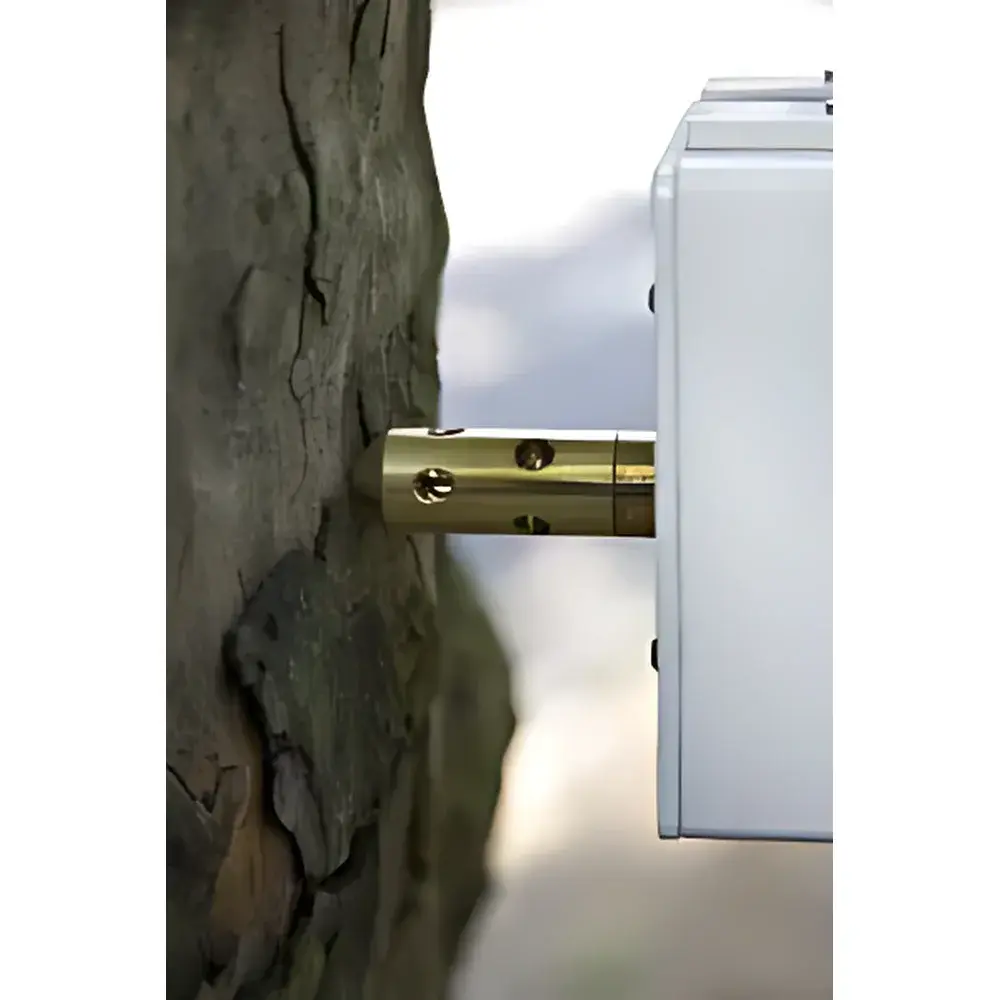
RESISTOGRAPH® Tree Micro-Drilling Resistance Tester by Rinntech
| Brand | Rinntech |
|---|---|
| Country of Origin | Germany |
| Model | RESISTOGRAPH® |
| Probe Diameter | 1.5 mm |
| Max. Penetration Depth | 45 cm (standard, optional range: 30–100 cm) |
| Penetration Speed | up to 50 cm/min |
| Spatial Resolution | 0.1 mm or 0.01 mm (selectable) |
| Device Weight | 3 kg |
| Onboard Data Storage | up to 500 resistance profiles |
| Integrated Thermal Printer | 1:1 real-time output |
| Power Supply | 12 V rechargeable battery |
| Included Software | DECOM Analysis Suite (profile visualization, editing, quantitative analysis, CSV/Excel export) |
Overview
The RESISTOGRAPH® Tree Micro-Drilling Resistance Tester, engineered and manufactured by Rinntech GmbH in Germany, is a field-deployable, non-destructive diagnostic instrument designed for quantitative assessment of internal wood integrity in living trees, standing timber, and structural timber elements. It operates on the principle of micro-drilling resistance measurement: a computer-controlled, motorized 1.5 mm diameter stainless steel probe is advanced at a constant speed into the wood matrix while high-frequency force transducers continuously record the torque and axial resistance encountered during penetration. These resistance values correlate directly with local wood density, moisture content, decay-induced lignin degradation, and anatomical features such as growth ring boundaries and void formation. Unlike acoustic or radar-based methods, the RESISTOGRAPH® delivers spatially resolved, depth-calibrated profiles with sub-millimeter resolution—enabling direct correlation between mechanical resistance signatures and anatomical or pathological conditions.
Key Features
- High-precision micro-drilling system with programmable penetration speed (up to 50 cm/min) and dual-resolution mode (0.1 mm or 0.01 mm step increment) for optimized data fidelity across diverse species and decay stages.
- Integrated 12 V lithium-ion battery pack with ergonomic backpack mounting—ensuring >6 hours of continuous field operation without external power.
- Onboard flash memory storing up to 500 complete resistance profiles; each profile includes timestamp, depth calibration, and environmental metadata (e.g., ambient temperature, operator ID).
- Real-time thermal printer with 1:1 analog output—providing immediate, tamper-evident hardcopy records compliant with GLP documentation requirements.
- Ruggedized aluminum housing and IP54-rated electronics—engineered for long-term reliability under variable outdoor conditions including rain, dust, and temperature fluctuations from –10 °C to +50 °C.
- Modular probe system supporting standardized 1.5 mm micro-drills (10 included); compatible with optional extended-length probes (up to 100 cm) for deep-root or large-diameter trunk assessment.
Sample Compatibility & Compliance
The RESISTOGRAPH® is validated for use across broadleaf and coniferous species, including but not limited to Fagus sylvatica, Quercus robur, Picea abies, and Pinus sylvestris. It accommodates diameters from 15 cm (young urban trees) to >200 cm (ancient oaks or structural columns). The method aligns with ISO 11579-2:2018 (“Wood — Determination of drilling resistance”), supports ASTM D143-22 Annex A7 (non-destructive evaluation of structural timber), and is routinely referenced in EN 1995-1-1 (Eurocode 5) Annex B for in-situ serviceability assessment of historic timber structures. All firmware and DECOM software comply with EU GDPR data handling standards and support audit trails required under ISO/IEC 17025:2017 for accredited testing laboratories.
Software & Data Management
The DECOM Analysis Software (v5.3+) provides full post-processing capability for resistance profiles. Users can perform baseline correction, ring boundary detection via derivative thresholding, decay zone quantification (using calibrated resistance thresholds per species), and comparative overlay of multiple profiles from the same tree. Data export functions include CSV, Excel (.xlsx), and XML formats—enabling integration with GIS platforms (e.g., ArcGIS Pro) and statistical packages (R, Python pandas). The software maintains full traceability: every exported file retains embedded metadata (probe ID, calibration date, operator signature, GPS coordinates if geotagged), satisfying FDA 21 CFR Part 11 electronic record requirements when configured with digital signature modules.
Applications
- Urban forestry risk assessment: identification of internal cavities, fungal decay zones, and compromised load-bearing cross-sections in street trees and heritage specimens.
- In-situ evaluation of timber structural members—including posts, beams, and roof trusses—in historic buildings, barns, and covered bridges.
- Dendroarchaeological and dendrochronological research: high-resolution growth ring width measurement and latewood/earlywood differentiation for climate reconstruction and dating.
- Forest health monitoring: longitudinal tracking of decay progression in monitored plots, supporting IUCN Red List assessments and Natura 2000 habitat reporting.
- Timber quality grading: objective classification of sawn timber and veneer logs prior to milling, reducing waste and improving yield prediction accuracy.
- Root system integrity screening: shallow-root probing (with custom short probes) to assess root rot in orchards and nursery stock.
FAQ
Is the RESISTOGRAPH® suitable for use on protected or ancient trees?
Yes. The 1.5 mm probe creates a negligible wound (<0.2% cross-sectional area loss), fully compliant with IUFRO guidelines for minimally invasive tree diagnostics and permitted under most national heritage tree protection statutes.
How does drilling resistance correlate with actual wood density or decay extent?
Empirical calibration curves exist for >40 commercial species; Rinntech provides species-specific lookup tables derived from paired core sampling and gravimetric density measurements. Decay severity is classified using normalized resistance indices relative to sound reference zones.
Can data be synchronized across multiple devices in a municipal forestry fleet?
Yes. DECOM supports centralized database deployment via SQL Server or PostgreSQL backends, enabling role-based access control, automated backup, and cross-device profile reconciliation with conflict resolution protocols.
What maintenance is required for long-term field reliability?
Annual recalibration of the torque sensor and probe alignment check are recommended. Rinntech-certified service centers provide NIST-traceable calibration certificates valid for 12 months.
Does the system meet cybersecurity standards for institutional procurement?
Firmware v4.2+ implements TLS 1.2 encrypted communication, secure boot, and firmware signing. DECOM software supports Windows 10/11 Group Policy enforcement and integrates with enterprise Active Directory authentication.





