
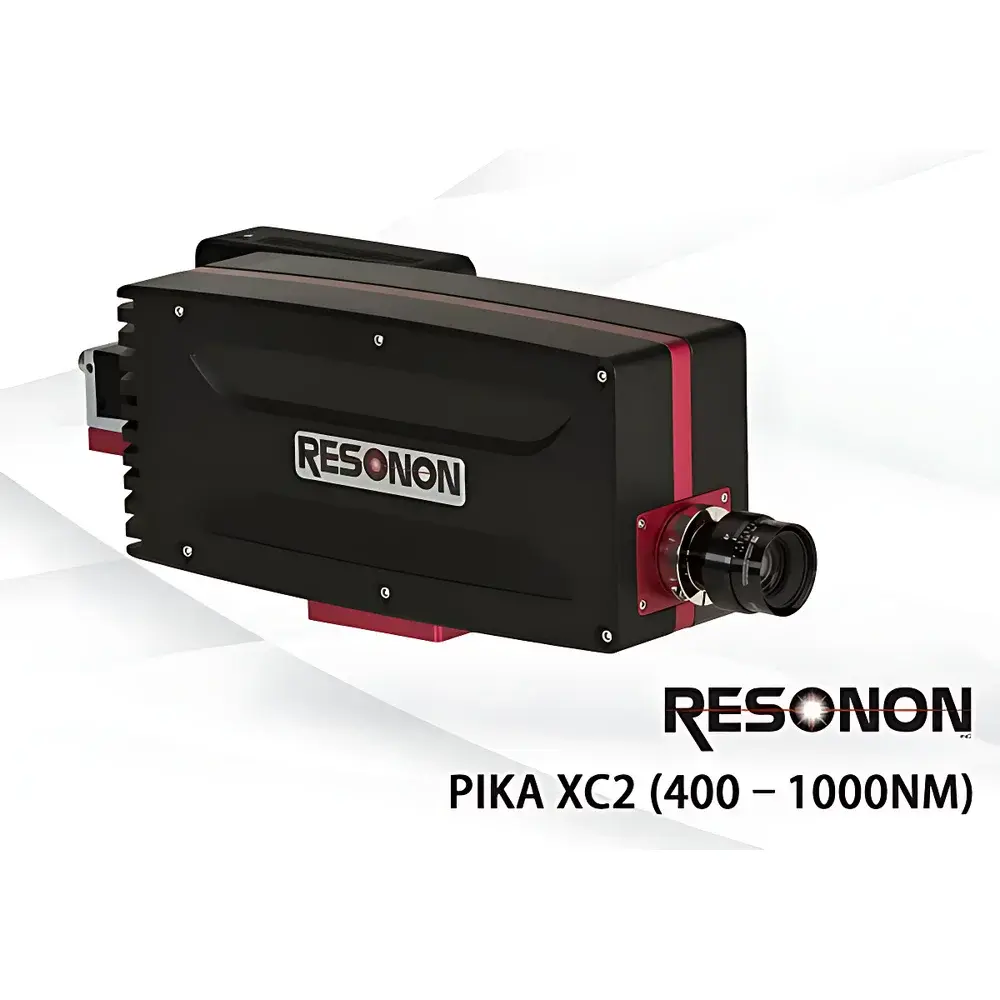
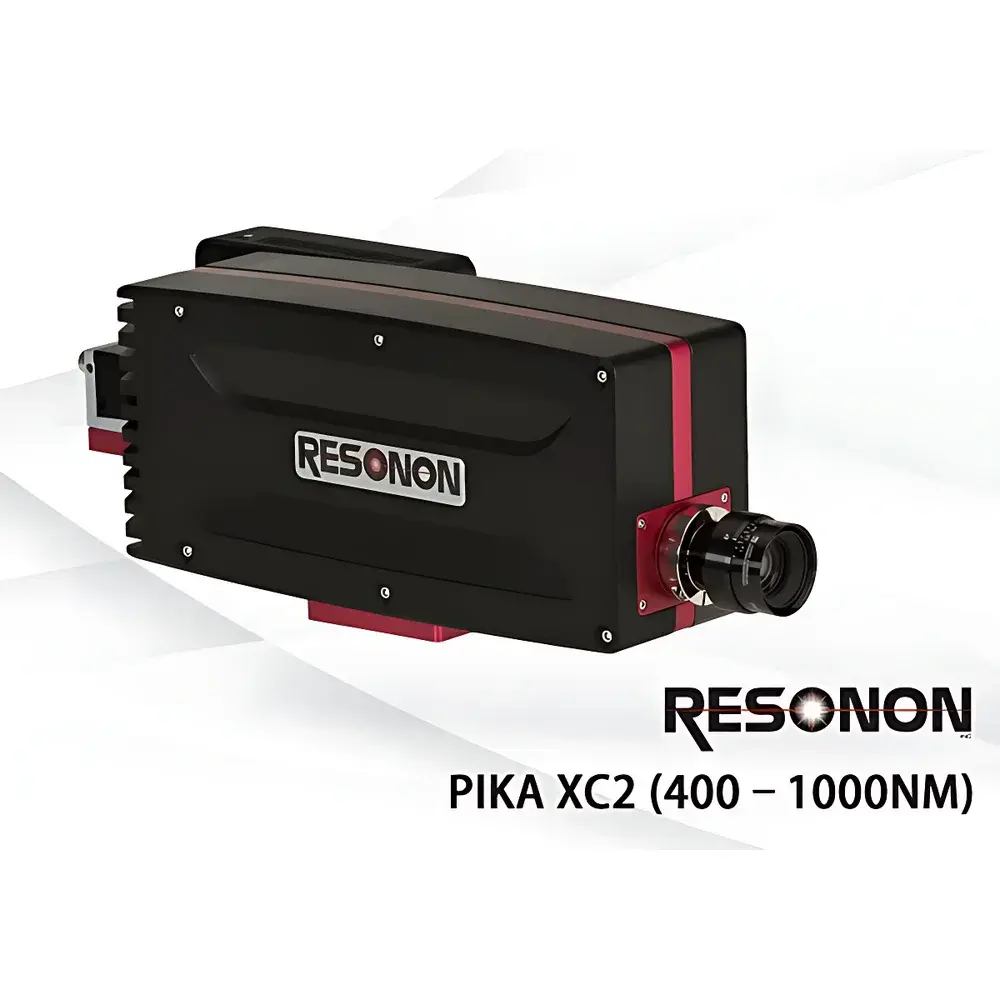
Resonon Pika XC2 Hyperspectral Imaging Camera
| Brand | Resonon |
|---|---|
| Origin | USA |
| Model | Pika XC2 |
| Operating Principle | Push-broom |
| Imaging Method | Dispersive |
| Platform Compatibility | Ground-based & Airborne |
| Spectral Range | 400–1000 nm |
| Spectral Resolution | 1.3 nm |
| Spatial Resolution (IFOV) | 0.36–1.1 mrad (configurable) |
| Field of View (TFOV) | 7.2°, 10.0°, or 21.5° (interchangeable optics) |
| Maximum Frame Rate | 171 fps |
| Spatial Pixels per Line | 1600 |
| Spectral Bands | 447 |
| Bit Depth | 12-bit |
| Weight | 2.2 kg |
| Dimensions | 10.1 × 27.5 × 7.4 cm |
| Aperture | f/2.4 |
| Pixel Size | 5.86 µm |
| RMS Spot Radius (avg.) | 6 µm |
| Smile (peak-to-peak) | 4 µm |
| Keystone (peak-to-peak) | 5 µm |
| Interface | USB 3.0 |
| Operating Temperature | 5–40 °C |
| Software Support | Native Windows & Linux drivers |
Overview
The Resonon Pika XC2 is a compact, lightweight push-broom hyperspectral imaging camera engineered for high-fidelity spectral data acquisition across visible and near-infrared (VNIR) wavelengths (400–1000 nm). Leveraging dispersive prism-based optical architecture, the Pika XC2 captures spatially registered spectral cubes at high frame rates—up to 171 fps—with 447 contiguous spectral bands and 1600 spatial pixels per scan line. Its design emphasizes optical fidelity: low smile (<4 µm p-p), low keystone (<5 µm p-p), and an average RMS spot radius of 6 µm ensure minimal geometric distortion and spectrally consistent pixel response. The f/2.4 aperture and 5.86 µm pixel pitch optimize photon collection efficiency while maintaining diffraction-limited performance across its operational temperature range (5–40 °C). Unlike scanning or snapshot systems, the push-broom method enables synchronized spatial-spectral sampling ideal for motion-compensated platforms—including UAVs, ground vehicles, conveyor belts, and laboratory goniometers—without requiring complex calibration for velocity-dependent smearing.
Key Features
- High spectral resolution of 1.3 nm FWHM across 400–1000 nm, enabling discrimination of narrow absorption features in vegetation pigments, mineral signatures, and chemical functional groups.
- Configurable field-of-view optics (7.2°, 10.0°, or 21.5° TFOV) paired with selectable instantaneous field-of-view (0.36–1.1 mrad IFOV) to support diverse standoff distances and spatial sampling requirements.
- Ruggedized aluminum housing (10.1 × 27.5 × 7.4 cm, 2.2 kg) rated for airborne vibration and thermal cycling; no moving parts in the optical path ensures long-term stability and minimal maintenance.
- USB 3.0 interface provides real-time data streaming without external frame grabbers; native drivers support both Windows and Linux environments for seamless integration into custom acquisition pipelines.
- 12-bit digitization with high dynamic range (>60 dB SNR typical) and low stray light (<0.1% relative irradiance) preserves quantitative radiometric integrity for reflectance and emissivity modeling.
- C++ Software Development Kit (SDK) enables full control over exposure, ROI selection, trigger modes, and metadata embedding—critical for automated QA/QC, embedded AI inference, or synchronization with LiDAR/GNSS units.
Sample Compatibility & Compliance
The Pika XC2 is platform-agnostic and validated for use in regulated and research-grade applications requiring traceable spectral measurement. Its optical performance meets ASTM E2795-22 criteria for hyperspectral sensor characterization, including spectral bandpass uniformity and spatial-spectral registration accuracy. When deployed with NIST-traceable reflectance standards (e.g., Spectralon® panels) and calibrated illumination sources, the system supports ISO/IEC 17025-compliant spectral reflectance mapping. For industrial process monitoring, it operates within FDA 21 CFR Part 11-compliant workflows when integrated with audit-trail-enabled acquisition software. No internal radiation source or hazardous materials are present; CE, FCC, and RoHS compliance is documented in the manufacturer’s technical dossier.
Software & Data Management
Data output conforms to standard ENVI-compatible .hdr/.bil formats with embedded wavelength vectors, GPS timestamps (when externally synchronized), and radiometric calibration coefficients. Resonon’s proprietary PikaLabs software provides real-time preview, spectral library matching (USGS, ECOSTRESS, SPECCHIO), and PCA-based anomaly detection. For enterprise deployment, the SDK allows integration with Python (via ctypes), MATLAB, or LabVIEW for batch processing, cloud ingestion (AWS S3, Azure Blob), or edge inference using ONNX models. All raw and processed datasets retain EXIF-like metadata—including exposure time, lens ID, temperature logs, and optical alignment flags—to satisfy GLP/GMP documentation requirements.
Applications
- Agricultural phenotyping: Quantification of chlorophyll-a/b, anthocyanin, and nitrogen indices via continuum-removed absorption depth analysis at 680 nm, 760 nm, and 820 nm.
- Mineral exploration: Discrimination of kaolinite, montmorillonite, and jarosite based on OH– and Fe³⁺ absorption features between 2100–2300 nm (requires optional extended-range variant; XC2 covers primary VNIR diagnostics).
- Pharmaceutical tablet coating uniformity: Detection of API distribution heterogeneity at sub-millimeter scale using spectral unmixing of lactose, HPMC, and active ingredient signatures.
- Recycling sorting: Real-time classification of PET, HDPE, and PVC polymers via characteristic C–H and C=O vibrational overtones resolved within the 700–950 nm window.
- Forensic document analysis: Differentiation of ink formulations and erased alterations through subtle spectral shifts in organic dye degradation products.
FAQ
Is the Pika XC2 suitable for UAV-mounted operation?
Yes—the 2.2 kg mass, low power draw (<8 W), and shock-resistant housing meet Class I UAV payload specifications; inertial measurement unit (IMU) synchronization is supported via TTL trigger and PPS input.
Can spectral calibration be performed in-field?
Yes—using Resonon’s portable calibration kit (NIST-traceable tungsten-halogen lamp + integrating sphere), users can generate updated radiometric and spectral response files on-site without returning to the lab.
Does the system support hardware triggering for synchronized multi-sensor setups?
Yes—programmable GPIO pins accept TTL-level start/stop triggers and provide encoder pulse outputs for motion-compensated scanning on linear stages or rotary tables.
What level of spectral preprocessing is required before quantitative analysis?
Raw data requires dark current subtraction and flat-field correction; Resonon provides factory-measured non-uniformity correction (NUC) maps, and the SDK includes functions for atmospheric correction (MODTRAN-based) when paired with co-located weather sensors.
Is remote firmware update capability available?
Yes—firmware revisions are delivered as signed binary packages; updates are applied via USB 3.0 without disassembly or service intervention.





