
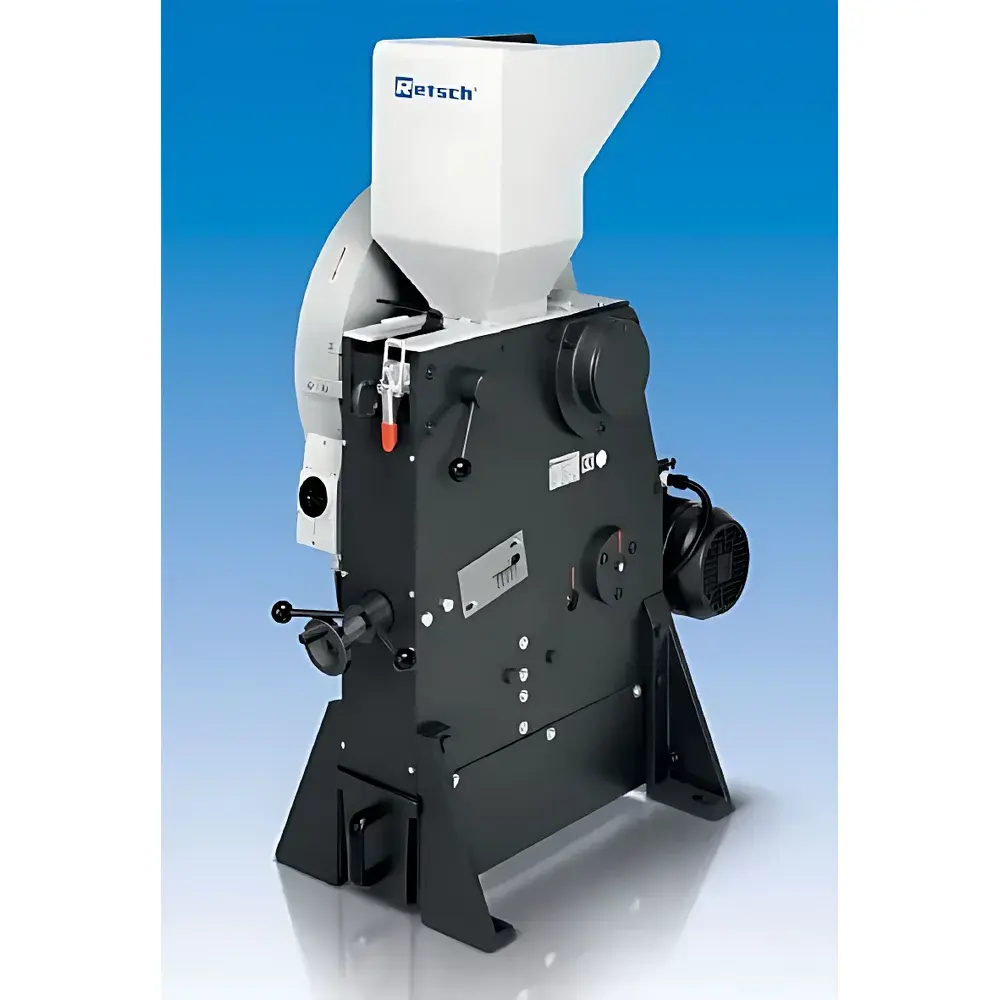
Retsch BB200 Jaw Crusher
| Brand | Retsch |
|---|---|
| Origin | Germany |
| Model | BB200 |
| Crusher Type | Jaw Crusher |
| Sample Type | Hard, brittle, and medium-hard materials |
| Max. Feed Size | < 90 mm |
| Final Particle Size (d90) | < 2 mm |
| Throughput | 300 kg/h |
| Jaw Plate Dimensions | 100 × 100 mm |
| Adjustable Gap Range | 0–30 mm |
| Gap Indication | Analog scale |
| Receiving Container Volume | 5 L |
| Motor Power | 1500 W |
| Dimensions (W × H × D) | 450 × 1160 × 900 mm |
| Net Weight | ~300 kg |
| Compliance | CE certified |
| Optional Features | Dust extraction interface, reversible funnel, central lubrication kit, mounting frame |
Overview
The Retsch BB200 Jaw Crusher is a robust, heavy-duty laboratory and pilot-scale crushing instrument engineered for reliable pre-crushing and coarse comminution of hard, brittle, and medium-hard solid materials. Based on the proven principle of compressive crushing—where material is subjected to high mechanical stress between two opposing jaw plates—one fixed and one moving in an elliptical motion driven by an eccentric shaft—the BB200 delivers consistent particle size reduction through controlled mechanical force. Unlike impact or shear-based grinders, jaw crushing minimizes heat generation and sample degradation, making it ideal for thermally sensitive or structurally heterogeneous feedstocks. Designed for reproducible operation under continuous or batch loading conditions, the BB200 serves as a critical first-stage size reduction unit upstream of analytical instrumentation (e.g., XRF, XRD, ICP-OES), sample homogenization workflows, or preparatory steps for geochemical, metallurgical, and cementitious material analysis.
Key Features
- High-capacity throughput of up to 300 kg/h with stable performance across extended operating cycles
- Adjustable crushing gap (0–30 mm) with analog scale readout enabling precise control over final particle size distribution
- Zero-point calibration function compensates for jaw plate wear, maintaining dimensional accuracy and repeatability over time
- Reversible, splash-free feed funnel ensures operator safety and minimizes cross-contamination during sample loading
- Four interchangeable jaw plate materials (manganese steel, hardened steel, tungsten carbide, ceramic) optimized for specific abrasion resistance and contamination control requirements
- Integrated safety features including motor brake system and interlocked safety switch compliant with EN 60204-1
- Tool-free access to grinding chamber and rapid-clean design reduce downtime between samples
- Optional dust extraction port compatible with standard laboratory vacuum systems (e.g., HEPA-filtered units) supports ISO 14001 and OSHA PEL compliance
- Modular configuration options include central lubrication system, floor-mounting frame, and integrated vibration damping base
Sample Compatibility & Compliance
The BB200 is validated for use with geological aggregates (granite, basalt, quartz), industrial minerals (feldspar, slag, fly ash), construction waste, coal, refractory ceramics, metal alloys (e.g., tungsten carbide), and oxide-based powders. Its mechanical design accommodates feed particles up to 90 mm in maximum dimension and yields a d90 ≤ 2 mm output under standard operating conditions—suitable for subsequent milling, fusion bead preparation, or direct instrumental analysis. The instrument meets CE marking requirements per Directive 2006/42/EC (Machinery Directive) and conforms to EN 61000-6-2 (EMC immunity) and EN 61000-6-4 (EMC emission) standards. For regulated environments, optional documentation packages support GLP-compliant validation protocols, including IQ/OQ templates and traceable calibration records aligned with ISO/IEC 17025 requirements.
Software & Data Management
The BB200 operates as a standalone mechanical device without embedded firmware or digital control interface. However, its analog gap scale, calibrated zero-point reference, and repeatable mechanical actuation enable full traceability when integrated into laboratory information management systems (LIMS) via manual log entries or external process documentation. Operators may record gap settings, feed mass, runtime, and observed throughput in accordance with internal SOPs or regulatory frameworks such as FDA 21 CFR Part 11 (when paired with electronic lab notebooks). Optional accessories—including vibration monitoring sensors and load-cell-equipped feed hoppers—facilitate integration with SCADA or MES platforms for real-time throughput analytics in pilot plant applications.
Applications
- Preparation of representative sub-samples from bulk ore shipments prior to assay or grade evaluation
- Routine size reduction of cement clinker and supplementary cementitious materials (SCMs) for Blaine surface area testing
- Crushing of refractory bricks and furnace linings for compositional mapping via SEM-EDS or XRF
- Conditioning of construction and demolition waste (CDW) for leaching tests (e.g., EN 12457 series)
- Primary comminution of geological core samples before pulverization for geochemical fingerprinting
- Processing of spent catalysts and metallurgical slags for elemental recovery feasibility studies
- Feedstock conditioning for thermal analysis (TGA/DSC) and hydrometallurgical leach optimization trials
FAQ
What is the recommended maintenance schedule for the BB200?
Routine inspection of jaw plate wear, bolt torque verification, and lubrication of the eccentric shaft bearing should be performed every 200 operating hours or at the end of each major campaign.
Can the BB200 be used for cryogenic or wet crushing?
No—the BB200 is designed exclusively for dry, ambient-temperature crushing of solid materials. Moisture or low-temperature embrittlement may compromise mechanical integrity and void warranty coverage.
Is the receiving container included with the base configuration?
Yes—a 5-liter removable polyethylene collection pan is supplied as standard equipment, featuring ergonomic handles and alignment guides for secure placement.
How does jaw plate material selection affect analytical results?
Material choice directly influences potential elemental contamination; tungsten carbide plates minimize Fe/Cr/Ni leaching in stainless-steel-sensitive assays, while ceramic variants prevent metallic interference in semiconductor-grade silicon processing.
Does Retsch provide application-specific validation support?
Yes—Retsch Application Laboratories offer method development services, including particle size distribution profiling (via laser diffraction or sieve analysis), wear rate assessment, and throughput optimization reports tailored to client feedstock characteristics.



