
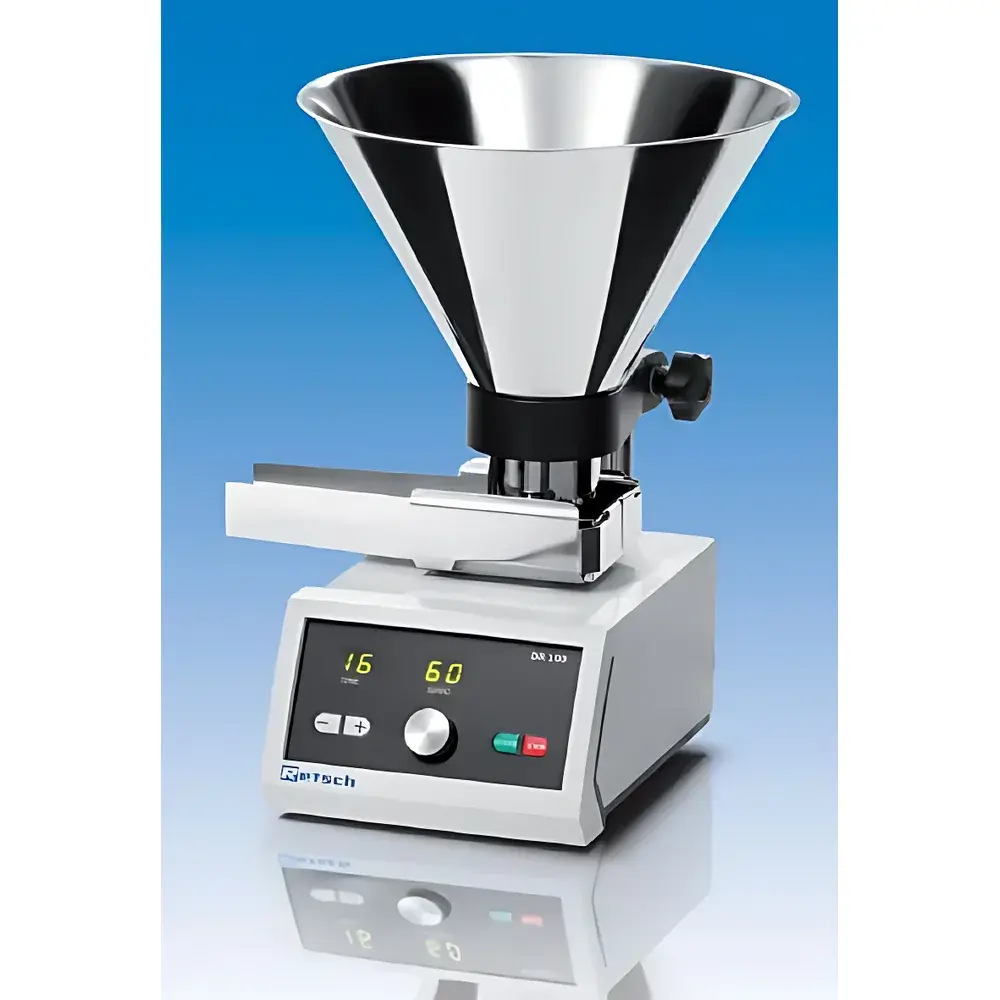
Retsch DR100 Vibratory Feed Unit
| Brand | Retsch |
|---|---|
| Origin | Germany |
| Model | DR100 |
| Feed Rate | 0–5 L/min (infinitely adjustable) |
| Feed Slot Width | 15 mm / 40 mm / 75 mm |
| Feed Slot Length | 210 mm |
| Hopper Capacity | 2.8 L (15/40 mm) / 3.5 L (75 mm) |
| Dimensions (W×H×D) | 260 × 420 × 280 mm |
| Weight | ~10 kg |
| Vibration Frequency | 50/60 Hz |
| Power Supply | 24 W per electromagnet |
| Max. Particle Size | <2 mm (15 mm slot) / <6 mm (40 mm slot) / <12 mm (75 mm slot) |
| Timer | Digital, 1–99 min or continuous operation |
| Compliance | CE certified |
| Maintenance | Maintenance-free design |
Overview
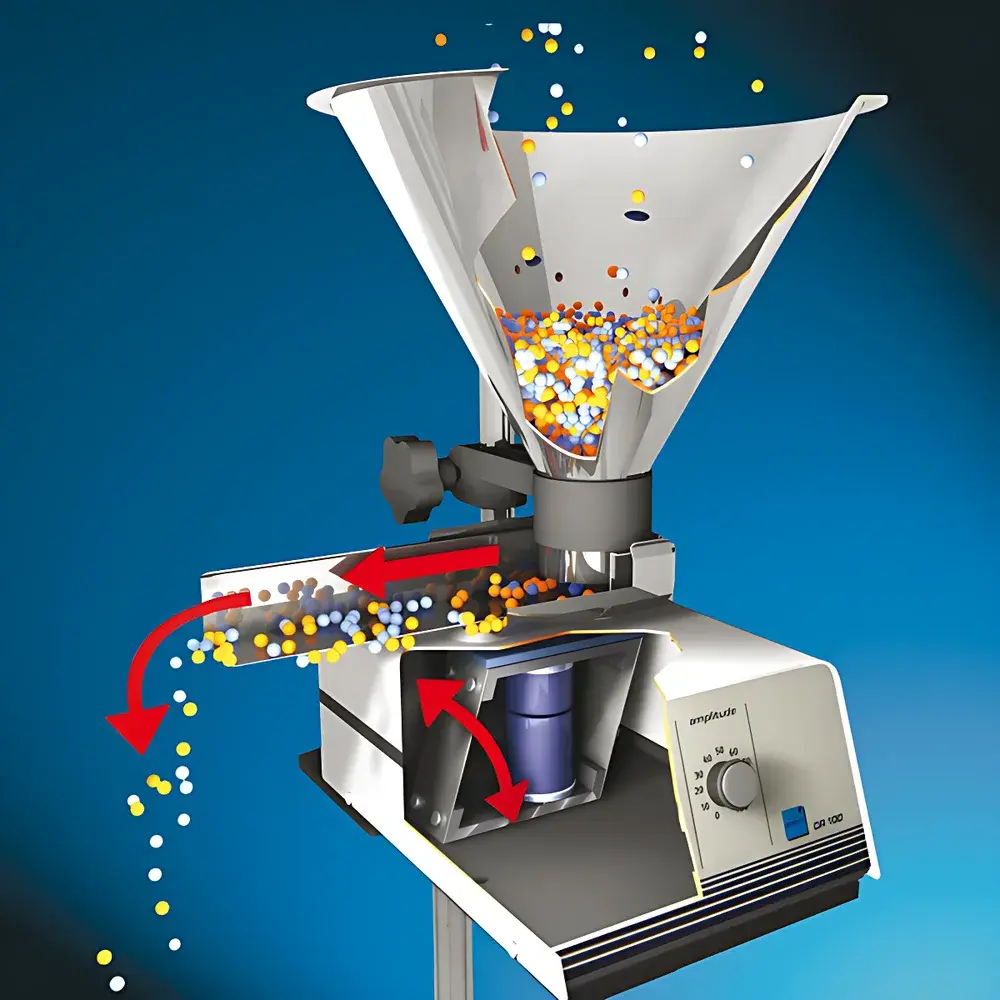
The Retsch DR100 Vibratory Feed Unit is a precision-engineered sample introduction system designed for reproducible, continuous, and uniform feeding of free-flowing bulk solids and fine powders into downstream analytical or processing equipment. Based on electromagnetic vibratory actuation, the DR100 operates on the principle of controlled harmonic oscillation: two 24 W electromagnets generate a precise 50 Hz (or 60 Hz, depending on regional mains frequency) vibration transmitted to a rigid feed trough. This induces gentle yet consistent material movement without mechanical agitation, minimizing particle segregation, attrition, or compaction—critical for maintaining representative sampling integrity in particle size analysis, milling, or elemental testing workflows.
Key Features
- Maintenance-free electromagnetic drive system with dual 24 W actuators ensures long-term operational stability and eliminates wear-prone mechanical components.
- Infinitely variable feed rate control (0–5 L/min) enables precise adaptation to diverse material flow characteristics and instrument throughput requirements.
- Vertically adjustable hopper allows real-time optimization of material bed height on the feed trough—essential for consistent layer formation across varying powder densities, moisture content, or cohesiveness.
- Three interchangeable feed trough widths (15 mm, 40 mm, 75 mm) support scalable applications—from micro-sampling for laser diffraction analyzers to high-volume feeding for centrifugal disc mills such as the Retsch ZM 100.
- Digital timer (1–99 minutes or continuous mode) provides programmable feed duration with repeatable start/stop logic, supporting unattended operation in GLP-compliant environments.
- Compact footprint (260 × 420 × 280 mm) and modular mounting interface facilitate seamless integration into existing laboratory benches or automated sample preparation lines.
- CE-certified construction complies with EU Machinery Directive 2006/42/EC and Electromagnetic Compatibility Directive 2014/30/EU.
- Quick-access feed trough design enables rapid cleaning between samples—minimizing cross-contamination risk during multi-sample campaigns.
Sample Compatibility & Compliance
The DR100 accommodates dry, pourable, non-sticky granular materials with maximum particle sizes up to 12 mm (dependent on selected trough width). It is not intended for fibrous, highly cohesive, hygroscopic, or abrasive materials requiring forced conveyance. The unit supports compliance-critical workflows by enabling traceable, operator-independent feeding protocols—particularly valuable when paired with instruments subject to ISO 13320 (laser diffraction), ASTM E11 (test sieves), or USP <429> (particle size distribution in pharmaceuticals). Its maintenance-free architecture aligns with GMP Annex 15 expectations for equipment qualification (IQ/OQ) and reduces downtime-related deviations in regulated QC laboratories.
Software & Data Management
While the DR100 operates as a standalone electromechanical unit, its integrated 0–10 V analog input/output interface permits bidirectional communication with external controllers—including Retsch’s ZM 100 Ultra Centrifugal Mill and other third-party instruments equipped with analog process control capability. When synchronized with compatible devices, feed rate can be dynamically modulated based on real-time load feedback or mill motor current draw, preventing overfeeding and ensuring optimal grinding efficiency. No proprietary software is required; integration leverages standard industrial signal protocols, facilitating audit-ready logging within existing LIMS or SCADA environments compliant with FDA 21 CFR Part 11 (where electronic records and signatures are employed).
Applications
- Automated sample introduction for laser diffraction particle size analyzers (e.g., Sympatec HELOS, Malvern Mastersizer).
- Controlled feeding into sieve shakers (e.g., Retsch AS 200, ANALYSETTE 3) to ensure consistent mass loading per sieve fraction.
- Synchronized operation with ultra-centrifugal mills (ZM 100) for closed-loop comminution workflows where feed rate directly influences final particle size distribution.
- Preparatory dosing for X-ray fluorescence (XRF) or inductively coupled plasma (ICP) sample preparation systems requiring homogeneous powder presentation.
- Calibration validation of loss-in-weight (LIW) feeders using gravimetric reference methods.
FAQ
What types of materials are suitable for the DR100?
Free-flowing, dry, non-fibrous powders and granules with particle sizes below 12 mm—depending on selected feed trough width. Materials must exhibit sufficient mobility under low-amplitude vibration.
Can the DR100 be used in explosion-hazard areas?
No. The DR100 is not ATEX- or IECEx-certified. For hazardous environments, consult Retsch’s Ex-rated accessories or alternative pneumatic feeding solutions.
Is the feed rate calibrated or traceably verified?
The DR100 provides repeatable relative feed rate adjustment but does not include built-in mass flow measurement. For quantitative volumetric calibration, users should perform gravimetric verification using timed collection and weighing per ISO 11272.
How is cleaning performed between samples?
The feed trough is accessible via front-panel release; residual material is removed using compressed air or soft brushes. No tools are required, and full cleaning typically takes under 90 seconds.
Does the DR100 require periodic recalibration?
No. As a purely mechanical-vibratory device with no sensors or feedback loops, it maintains consistent performance over time without recalibration—provided mounting surfaces remain level and undamaged.



