
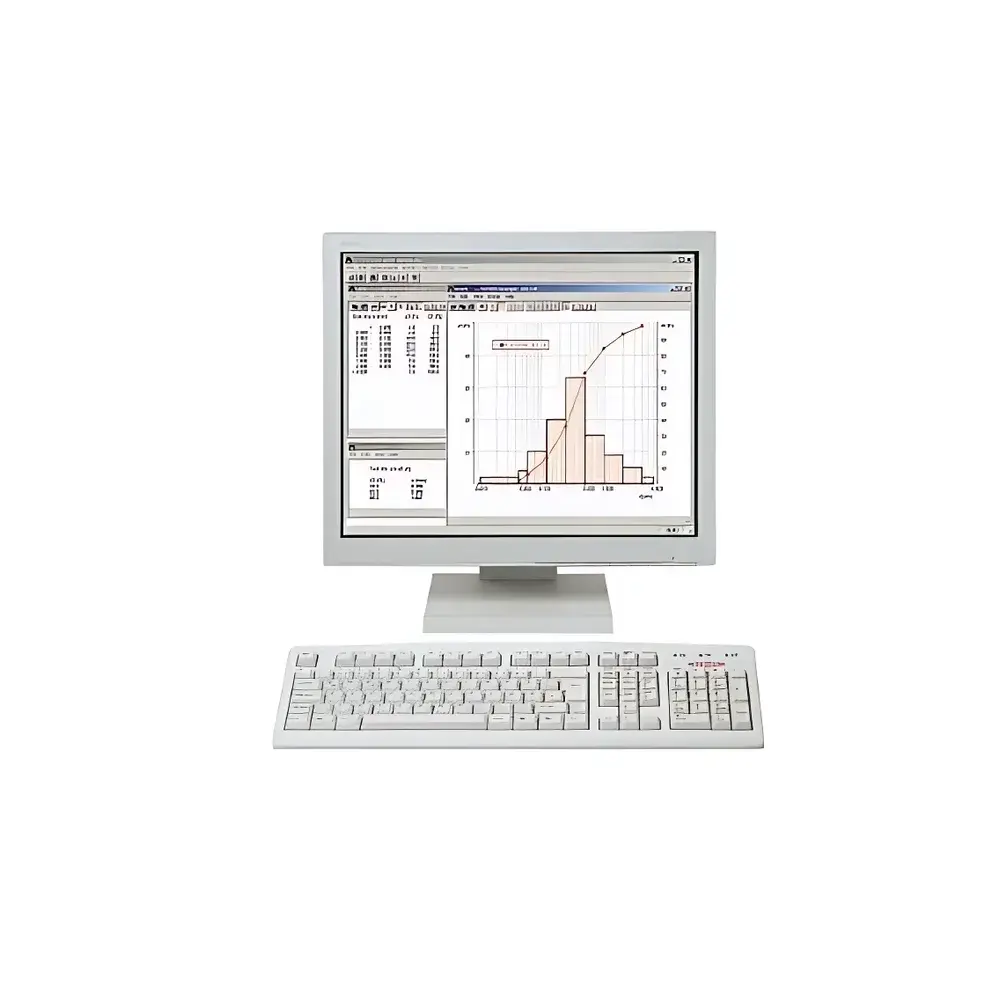
Retsch EasySieve Software for Sieve Analysis
| Brand | Retsch |
|---|---|
| Origin | Germany |
| Model | EasySieve |
| Compliance | DIN 66165, ASTM E11, ISO 3310-1, USP <786> |
| Data Export | ASCII, CSV, Excel-compatible |
| Integration | RETSCH “control” series sieve shakers, CAMSIZER®, CRYSTAL-SIZER®, LIMS via EasySieve® Comfort |
| Reporting | Automated DIN-compliant sieve analysis reports with Q₃(x), p₃(x), q₃(x), RRSB parameters, Sauter mean diameter (x₃₂), AFS fineness number, specific surface area (Sᵥ, Sₘ), splinter value, polydispersity index |
Overview
Retsch EasySieve® is a dedicated, Windows-based software platform engineered for the acquisition, calculation, visualization, and regulatory-compliant reporting of dry sieve analysis data. It operates in full synergy with RETSCH’s range of mechanical sieve shakers—including the AS 200, AS 450, and ANALYSETTE 3 “control” series—enabling fully automated mass measurement integration via RS-232 or USB-connected analytical balances. The software implements standardized particle size distribution mathematics rooted in cumulative mass fraction theory, computing key descriptors including Q₃(x) (cumulative passing), p₃(x) (class mass fraction), q₃(x) (distribution density), and log-normalized q₃*(x). Its core algorithmic framework adheres to the principles defined in DIN 66165 (German standard for sieve analysis evaluation), ASTM E11 (specification for wire cloth and sieves), and ISO 3310-1 (test sieves—technical requirements and testing). EasySieve® does not perform physical sieving; rather, it serves as the certified digital backbone for post-sieving data processing, ensuring traceability, reproducibility, and audit-readiness in GLP- and GMP-regulated environments.
Key Features
- Fully automated real-time data transfer from RETSCH “control”-series sieve shakers and compatible analytical balances
- Comprehensive parameter management: user-defined sieve stack configurations, tare weight storage, instrument calibration settings, and product-specific method templates
- Regulatory-grade reporting engine generating DIN 66165–compliant PDF/printed reports with embedded metadata (operator ID, timestamp, instrument serial, sieve mesh certification)
- Advanced statistical output: RRSB plot generation, splinter value (quantifying coarse fragment content), polydispersity index, AFS fineness number, and Sauter mean diameter (x₃₂)
- Specific surface area estimation (Sᵥ and Sₘ) based on mass-weighted particle size distribution and assumed particle geometry
- Encryption-enabled method protection to prevent unauthorized modification of validated sieve protocols
- Seamless bidirectional data exchange with LIMS via EasySieve® Comfort module using ASTM E1461-compliant messaging protocols
Sample Compatibility & Compliance
EasySieve® supports granular, free-flowing, non-agglomerating solid particulates across industrial and research domains—including foundry sands, metal powders (e.g., Ti-6Al-4V, Inconel 718), pharmaceutical excipients, agricultural seeds, mineral ores, cementitious materials, and polymer granules. All calculations assume spherical or near-spherical morphology and monomodal size distributions unless otherwise specified by user input. The software enforces strict compliance with international sieve standards: mesh sizes are referenced against certified wire cloth specifications per ISO 3310-1 and ASTM E11, with optional Tyler scale conversion. For regulated laboratories, EasySieve® Comfort includes full 21 CFR Part 11–compliant electronic signature support, audit trail logging (user actions, parameter changes, report generation events), and role-based access control—meeting FDA, EMA, and WHO-GMP documentation requirements.
Software & Data Management
Built on Microsoft .NET Framework for Windows 10/11 (64-bit), EasySieve® employs a modular architecture separating data acquisition, mathematical processing, and report generation layers. Raw mass values are ingested either manually or via direct balance interface; the software then auto-calculates residual and passing fractions per sieve cut point. All intermediate and final results are stored in an encrypted local SQLite database with SHA-256 hashing for integrity verification. Users may export datasets in ASCII, CSV, or Excel-native formats; graphical outputs (Q₃(x) curves, histogram bar plots, RRSB linearizations) are exportable as high-resolution PNG or EMF files. Integration with CAMSIZER® and CRYSTAL-SIZER® optical analyzers enables hybrid workflow correlation—allowing comparative validation between sieve and image-based sizing methods under identical sample preparation protocols.
Applications
- Quality control of additive manufacturing feedstock powders per ASTM F3049 and ISO/ASTM 52907
- Foundry sand grading verification per AFS 2221.0 and ISO 11171
- Pharmaceutical granule characterization supporting USP and ICH Q5A guidelines
- Soil texture classification in geotechnical labs per ASTM D422 and ISO 14688-1
- Coal ash fineness assessment for cement blending compliance (ASTM C618)
- Food powder consistency monitoring (e.g., flour, sugar, instant coffee) per ISO 8587
- Research-level particle breakage analysis using splinter value and fragmentation index metrics
FAQ
Does EasySieve® require a dedicated hardware dongle or network license server?
No. Licensing is node-locked to the host PC via hardware fingerprinting; no dongle or central license manager is required.
Can EasySieve® import historical sieve data from legacy spreadsheets?
Yes—via CSV template import with column mapping for sieve aperture, retained mass, and tare weights.
Is method validation support included for GxP environments?
Yes. The software provides IQ/OQ documentation templates, change control logs, and built-in performance verification routines per ASTM E2500.
What balance communication protocols are supported?
RS-232 (ASCII command set), USB HID, and Ethernet TCP/IP interfaces compliant with Mettler Toledo, Sartorius, and Shimadzu balance firmware versions ≥2018.
Does EasySieve® calculate span or uniformity coefficients?
Yes—automatically derived from x₁₀, x₅₀, and x₉₀ values in the Q₃(x) distribution, with optional display in report footers.



