
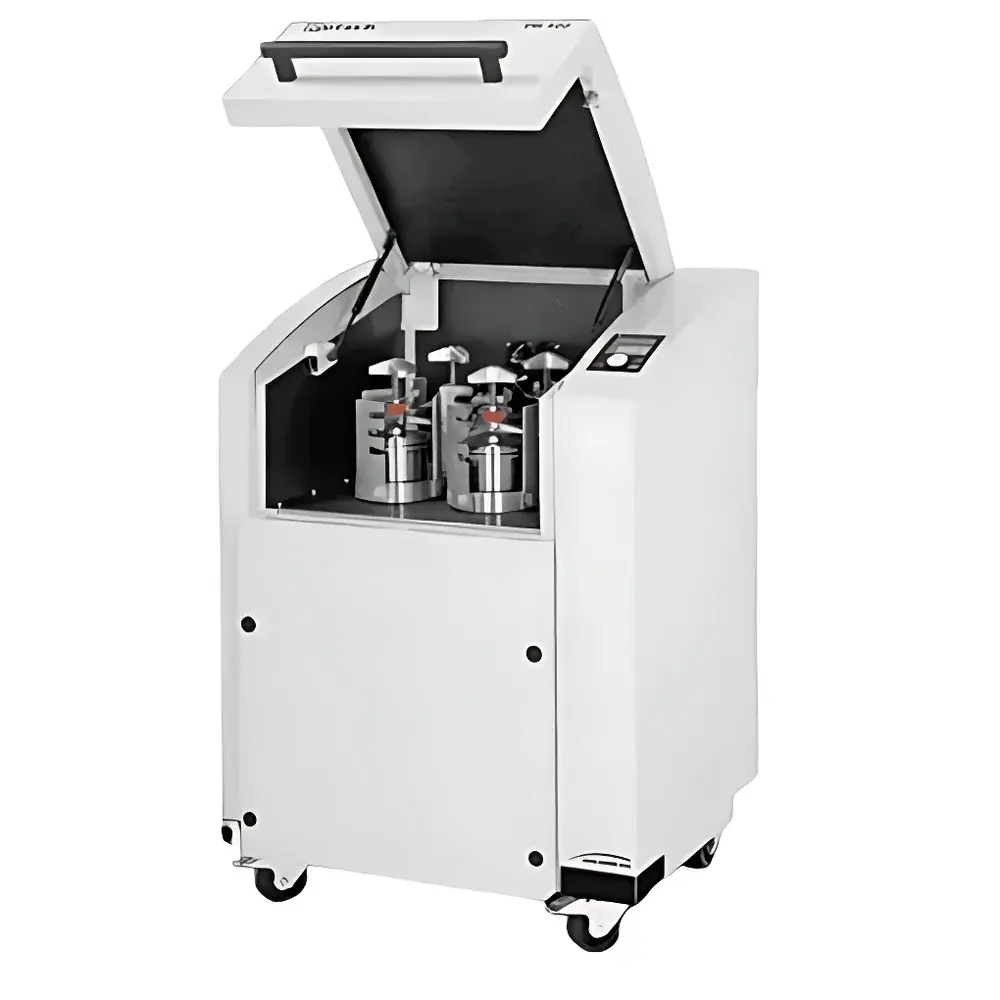
RETSCH PM 400 Planetary Ball Mill
| Brand | RETSCH |
|---|---|
| Origin | Germany |
| Model | PM 400 |
| Instrument Type | Planetary Ball Mill |
| Sample Applicability | Hard and brittle materials |
| Feed Size | < 10 mm |
| Final Particle Size | < 0.1 µm (achievable under optimized conditions) |
| Batch Capacity | up to 4 × 220 mL |
| Stacked Vial Configuration | up to 8 × 20 mL |
| Maximum Speed | 400 rpm |
| Grinding Principle | Planetary motion with counter-rotating grinding bowls (sun wheel : bowl = 1 : −2 to −3) |
| Temperature & Pressure Monitoring | Optional GrindControl Kit |
| Grinding Modes | Dry and wet |
| SOP Storage | 10 protocols |
| Max. Runtime | 99 h with programmable pauses and direction reversal |
Overview
The RETSCH PM 400 is a high-energy, floor-standing planetary ball mill engineered for reproducible, high-throughput size reduction and mechanical activation of hard, brittle, fibrous, or temperature-sensitive materials. Operating on the principle of planetary motion, the instrument subjects grinding media and samples to intense centrifugal and Coriolis forces generated by the differential rotation between the sun wheel (driving disk) and the grinding bowls—typically at a fixed speed ratio of 1:−2, 1:−2.5, or 1:−3. This kinematic configuration ensures that grinding balls experience repeated high-velocity impacts and shear stresses, enabling efficient comminution down to sub-micron particle sizes (< 0.1 µm), particularly in applications such as mechanochemical synthesis, mechanical alloying, nanomaterial preparation, and homogenization of heterogeneous composites.
Key Features
- Four independent grinding stations accommodating jars from 12 mL to 500 mL; smaller jars (12–80 mL) can be stacked vertically to double throughput per station
- Maximum rotational speed of 400 rpm with large-diameter sun wheel for enhanced energy input
- Programmable bidirectional rotation to minimize agglomeration and improve dispersion uniformity
- Integrated safety interlocks: mechanical locking system, sensor-based jar clamping verification, and imbalance detection for unattended operation
- GrindControl optional module enables real-time monitoring of internal jar temperature and pressure during milling—critical for exothermic mechanochemical reactions or atmosphere-controlled synthesis
- Human-centered interface with intuitive single-button navigation, backlit LCD display, and ergonomic parameter entry
- Automatic grinding chamber ventilation post-run; built-in power-failure backup retains remaining processing time and active SOP settings
- Support for dry and wet grinding across five jar material options: hardened steel, stainless steel, tungsten carbide, agate, and polyurethane—each selected to minimize contamination and maximize chemical compatibility
Sample Compatibility & Compliance
The PM 400 demonstrates broad applicability across diverse material classes—including metals (e.g., iron ore, silicon carbide), ceramics (quartz, alumina), minerals (kaolin, bentonite), polymers (PMMA), biological tissues (bone, hair), and composite waste streams (e-waste, slag, compost). Its robust architecture meets stringent laboratory safety standards, including CE marking per Machinery Directive 2006/42/EC and electromagnetic compatibility (EMC) compliance per EN 61326-1. While not inherently GLP/GMP-certified, the instrument supports audit-ready workflows when paired with validated SOPs and GrindControl data logging—facilitating traceability in regulated environments aligned with ISO/IEC 17025 and ASTM E2917 guidelines for mechanical testing of particulate systems.
Software & Data Management
The PM 400 operates via an embedded firmware platform—not PC-dependent software—ensuring deterministic timing and immunity to external OS interruptions. Up to ten standard operating procedures (SOPs) can be stored internally, each defining speed, duration, pause intervals, direction sequence, and start delay. All parameters are timestamped and logged upon completion. When equipped with GrindControl, temperature and pressure traces are saved in CSV format for post-processing in third-party analysis tools. The system does not require FDA 21 CFR Part 11-compliant electronic signatures out-of-the-box but is compatible with external LIMS integration via RS232 or optional Ethernet module for centralized data governance.
Applications
Mechanochemical synthesis of co-crystals, metal–organic frameworks (MOFs), and solid-state electrolytes; mechanical alloying of Fe–Al, Ni–Ti, or Mg–H systems; top-down nanomaterial production (e.g., graphene oxide exfoliation, quantum dot synthesis); homogenization of catalyst precursors and ceramic slurries; pretreatment of geological, environmental, and forensic samples prior to XRD, SEM-EDS, or ICP-MS analysis; and long-duration stability testing of pharmaceutical intermediates under inert or reactive atmospheres using RETSCH gas-tight lids.
FAQ
What is the smallest achievable particle size with the PM 400?
Under optimized conditions—including appropriate jar material, ball-to-powder ratio, rotational speed, and milling time—particle sizes below 0.1 µm (100 nm) can be attained for brittle inorganic materials like quartz or silicon carbide.
Can the PM 400 perform cryogenic milling?
No—the instrument is not designed for liquid nitrogen cooling. For low-temperature milling, users must employ pre-chilled jars and balls, and limit run times to avoid thermal drift; dedicated cryo-mills are recommended for sustained sub-zero operation.
Is wet grinding supported, and what solvent compatibility should be considered?
Yes, wet grinding is fully supported. Jar and ball material selection must account for solvent compatibility—for example, agate jars for HF-containing solutions, stainless steel for aqueous organics, and polyurethane for highly abrasive slurries.
How does the imbalance sensor function during unattended operation?
The sensor continuously monitors vibration amplitude and frequency spectra; if deviation exceeds preset thresholds indicating jar misalignment or uneven loading, the drive automatically decelerates and halts before reaching unsafe operational limits.
What documentation is provided for IQ/OQ validation?
RETSCH supplies factory calibration certificates, mechanical performance test reports, and user manuals compliant with ISO 9001. Site-specific IQ/OQ protocols require lab-developed test scripts aligned with local regulatory expectations and equipment configuration.



