
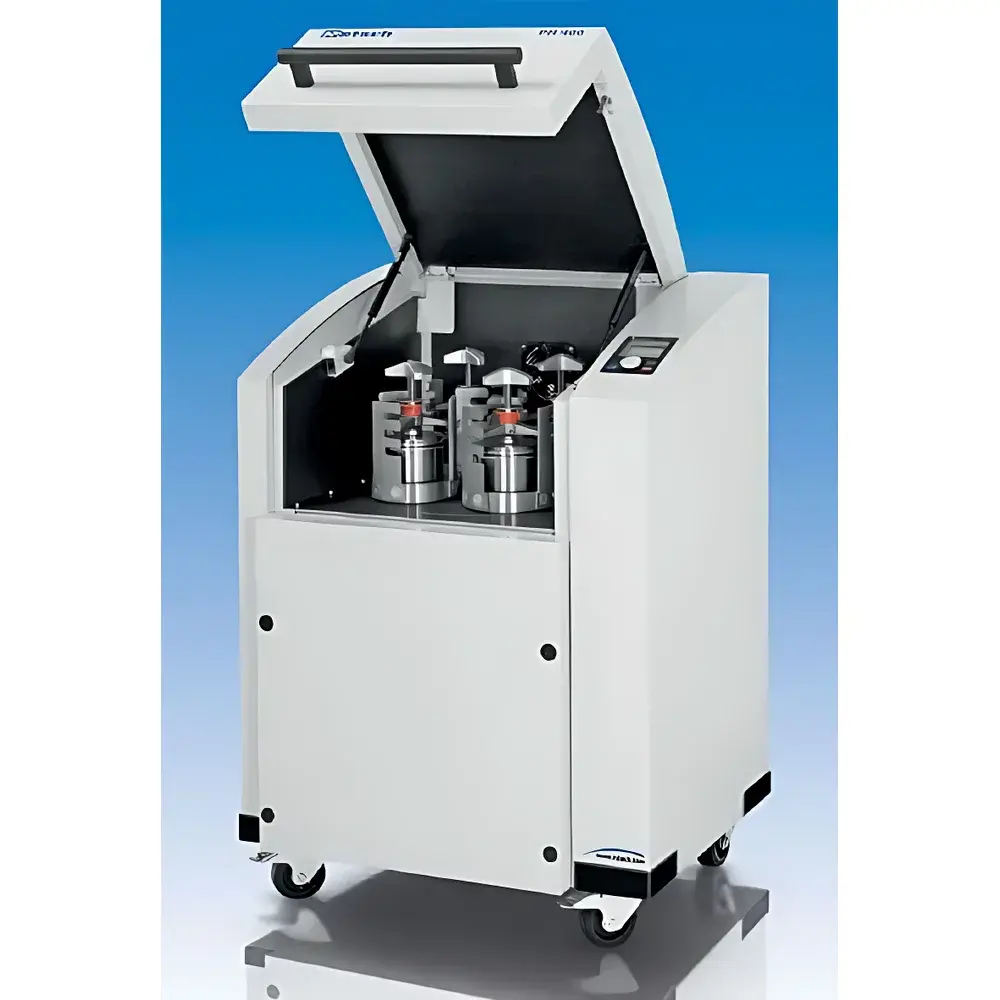
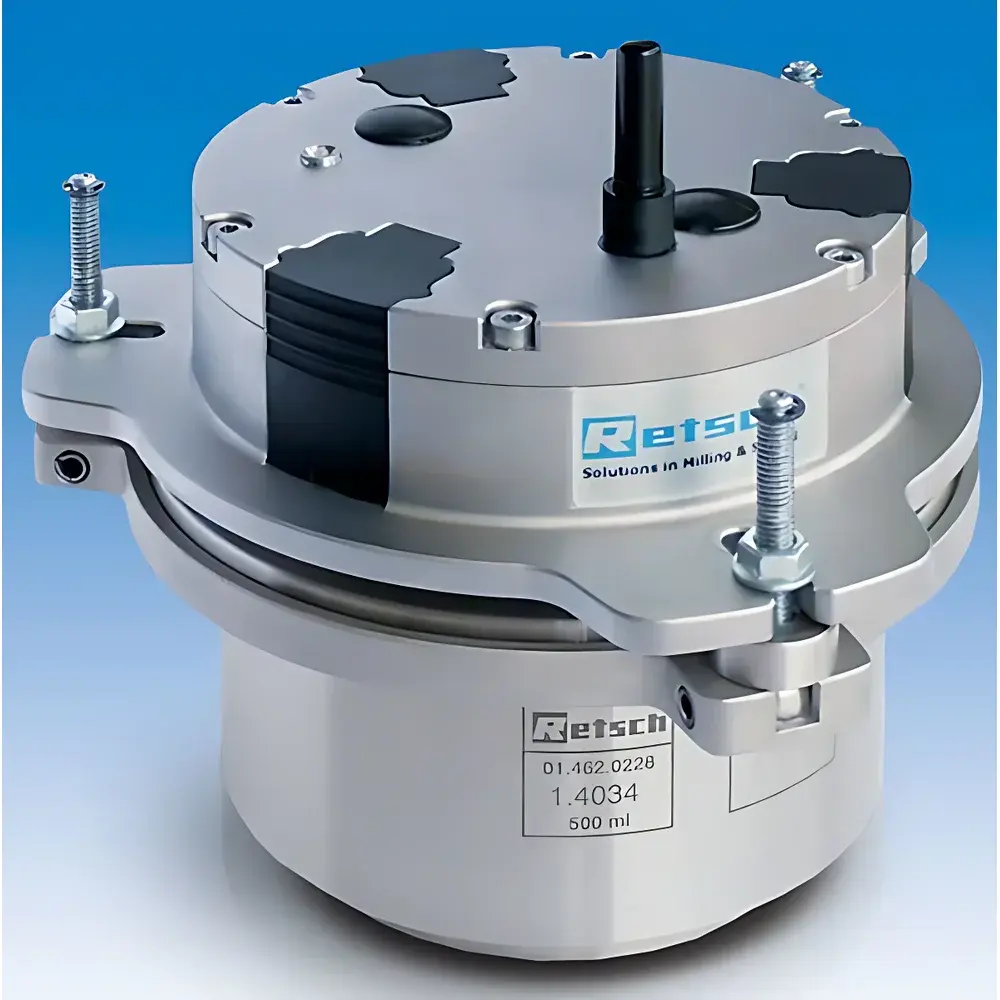
Retsch PM400MA High-Energy Planetary Ball Mill for Alloy Grinding
| Brand | Retsch |
|---|---|
| Origin | Germany |
| Model | PM400MA |
| Instrument Type | Planetary Ball Mill |
| Sample Applicability | Hard and Brittle Materials (e.g., Alloys, Carbides, Metals) |
| Final Particle Size | ≤1 µm |
| Feed Size | <10 mm |
| Batch Capacity | Up to 4 × 220 mL |
| Sun Wheel Diameter | 300 mm |
| Display | Large LED Digital Interface |
| Dimensions (W×H×D) | 836 × 1220 × 780 mm |
| Weight | ~290 kg |
| Certification | CE |
| Programmable Memory | 3 Preset Methods |
| Parameter Lock Function | Yes |
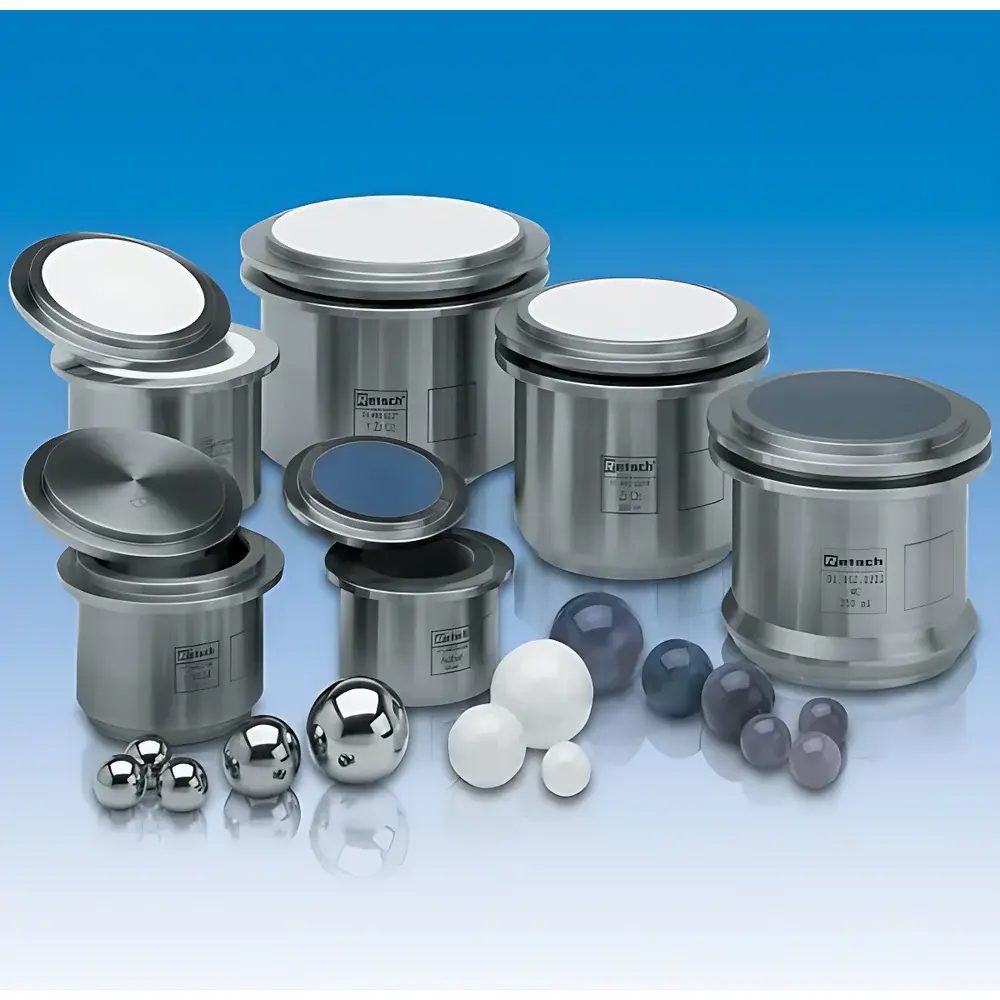
| Grinding Jar Volumes Available | 12, 25, 50, 80, 125, 250, 500 mL |
Overview
The Retsch PM400MA is a high-energy planetary ball mill engineered specifically for the ultra-fine comminution of exceptionally hard and ductile materials—particularly metallic alloys, intermetallic compounds, and refractory metals. Unlike standard planetary mills, the PM400MA features an optimized gear ratio between the sun wheel and grinding jars, delivering significantly higher impact energy per collision cycle. This mechanical design enables efficient particle size reduction through intense inertial forces generated by centrifugal acceleration and Coriolis effects during high-speed rotation. The instrument operates on the principle of planetary motion: grinding jars rotate on their own axes while simultaneously revolving around a central sun wheel, creating superimposed rotational vectors that maximize kinetic energy transfer to the sample. As a result, the PM400MA achieves reproducible sub-micron final particle sizes (down to ≤1 µm), making it suitable for applications requiring homogenized, nanostructured, or amorphous alloy powders—such as metallurgical research, additive manufacturing feedstock preparation, and solid-state reaction synthesis.
Key Features
- Alloy-optimized drive system with enhanced speed ratio for superior impact energy delivery
- Digital speed and time control ensuring constant rotational velocity throughout grinding cycles
- High-precision LED display with intuitive interface for real-time parameter monitoring
- Three programmable memory slots for storing validated grinding protocols
- Parameter lock function to prevent unintended modifications during operation or multi-user environments
- Robust cast-iron housing and vibration-dampened base for stable operation at up to 650 rpm (sun wheel)
- Compliance with CE safety directives for laboratory equipment (2014/30/EU EMC & 2014/35/EU LVD)
Sample Compatibility & Compliance
The PM400MA is validated for processing hard, brittle, and moderately ductile inorganic samples—including titanium alloys, nickel-based superalloys, stainless steels, tungsten carbides, and rare-earth magnets. Its high-energy configuration mitigates cold welding and agglomeration issues commonly observed when milling ductile metals. Grinding jars are available in multiple materials (stainless steel, hardened steel, tungsten carbide, zirconia, agate) to minimize contamination and enable chemically inert processing. All jar volumes (12–500 mL) maintain geometric consistency to ensure uniform energy distribution across batches. The system supports GLP-compliant documentation workflows when integrated with external lab management software; though the mill itself does not include FDA 21 CFR Part 11 audit trail functionality, its repeatable digital protocol storage aligns with ISO/IEC 17025 requirements for method validation and traceability.
Software & Data Management
The PM400MA operates via standalone embedded firmware without proprietary PC software. All operational parameters—including speed (rpm), time (0.01–99h 59m), direction (forward/reverse), and pause intervals—are set directly on the front-panel LED interface. Each stored method retains full parameter sets, enabling rapid recall and cross-laboratory method transfer. While no native data export capability exists, users may log operational records manually or integrate the mill into broader LIMS ecosystems using external timers and electronic lab notebooks. For regulatory environments, manual SOP adherence (e.g., recording batch ID, jar material, speed, duration, cooling intervals) satisfies ASTM E2917-22 guidelines for mechanical alloying process documentation.
Applications
- Production of nanocrystalline and amorphous alloy powders for sintering and binder jetting
- Mechanical alloying of immiscible metal systems (e.g., Al–Fe, Cu–Ti)
- Preparation of reactive metal powders for hydrogen storage studies
- Homogenization of master alloys prior to spectroscopic analysis (XRF, ICP-OES)
- Grinding of hard ceramic-metal composites for TEM lamella preparation
- Accelerated solid-state synthesis of intermetallic phases under controlled atmosphere (when used with gas-tight jars)
FAQ
What distinguishes the PM400MA from the standard PM400 model?
The PM400MA features a modified gear train that increases the relative angular velocity between the sun wheel and grinding jars, resulting in higher impact energy—critical for fracturing tough metallic alloys without excessive heat buildup.
Can the PM400MA be used under inert or reducing atmospheres?
Yes, when equipped with gas-tight grinding jars and compatible sealing kits, the system supports argon or nitrogen purging for oxygen-sensitive alloy processing.
Is cryogenic grinding supported?
The PM400MA is not designed for direct liquid nitrogen cooling; however, pre-chilled jars and low-temperature-compatible grinding media (e.g., hardened steel) allow extended low-heat operation for thermally sensitive alloys.
What maintenance is required for long-term reliability?
Routine inspection of gear lubrication, jar clamping mechanisms, and vibration isolation mounts is recommended every 500 operating hours; no scheduled calibration is required due to the purely mechanical speed control architecture.
Does Retsch provide application support for alloy-specific protocols?
Yes—Retsch’s Application Laboratory offers validated grinding methods for common alloys (e.g., Inconel 718, Ti-6Al-4V), including optimal jar material selection, ball-to-powder ratio, and cooling interval recommendations.



