
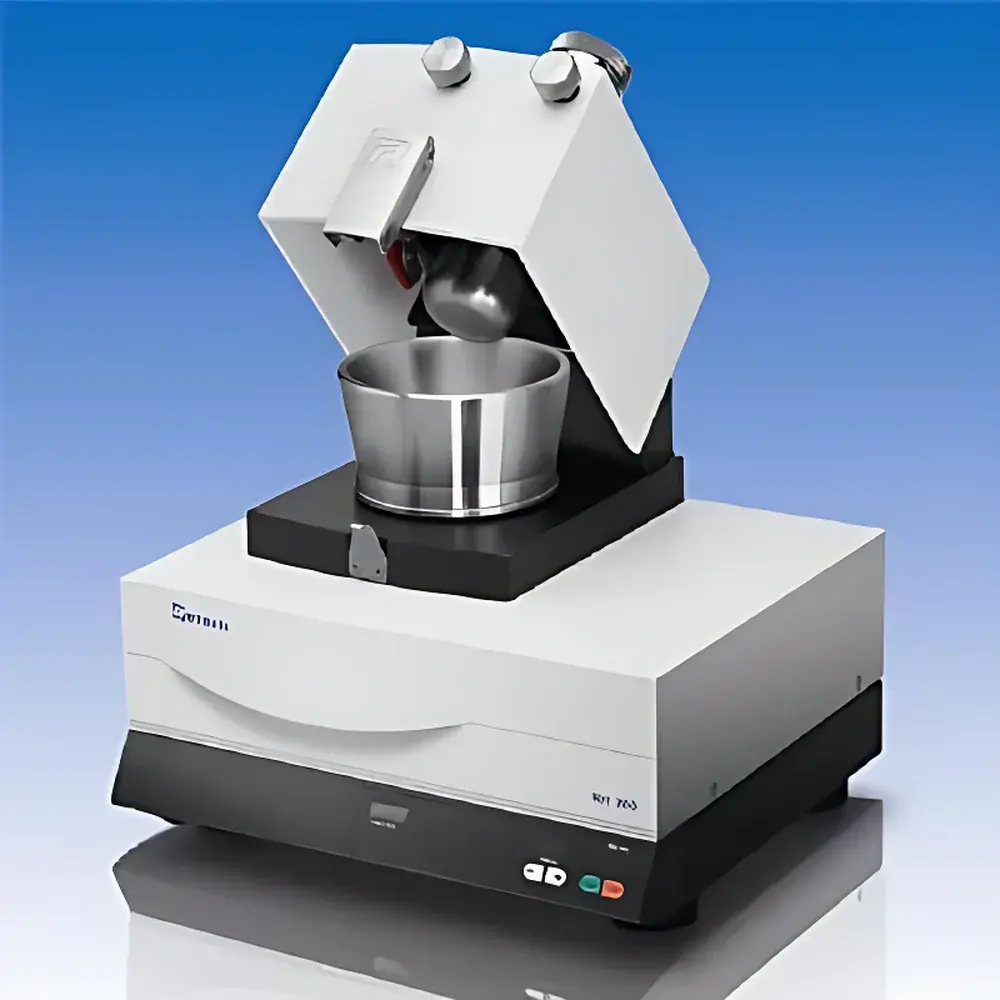
Retsch RM200 Mortar Grinder
| Brand | Retsch |
|---|---|
| Origin | Germany |
| Model | RM200 |
| Grinding Principle | Mortar-and-pestle compression and shear |
| Sample Type | Soft, brittle, fibrous, pasty, or powdered materials |
| Feed Size | ≤ 8 mm |
| Final Particle Size | < 10 µm |
| Batch Volume | 10–190 mL |
| Speed | 100 rpm (50/60 Hz) |
| Grinding Time | 0–99 min or continuous |
| Pestle Pressure | Adjustable via calibrated scale |
| Compliance | CE, EN 61000-6-2/-6-3, EN 61000-3-2/-3-3 |
Overview
The Retsch RM200 Mortar Grinder is a precision-engineered laboratory instrument designed for reproducible, low-contamination size reduction of soft, brittle, fibrous, and pasty samples. Based on the classical mortar-and-pestle principle—adapted for automated, controlled operation—the RM200 applies compressive force and tangential shear through rotational motion of the grinding bowl and dynamic engagement of an eccentrically mounted pestle. Unlike impact-based mills, this mechanism minimizes heat generation and structural degradation, making it especially suitable for thermolabile, hygroscopic, or amorphous materials such as homeopathic preparations, pharmaceutical excipients, botanicals, and biological tissues (e.g., cryo-preserved yeast cells). Introduced in 2007 as the successor to the RM100, the RM200 features an integrated drive system with overload protection, sealed grinding chamber, and adjustable pestle pressure—enabling consistent particle size distribution down to <10 µm without requiring cryogenic assistance.
Key Features
- Automated mortar-and-pestle action: Rotating grinding bowl drives passive pestle rotation via frictional coupling; eccentric mounting ensures uniform material feed into the grinding gap.
- Calibrated pestle pressure adjustment: Spring-loaded pestle force is set via a marked scale (0–10), enabling method optimization for varying sample hardness and cohesiveness.
- Sealed, noise-dampened grinding chamber: Polymethyl methacrylate (Plexiglas®) viewing window allows real-time process monitoring while maintaining dust containment and reducing acoustic emission (<70 dB(A)).
- Dual-mode operation: Supports both dry grinding and wet grinding (with solvents or dispersants), accommodating suspension preparation and homogenization of pastes or slurries.
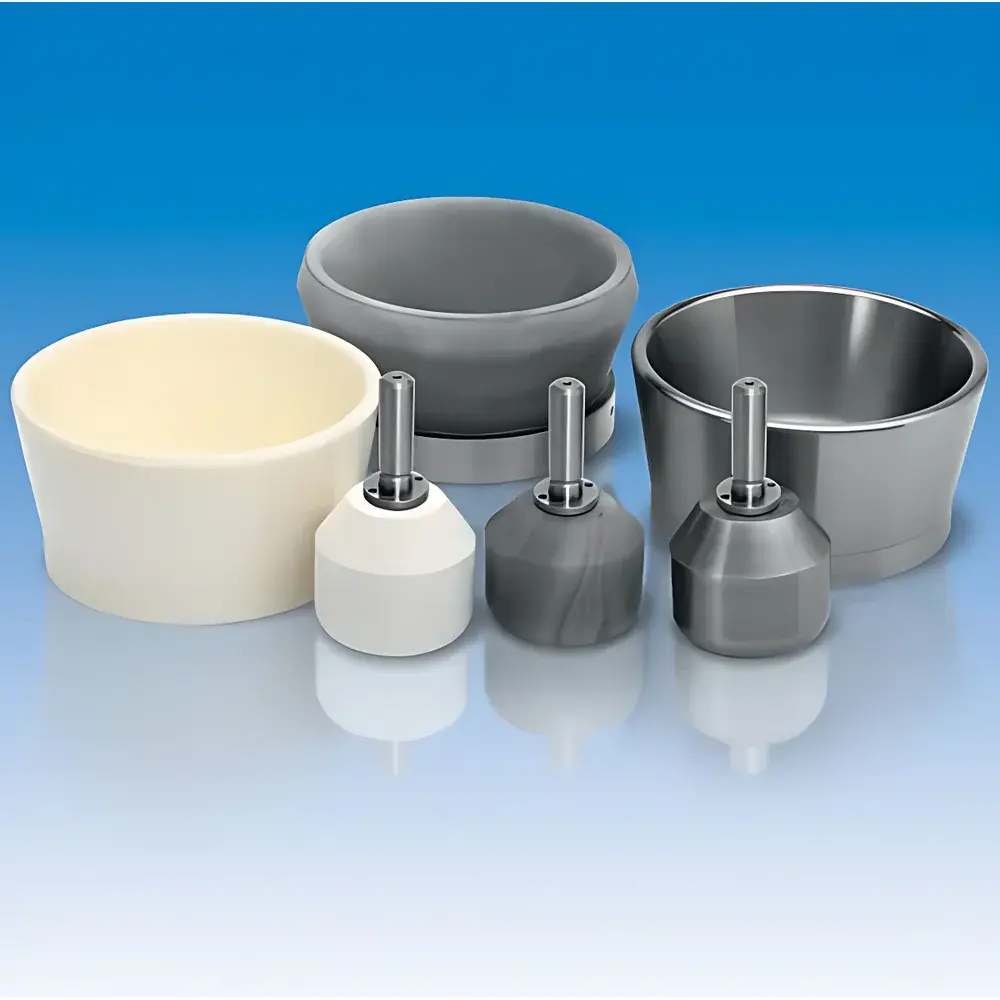
- Seven interchangeable grinding sets: Available in agate, stainless steel, tungsten carbide, ceramic, hardened steel, PTFE-coated steel, and sintered corundum—ensuring chemical inertness and minimizing cross-contamination in regulated environments.
- Precision timing control: Digital timer (0–99 min) with continuous mode option; programmable start/stop functionality supports unattended operation and method standardization.
- CE-compliant safety architecture: Integrated motor thermal protection, interlocked lid switch, and electromagnetic braking ensure compliance with EN 61000-6-2 (immunity) and EN 61000-6-3 (emissions), as well as Machinery Directive 2006/42/EC.
Sample Compatibility & Compliance
The RM200 accommodates heterogeneous matrices including ash, cement clinker, soil aggregates, herbal powders, spices, freeze-dried biomass, foodstuffs (e.g., oilseeds), pharmaceutical intermediates, silicates, salts, and slag. Its gentle yet effective comminution preserves crystallinity and avoids amorphization artifacts common in high-energy ball milling. For regulated laboratories, the instrument supports GLP/GMP workflows: batch records can be linked to time-stamped operating parameters (duration, pressure setting, cycle count), and optional data export enables traceability per FDA 21 CFR Part 11 requirements when paired with validated LIMS integration. All grinding sets comply with ISO 8502-12 (surface cleanliness) and USP particulate matter testing protocols when used for pharmaceutical reference standards.
Software & Data Management
The RM200 operates as a standalone unit with an intuitive front-panel interface—no external PC or proprietary software required. However, its analog output (0–10 V) and digital I/O ports support integration into centralized lab automation systems (e.g., LabVIEW, DeltaV) for remote parameter logging and event-triggered sampling. Timestamped operational logs—including pestle pressure index, runtime, and lid-open cycles—are stored internally for audit readiness. When deployed in quality control labs following ISO/IEC 17025, users may document calibration intervals for pestle load verification (per manufacturer’s torque-check procedure) and validate grinding repeatability using certified reference materials (e.g., NIST SRM 1976b for particle size distribution).
Applications
- Pharmaceutical R&D: Homogenization of homeopathic dilutions, granulation blends, and tablet coating powders prior to HPLC or dissolution testing.
- Environmental analysis: Preparation of soil, sediment, and fly ash samples for XRF, ICP-OES, or leaching studies (TCLP, SPLP).
- Food & agriculture: Milling of spices, grains, and oleaginous seeds for fat extraction, mycotoxin screening, or NIR calibration.
- Materials science: Pre-treatment of ceramics, catalysts, and battery electrode precursors to achieve narrow PSD before sintering or slurry casting.
- Life sciences: Cryo-assisted disruption of fungal or plant tissue for RNA integrity preservation during nucleic acid isolation workflows.
FAQ
What types of samples are incompatible with the RM200?
Samples with excessive moisture (>15% w/w) or high viscosity (e.g., undiluted honey, polymer melts) may impede pestle movement and cause uneven grinding. Pre-drying or dilution is recommended.
Can the RM200 achieve sub-micron particle sizes?
No—its design targets analytical-grade fineness down to <10 µm. Sub-micron processing requires planetary ball milling or jet milling.
Is cleaning validation supported for GMP environments?
Yes: All grinding sets are autoclavable (except PTFE-coated), and residue recovery studies can be performed using swab testing per PDA TR29 guidelines.
How often does the pestle spring require recalibration?
Annually—or after 500 operating hours—using Retsch’s certified torque verification kit (Order No. 20.710.0003).
Does the RM200 meet ASTM D2493 for coal grindability testing?
It is not configured for Hardgrove testing; however, it satisfies ASTM D3174 (ash determination) and D3175 (volatile matter) sample preparation requirements.



