
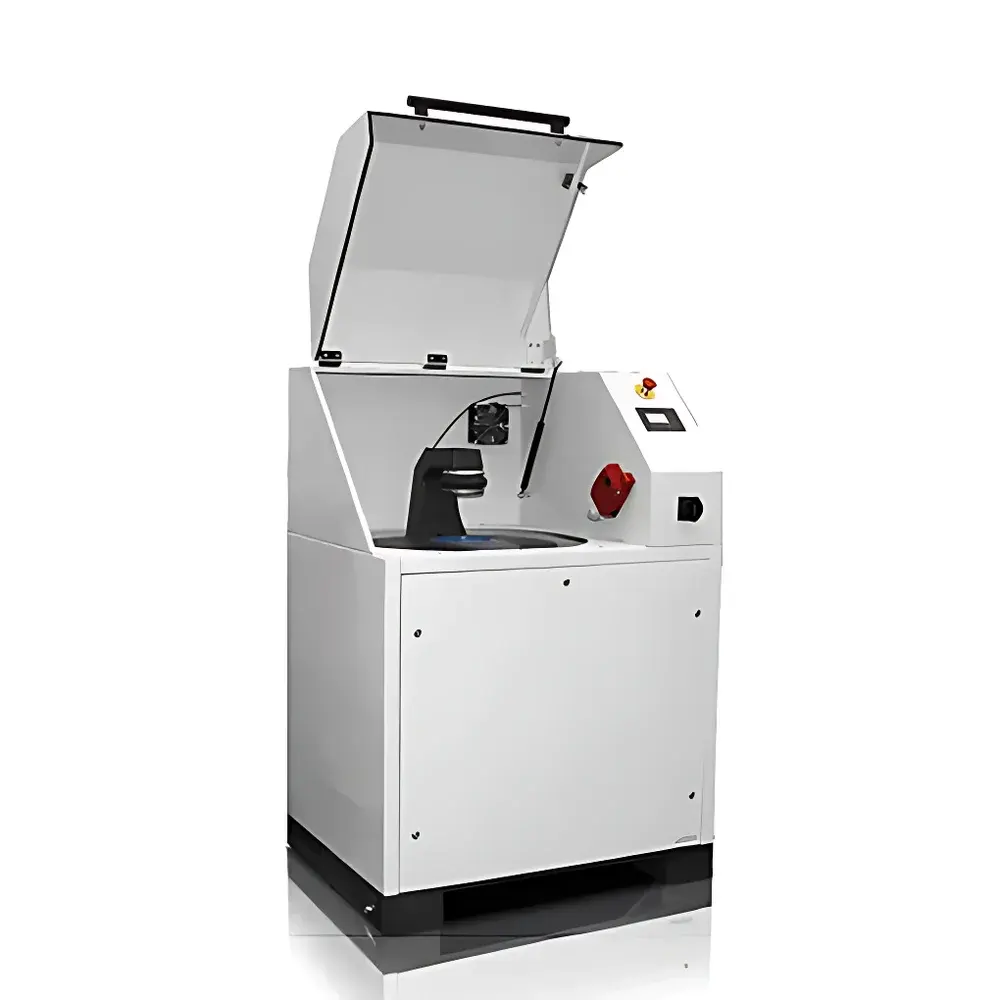
RETSCH RS 300 Planetary Vibratory Disc Mill
| Brand | RETSCH |
|---|---|
| Origin | Germany |
| Model | RS 300 |
| Instrument Type | Vibratory Disc Mill |
| Sample Hardness | Hard to Very Hard Materials |
| Max. Feed Size | < 20 mm |
| Final Particle Size | < 20 µm |
| Operating Speed | 912 rpm |
| Grinding Chamber Volume | 100–2000 mL |
| Drive Principle | Three-dimensional eccentric vibration |
| Programmable Interval Mode | Yes (Auto Start/Stop) |
| Rotation Direction | Alternating left/right |
| Optional Features | Pneumatic clamping system, motorized height-adjustable lifting column, sound-dampened enclosure |
Overview
The RETSCH RS 300 Planetary Vibratory Disc Mill is an industrial-grade laboratory grinding instrument engineered for rapid, reproducible size reduction of hard, brittle, and fibrous materials. Unlike conventional planetary ball mills or jaw crushers, the RS 300 employs a patented three-dimensional vibratory motion generated by an eccentrically mounted disc drive—producing high-frequency impacts between grinding media and sample while simultaneously inducing shearing and mixing effects. This kinematic principle enables efficient comminution down to sub-20 µm particle sizes without thermal degradation, making it particularly suitable for pre-treatment steps in XRF, XRD, ICP-OES, and geochemical analysis workflows. Designed and manufactured in Haan, Germany, the RS 300 complies with EU Machinery Directive 2006/42/EC and conforms to EN 61000-6-2 (EMC immunity) and EN 61000-6-4 (EMC emission) standards.
Key Features
- Three-axis eccentric vibratory drive ensures uniform energy distribution across the grinding chamber, delivering high reproducibility (RSD < 3% for repeated runs under identical parameters)
- Pneumatically actuated clamping system guarantees secure, leak-free closure of the grinding chamber; operation is interlocked to prevent start-up unless correct pressure (>6 bar) is verified
- Programmable interval mode supports automated grinding cycles with user-defined on/off durations—critical for heat-sensitive or reactive samples
- Bi-directional rotation (clockwise/counterclockwise alternation) minimizes centrifugal bias and improves homogenization during co-grinding of multi-component samples
- Modular grinding vessel design accommodates volumes from 100 mL to 2000 mL; available in stainless steel, tungsten carbide, agate, sintered corundum, and PTFE-lined variants to eliminate cross-contamination
- Integrated acoustic enclosure reduces operational noise to ≤72 dB(A), meeting occupational safety thresholds per ISO 11201
- Optional motorized lifting column (RS-Lift) enables ergonomic handling of heavy grinding vessels (up to 25 kg), aligning with ISO 11228-1 ergonomic load-handling guidelines
Sample Compatibility & Compliance
The RS 300 is validated for processing heterogeneous, abrasive, and high-density matrices including geological samples (ores, slags, silicates), construction materials (cement, concrete, fly ash), energy-related feedstocks (coal, coke, biomass), advanced ceramics, metal oxides, and electronic scrap. Its mechanical robustness allows direct milling of samples with Mohs hardness up to 9 (e.g., corundum, silicon carbide). All wet and dry grinding protocols adhere to ASTM D2234 (coal sampling), ISO 13320 (laser diffraction particle sizing preparation), and USP (pharmaceutical comminution validation requirements). The sealed grinding chamber satisfies containment criteria for low-to-moderate toxicity materials per OSHA 1910.1200 (Hazard Communication Standard).
Software & Data Management
While the RS 300 operates via intuitive tactile control panel (no embedded PC required), it supports full traceability when integrated into networked lab environments. Parameter settings—including speed, duration, interval timing, and direction sequence—are stored locally with timestamp and operator ID (via optional RFID badge reader). When connected to RETSCH’s optional LabSuite™ LIMS interface, all grinding logs—including vessel ID, batch number, ambient temperature, and pneumatic pressure verification status—are exported in CSV or XML format compliant with FDA 21 CFR Part 11 (electronic records/signatures) and GLP audit requirements. Audit trails are immutable and time-stamped to ISO/IEC 17025:2017 clause 7.10.2.
Applications
- Geochemical laboratories preparing rock powders for major/minor element analysis by ICP-MS or XRF
- Cement quality control labs generating homogenized test portions for Blaine surface area and strength testing (EN 196-6)
- Recycling R&D centers milling WEEE fractions prior to metal leaching or LIB cathode material recovery
- Materials science groups producing nanostructured precursors for solid-state battery electrolytes
- Environmental labs reducing soil and sediment composites to analytical fineness for EPA Method 6010D (ICP-OES) and 6020B (ICP-MS)
- Pharmaceutical development labs performing excipient compatibility studies requiring contaminant-free micronization
FAQ
What types of grinding media are compatible with the RS 300?
Standard configurations support spherical or cylindrical media in stainless steel, tungsten carbide, zirconia, agate, and sintered corundum. Media diameter ranges from 1 mm to 20 mm depending on vessel volume and target fineness.
Can the RS 300 be used for cryogenic grinding?
No—the RS 300 is not designed for liquid nitrogen cooling. For cryo-applications, RETSCH recommends the MM 400 Mixer Mill with cryo-adapted clamps and stainless-steel jars.
Is cleaning validation supported for regulated environments?
Yes. Each vessel type includes documented swab recovery data (per USP ) for common residues (e.g., SiO₂, Fe₂O₃, CaCO₃); cleaning protocols are available upon request with GMP-aligned SOP templates.
Does the pneumatic clamping system require external compressed air?
Yes—a clean, oil-free supply at 6–8 bar is mandatory. Integrated pressure sensors verify line integrity before enabling the drive motor.
How does the RS 300 compare to planetary ball mills in terms of throughput?
For hard, coarse feed (<20 mm), the RS 300 achieves comparable final fineness in ~30–50% less time due to higher impact frequency (912 rpm vs. typical 300–600 rpm in planetary mills) and absence of rotational inertia limitations.



