
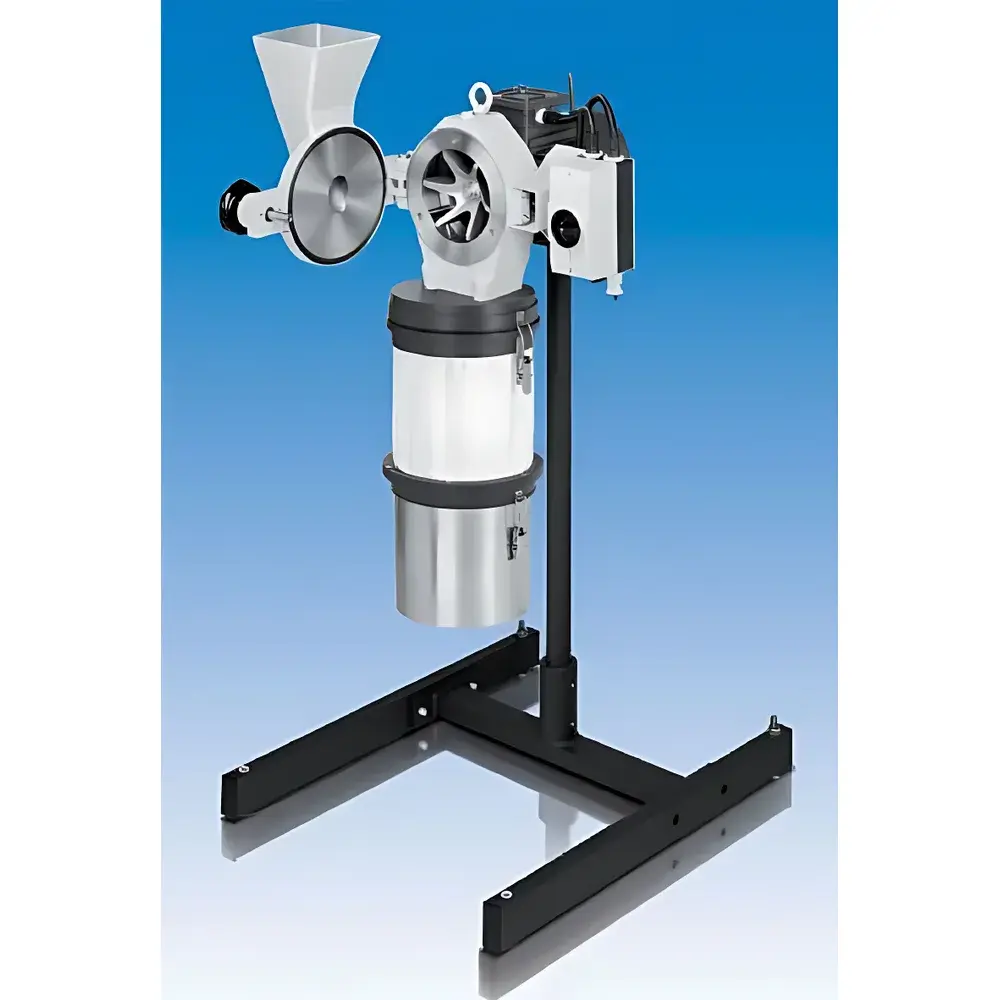
Retsch SR200 Rotational Impact Mill
| Brand | Retsch |
|---|---|
| Origin | Germany |
| Model | SR200 |
| Instrument Type | Impact Mill |
| Sample Hardness | Soft to Medium-Hard |
| Max Feed Size | ≤15 mm |
| Final Particle Size | ≤80 µm |
| Throughput | 120 kg/h |
| Sieve Aperture Range | 0.01–0.5 mm |
| Motor Speed (50 Hz) | 2850 rpm |
| Peripheral Rotor Speed | 20.5 m/s |
| Drive Power | 1.1 kW |
| Chamber Material | Grey Cast Iron |
| Receiving Container Volume | 5 L or 30 L |
| Dimensions (W×H×D, with base) | 560 × 1150 × 700 mm |
| Net Weight (with base) | ~57 kg |
| Compliance | CE certified |
| Safety Features | Electromagnetic brake (stopping time <0.5 s), splash-proof inlet/outlet design, interlocked access shielding |
Overview
The Retsch SR200 Rotational Impact Mill is an industrial-grade laboratory mill engineered for high-throughput size reduction of soft to medium-hard solid materials. Operating on the principle of rotational impact comminution, the SR200 utilizes a high-speed rotating rotor equipped with hardened steel impact elements that deliver controlled kinetic energy to feed material via repeated hammering, collision, and shearing actions within a fixed chamber. Feed material enters centrally through a gravity-fed hopper, is accelerated radially outward by the rotor, and impacts against stationary breaker inserts and the inner chamber wall—generating particle fragmentation through combined mechanical stress modes. Particles smaller than the selected sieve aperture pass through the perforated screen into the receiving container; oversized particles remain in the grinding zone until further reduced. This closed-loop, continuous-flow design ensures reproducible particle size distribution (PSD) and minimizes thermal load, making the SR200 particularly suitable for routine sample preparation in quality control, geochemical analysis, pharmaceutical development, and materials science laboratories.
Key Features
- High-capacity throughput up to 120 kg/h—optimized for batch and semi-continuous operation in production-support labs.
- Precision-engineered impact chamber constructed from grey cast iron for wear resistance and structural stability under dynamic loading.
- Interlocked safety door with rapid clamping mechanism enables tool-free access to the grinding chamber and sieve assembly—reducing downtime during cleaning or maintenance.
- Electromagnetic braking system halts rotor rotation in less than 0.5 seconds upon door opening or emergency stop activation, meeting EN 60204-1 functional safety requirements.
- Modular sieve system with standardized apertures (0.01–0.5 mm); quick-release mounting allows interchange without tools or alignment calibration.
- Dual-voltage motor compatibility (50/60 Hz) with fixed-speed asynchronous drive delivering 1.1 kW nominal output and consistent peripheral rotor velocity (20.5 m/s at 50 Hz).
- Integrated splash protection at feed inlet and discharge outlet prevents cross-contamination and operator exposure during operation.
Sample Compatibility & Compliance
The SR200 accommodates a broad spectrum of dry, non-fibrous, non-sticky materials including soils, construction aggregates, pharmaceutical granules, agricultural seeds, coal, fertilizers, rare-earth oxides, fly ash, and herbal botanicals. It is not recommended for highly elastic, fibrous, oily, or temperature-sensitive samples requiring cryogenic processing. All mechanical and electrical components comply with EU Machinery Directive 2006/42/EC and Low Voltage Directive 2014/35/EU. The device carries CE marking and conforms to EN ISO 12100 (risk assessment), EN 61000-6-2 (immunity), and EN 61000-6-4 (emissions). For regulated environments, the SR200 supports GLP-compliant documentation when paired with validated SOPs—though it does not include built-in audit trail or electronic signature capabilities per FDA 21 CFR Part 11.
Software & Data Management
The SR200 operates as a standalone electromechanical instrument with no embedded microprocessor or digital interface. Operation is controlled via a dedicated I/O panel featuring start/stop buttons, emergency stop, and status indicators. No proprietary software is required or provided. Users maintain process traceability through manual logbooks or external LIMS integration—recording batch ID, sieve specification, feed mass, run duration, and ambient conditions. For laboratories implementing digital workflows, Retsch recommends pairing the SR200 with its optional digital weighing station (e.g., XPR series) and third-party data acquisition systems compliant with ASTM E2500 and ISO/IEC 17025 documentation standards.
Applications
- Preparation of homogenized sub-samples for XRF, ICP-OES, and elemental analysis of geological and environmental matrices.
- Routine particle size conditioning prior to sieve analysis (ASTM D422, ISO 11277) or laser diffraction measurement (ISO 13320).
- Pharmaceutical excipient milling for dissolution testing and content uniformity studies (USP <701>).
- Reduction of heterogeneous biomass and feedstock for proximate analysis (ASTM D3172, D3173).
- Standardization of reference materials in accredited calibration labs (ISO/IEC 17034).
- Feedstock sizing for additive manufacturing powder characterization (ASTM F3049).
FAQ
What types of materials are unsuitable for the SR200?
Materials with high elasticity (e.g., rubber, thermoplastic polymers), fibrous structure (e.g., cellulose pulp, cotton), moisture content >5% w/w, or thermal sensitivity below 60 °C may cause clogging, poor size reduction, or degradation.
Can the SR200 be used for wet grinding?
No—the SR200 is designed exclusively for dry grinding applications. Introduction of liquid or slurry will compromise sieve performance and increase wear on impact elements.
Is the final particle size distribution narrow or broad?
The SR200 produces a moderately broad PSD typical of impact mills; for narrower distributions, downstream classification (e.g., air jet sieving per ISO 2591-1) is recommended.
How often should the rotor blades and sieve be replaced?
Service life depends on sample abrasivity and throughput; Retsch recommends visual inspection after every 200 operational hours and replacement based on measurable wear depth (>0.3 mm groove erosion on impact edges).
Does the SR200 require calibration?
As a mechanical size-reduction device without transducers or feedback loops, it does not require periodic metrological calibration—but users must verify sieve aperture integrity using certified gauge wires (ISO 3310-1) before critical analyses.



