
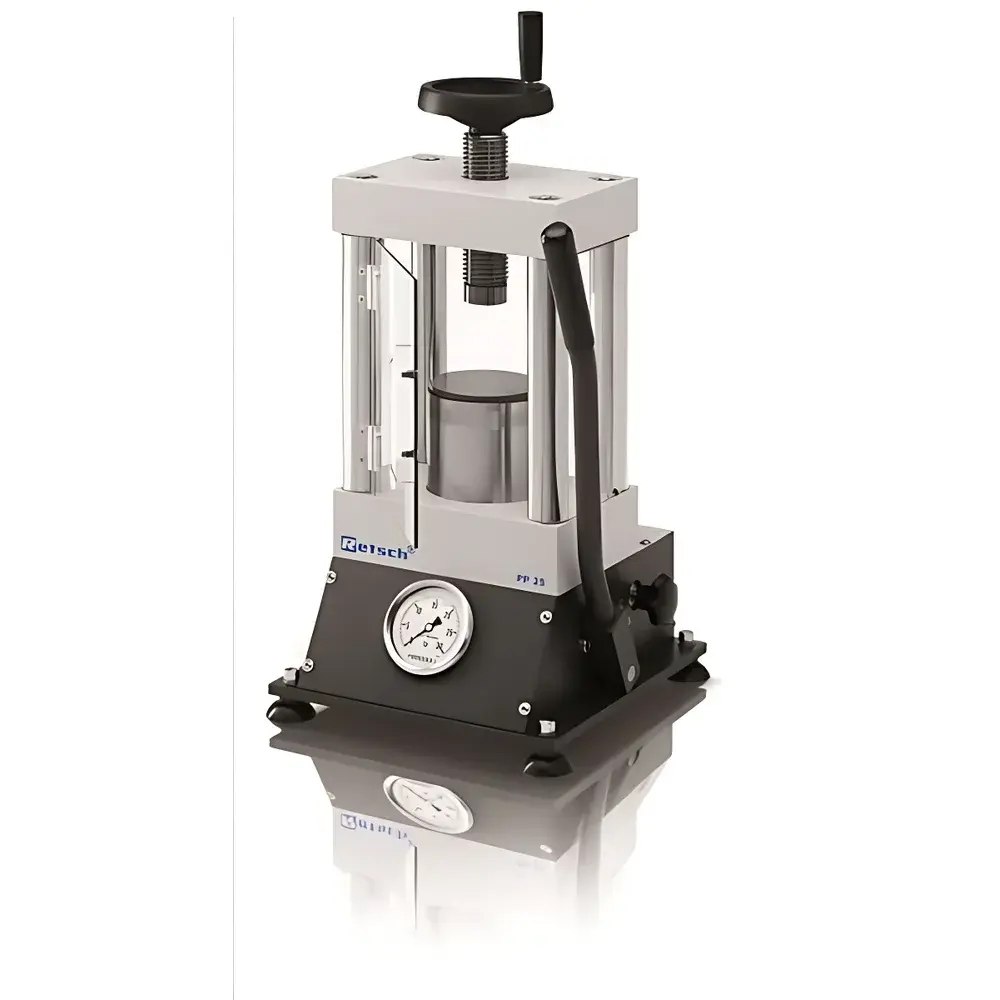
Retsch PP25 Automatic Pellet Press
| Brand | Retsch |
|---|---|
| Origin | Germany |
| Model | PP25 |
| Maximum Pressure | 25 tons |
| Pressure Display Range | 0–30 tons |
| Hydraulic Cylinder Diameter | 108 mm |
| Base Cylinder Diameter | 100 mm |
| Stroke | up to 25 mm |
| Annular Bearing Diameter | 30 mm |
| Shaft Torque Capacity | up to 90 mm |
| Throat Clearance | 35–125 mm |
| Column Spacing | 160 mm |
| Dimensions (W×H×D) | 310 × 560 × 290 mm |
| Net Weight | 50.5 kg |
| Die Sizes | 32 mm and 40 mm |
| Die Material | Hardened stainless steel |
| Automation Level | Fully automatic |
Overview
The Retsch PP25 Automatic Pellet Press is an engineered solution for high-precision, reproducible sample compaction in analytical laboratories. Designed according to the principles of uniaxial cold isostatic pressing, the PP25 applies controlled hydraulic force to powdered or granular samples confined within precision-machined dies—enabling the production of homogeneous, mechanically stable pellets suitable for quantitative elemental analysis. Its core architecture integrates a rigid C-frame structure with a dual-column load path and a calibrated hydraulic actuation system, ensuring minimal frame deflection and consistent stress distribution across the die cavity. The press is widely deployed in preparation workflows for X-ray fluorescence (XRF), wavelength-dispersive XRF (WDXRF), and energy-dispersive XRF (EDXRF) spectrometry, where pellet integrity, surface flatness, and density uniformity directly influence measurement accuracy and long-term calibration stability.
Key Features
- Full automation with programmable pressure ramping, dwell time, and decompression sequence—reducing operator variability and supporting GLP-compliant documentation protocols.
- Maximum compressive force of 25 tons (245 kN), with real-time digital pressure readout spanning 0–30 tons (0–294 kN) for precise process verification.
- Robust C-frame construction featuring hardened steel columns spaced at 160 mm, minimizing lateral flexure during high-load operation.
- Adjustable throat clearance (35–125 mm) accommodates a wide range of die heights and auxiliary tooling—including alignment fixtures and automated ejection modules.
- Included interchangeable hardened stainless-steel dies (32 mm and 40 mm diameter) with polished internal surfaces to minimize sample adhesion and ensure repeatable pellet geometry.
- Integrated safety interlocks, emergency stop circuitry, and overload protection conforming to EN 61000-6-2 (EMC) and EN 61000-6-4 (emission) standards.
- Compact footprint (310 × 560 × 290 mm) and 50.5 kg net weight facilitate integration into fume hoods, glove boxes, or shared instrumentation suites without structural reinforcement.
Sample Compatibility & Compliance
The PP25 supports a broad spectrum of inorganic and organic powders—including oxides, carbonates, silicates, metal alloys, polymers, and pharmaceutical excipients—provided particle size distribution falls within typical XRF pelletization guidelines (D90 < 75 µm). It complies with ASTM E1361 (Standard Practice for Preparation of Solid Samples for XRF Analysis) and ISO 20051 (X-ray fluorescence spectrometry — Calibration and verification of wavelength dispersive instruments). All mechanical components meet RoHS Directive 2011/65/EU requirements. When operated with validated SOPs and traceable pressure calibration certificates, the system supports audit readiness under FDA 21 CFR Part 11 (electronic records/signatures) and ISO/IEC 17025:2017 (testing laboratory competence).
Software & Data Management
While the PP25 operates via an embedded microcontroller interface with tactile keypad and LED display, it is compatible with optional Retsch LabSuite™ software (v3.2+) for remote parameter configuration, batch logging, and export of pressure/time profiles in CSV format. Audit trails include timestamped event logs (start/stop/dwell/completion), user ID tagging, and pressure deviation alerts. Data files are structured to integrate with LIMS platforms via standard ODBC drivers and support metadata tagging per ISO 8601 date-time formatting. No proprietary cloud services or firmware updates require external internet connectivity—ensuring data sovereignty in regulated environments.
Applications
- Preparation of pressed pellets for routine XRF analysis of geological, metallurgical, and cementitious materials.
- Production of certified reference material (CRM) discs for instrument calibration and method validation.
- Compaction of catalyst powders and battery electrode precursors prior to SEM-EDS or XRD characterization.
- Formulation studies requiring controlled density gradients in pharmaceutical tablet prototypes.
- Archival sample preservation—pellets exhibit low hygroscopicity and minimal binder dependency when prepared using borate fusion-free protocols.
FAQ
What is the maximum recommended operating pressure for routine XRF pellet preparation?
For optimal pellet homogeneity and minimal die wear, Retsch recommends 15–22 tons for most mineral and oxide samples; 25-ton capacity is reserved for high-density alloys or refractory compounds.
Can the PP25 be integrated into automated sample prep lines?
Yes—via optional RS-232 or Ethernet/IP interface modules, enabling synchronization with robotic sample loaders and downstream XRF autosamplers.
Is die cleaning required between different sample matrices?
Yes; hardened stainless-steel dies must be cleaned with ethanol or acetone and inspected for surface scoring before switching between halide-rich and alkali-metal samples to prevent cross-contamination.
Does the PP25 support pressure calibration traceability to national standards?
Yes—Retsch provides UKAS-accredited calibration certificates (ISO/IEC 17025) upon request, with annual recalibration intervals aligned to ISO 9001 quality management requirements.
What maintenance schedule is recommended for hydraulic system longevity?
Hydraulic oil replacement every 2,000 operating hours or biannually (whichever occurs first); seal inspection during die change procedures; column lubrication with ISO VG 68 mineral oil quarterly.



