
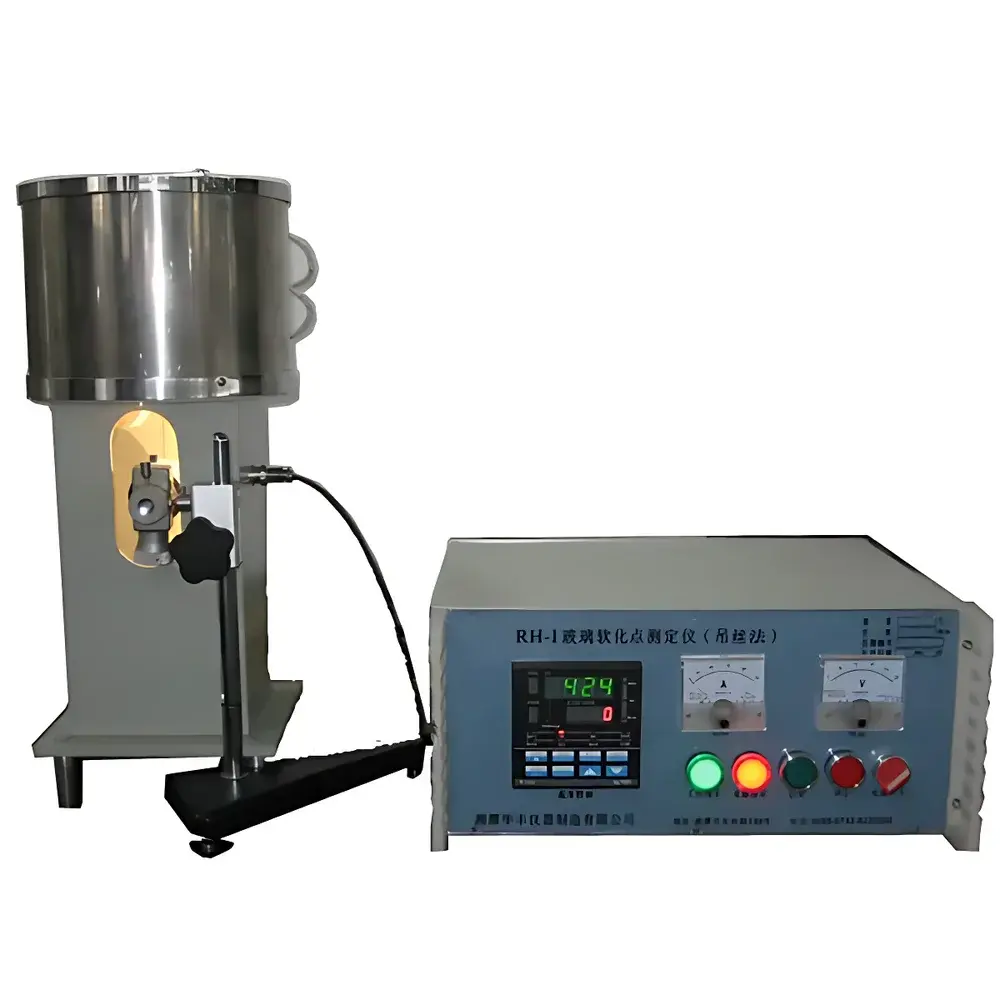
RH-I Glass Softening Point Tester (Fiber-Extension Method)
| Origin | Hunan, China |
|---|---|
| Manufacturer Type | Distributor |
| Origin Category | Domestic |
| Model | RH-I |
| Price | Upon Request |
| Heating Power | 600 W |
| Max Operating Temperature | 900 °C (1100 °C transient) |
| Temperature Resolution | 0.1 °C |
| Micrometer Drum Resolution | 0.01 mm |
| Heating Rate Control | 5 ± 1 °C/min |
| Timing Accuracy | 0.1 s |
Overview
The RH-I Glass Softening Point Tester (Fiber-Extension Method) is a precision thermal analysis instrument engineered for the standardized determination of the softening point (Ts) of inorganic glasses and glass-ceramic materials. It operates on the principle of controlled thermal elongation under gravity—commonly referred to as the fiber-extension or filament-deformation method. In accordance with ISO 7884:1978(E), the instrument heats a vertically suspended glass filament (235 ± 1 mm in length, standardized diameter) at a strictly regulated heating rate of 5 ± 1 °C/min. As temperature increases, the filament undergoes viscoelastic deformation due to its decreasing viscosity. The softening point Ts is defined as the temperature at which the filament extends at a linear rate of exactly 1.0 mm/min—corresponding to an effective viscosity of approximately 4.5 × 10⁶ Pa·s. This thermorheological endpoint provides critical data for glass formulation validation, thermal processing window definition, and quality control in optical, container, and architectural glass manufacturing.
Key Features
- High-stability resistance-heated furnace with 600 W power rating and sustained operational capability up to 900 °C (transient tolerance to 1100 °C), ensuring reliable performance across soda-lime, borosilicate, and lead-alkali glass systems.
- Digital temperature control system with 0.1 °C resolution and closed-loop feedback, enabling precise compliance with ISO 7884’s specified heating ramp tolerance (±1 °C/min deviation).
- Optical projection-based measurement subsystem integrating a calibrated micrometer drum with 0.01 mm reading resolution, eliminating parallax error and supporting traceable dimensional tracking of filament elongation in real time.
- Integrated high-precision timer with 0.1 s resolution, synchronized with temperature acquisition to support accurate derivation of extension rate (mm/min) over consecutive 60-second intervals.
- Rigid vertical sample holder assembly with low-thermal-expansion ceramic supports, minimizing mechanical drift and ensuring axial alignment stability during prolonged heating cycles.
Sample Compatibility & Compliance
The RH-I accommodates standard cylindrical glass filaments prepared per ISO 7884:1978(E)—235 ± 1 mm in length and 0.65–0.75 mm in diameter—with minimal sample preparation requirements. It is validated for use with oxide-based glasses including but not limited to SiO2-Na2O-CaO, B2O3-Al2O3-SiO2, and PbO-SiO2 systems. The instrument conforms to the core procedural and metrological requirements of ISO 7884:1978(E) and is compatible with laboratory quality assurance frameworks aligned with ISO/IEC 17025. While not inherently 21 CFR Part 11-compliant, its analog-digital hybrid architecture allows integration into validated environments via external data logging systems with audit-trail capabilities.
Software & Data Management
The RH-I operates in manual or semi-automated mode: temperature and time are recorded digitally, while filament extension is measured visually via the projection micrometer and logged manually. For laboratories requiring electronic data capture, optional RS-232 or USB interfaces (available upon request) enable connection to third-party acquisition software. Raw data—including timestamped temperature values and corresponding extension readings—is exportable in CSV format for post-processing in Excel, MATLAB, or statistical analysis platforms. All measurements support GLP-aligned documentation, including operator ID, calibration certificate references, and environmental condition annotations.
Applications
- Quality assurance of raw glass batches in production facilities, verifying consistency of thermal behavior prior to forming or annealing.
- Development and optimization of new glass compositions, particularly where viscosity–temperature relationships govern melt homogenization, fining, or drawing processes.
- Technical specification verification for regulatory submissions involving packaging glass (e.g., pharmaceutical vials per USP or ISO 8512).
- Educational use in materials science laboratories for teaching fundamental concepts of glass transition, viscosity–temperature modeling (e.g., Vogel–Fulcher–Tammann equation), and standard thermal test methodologies.
- Interlaboratory comparison studies under ISO/IEC 17043 proficiency testing schemes for softening point determination.
FAQ
What standard does the RH-I comply with?
The RH-I is designed and verified in accordance with ISO 7884:1978(E), “Glass — Determination of softening temperature — Fiber-extension method.”
Can the RH-I measure softening points above 900 °C?
The furnace is rated for continuous operation up to 900 °C; short-term excursions to 1100 °C are permissible but not recommended for routine use due to accelerated element aging.
Is automatic data recording included as standard?
No—the base configuration relies on manual recording of extension and temperature. Optional digital data acquisition modules are available for integration with external PCs.
What sample preparation is required?
Users must prepare glass filaments of precisely 235 ± 1 mm length and uniform cross-section (diameter 0.65–0.75 mm), typically by flame-drawing followed by careful annealing and straightening.
Does the instrument require annual calibration?
Yes—temperature sensors and micrometer drums shall be calibrated annually against NIST-traceable standards, with calibration certificates maintained per ISO/IEC 17025 requirements.



