
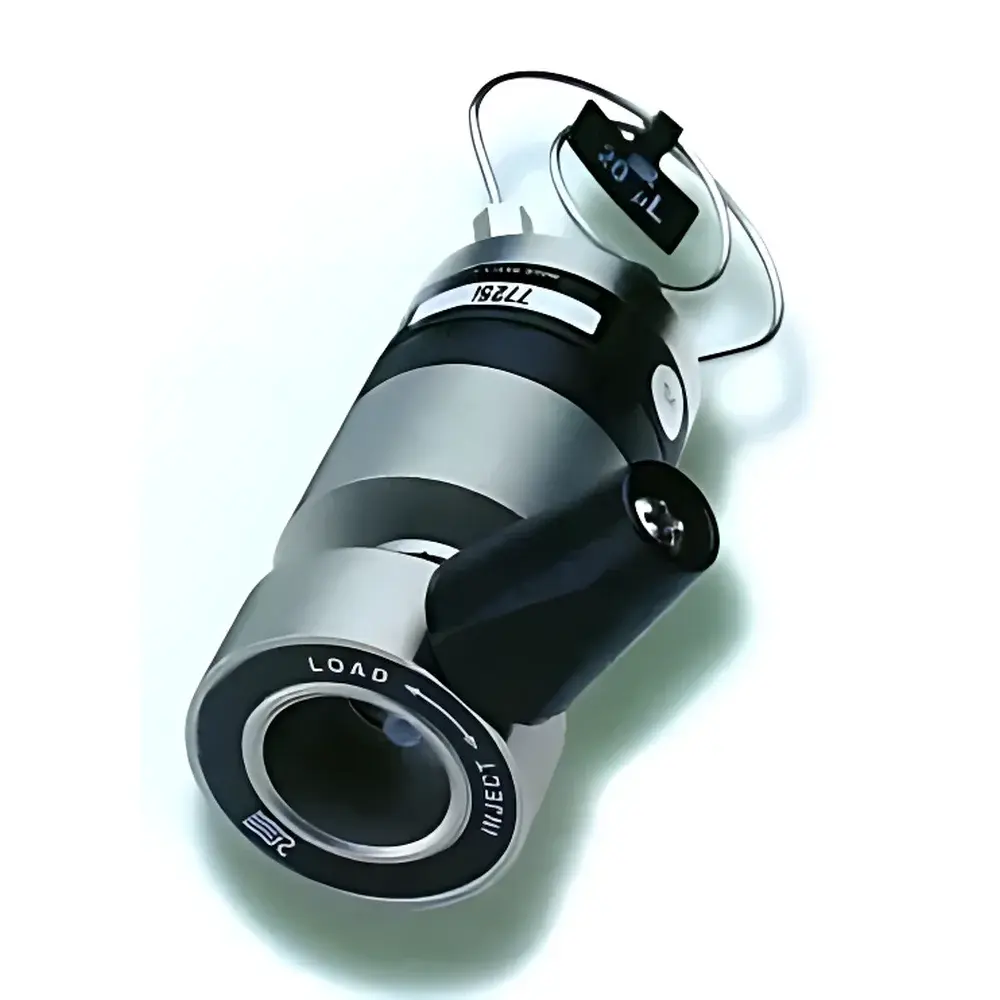
Rheodyne 7725i Manual HPLC Injection Valve
| Brand | Rheodyne |
|---|---|
| Origin | USA |
| Construction | Stainless Steel (316 SS) |
| Max Operating Pressure | 34 MPa (5,000 psi), adjustable up to 48 MPa |
| Max Temperature | 50 °C |
| Port Configuration | 6-Position, 2-Port (Load/Inject) |
| Standard Loop Volume | 20 µL |
| Optional Loop Volumes | 2 µL (ultra-micro), 5 µL, 10 µL, 50 µL |
Overview
The Rheodyne 7725i Manual HPLC Injection Valve is a precision-engineered, six-port, two-position (load/inject) switching valve designed for high-pressure liquid chromatography applications requiring reproducible, low-dead-volume sample introduction. Based on the proven Rheodyne metering block bypass (MBB) architecture, the 7725i maintains uninterrupted mobile phase flow during both loading and injection cycles—eliminating pressure spikes, baseline disturbances, and column overpressure risks commonly associated with conventional stop-flow valves. Its robust 316 stainless steel construction, chemically inert wetted surfaces, and precisely lapped rotor/stator interface ensure long-term sealing integrity and minimal carryover (<0.01% typical) across thousands of injection cycles. The valve operates within a validated pressure range of 0–34 MPa (5,000 psi), with mechanical pressure adjustment via rear-mounted knob enabling safe operation up to 48 MPa under controlled conditions. Designed for compatibility with analytical, semi-preparative, and method-development workflows, the 7725i serves as a foundational component in ISO/IEC 17025-accredited laboratories and GLP-compliant QC environments.
Key Features
- MBB (Metering Block Bypass) technology ensures continuous mobile phase flow—no interruption during load/inject transition, preserving column integrity and chromatographic stability
- Integrated position-sensing switch (“i” suffix) provides TTL-compatible electronic feedback for synchronization with data acquisition systems or autosampler controllers
- Rear-mounted pressure-adjustment knob enables precise, tool-free optimization of rotor seal compression—reducing leakage risk while extending service life
- Expanded tubing port angle (±30° rotational tolerance per port) simplifies routing in dense instrument configurations and minimizes stress on PEEK or stainless steel capillaries
- Standard 20 µL fixed-volume loop; optional ultra-micro 2 µL loop available with dedicated hardware kit (including low-diffusion needle seat and reduced-volume stator)
- Full compatibility with common HPLC solvents (acetonitrile, methanol, aqueous buffers, TFA, HFBA) and pH 1–12 mobile phases; extended compatibility to pH 0–14 with optional PEEK/Tefzel variants (9725i series)
Sample Compatibility & Compliance
The 7725i supports aqueous, organic, and mixed-phase samples across molecular weight ranges typical of small-molecule pharmaceuticals, natural products, peptides, and oligonucleotides. Its low-adsorption stainless steel flow path and absence of elastomeric seals prevent analyte binding or leaching—critical for trace-level quantitation and method transfer. The valve meets mechanical and dimensional specifications outlined in ASTM D5292 (HPLC system component testing) and complies with material biocompatibility requirements per USP . When integrated into validated chromatographic systems, it supports 21 CFR Part 11 audit trail requirements through synchronized digital position signaling (via optional external relay or PLC interface). Routine maintenance intervals are defined per manufacturer’s SOPs and align with ISO/IEC 17025 clause 6.4.7 (equipment verification).
Software & Data Management
While the 7725i is manually actuated, its integrated position sensor (standard on “i” models) outputs a binary TTL signal indicating Load or Inject state. This signal can be routed to chromatography data systems (CDS) such as Thermo Chromeleon, Waters Empower, or Agilent OpenLab for automated event tagging, injection counter logging, and sequence validation. The valve does not require firmware or driver installation; its passive electrical interface operates at 5 VDC, 10 mA max, and is compatible with standard opto-isolated digital input modules. All configuration parameters—including loop volume, seal compression setting, and actuation history—are documented in the laboratory’s equipment logbook per GLP Annex 11 guidance.
Applications
- Analytical HPLC method development and validation where injection precision (RSD < 0.3% for n ≥ 10) and carryover control are critical
- Method transfer between labs using identical valve configurations and loop volumes
- Offline fraction collection coupling with multi-port switching (e.g., directing eluent to discrete vials during gradient peaks)
- Preparative LC sample introduction when paired with 3725-series large-loop adapters (2–20 mL loops)
- QC release testing of APIs and intermediates under ICH Q2(R2) precision and robustness criteria
- Stability-indicating assays requiring consistent dwell volume and minimized extra-column dispersion
FAQ
What is the difference between the 7725 and 7725i models?
The “i” suffix denotes integrated position sensing—providing TTL-level electronic confirmation of valve orientation (Load/Inject), enabling synchronization with CDS software and automated sequence tracking.
Can the 7725i be used with UHPLC systems operating above 600 bar?
Yes—its rated pressure of 34 MPa (5,000 psi) meets standard UHPLC requirements; the adjustable seal compression allows safe operation up to 48 MPa (6,960 psi) under qualified conditions.
Is the 2 µL ultra-micro loop compatible with all 7725i units?
No—it requires the dedicated 2 µL kit (P/N 7725-002), including modified stator, needle seat, and low-volume loop holder; installation must follow Rheodyne Technical Bulletin TB-7725-UM.
How often should the rotor seal be replaced?
Under typical analytical use (≤50 injections/day, ≤34 MPa), replacement is recommended every 6–12 months or after 5,000 cycles—verified by pressure decay test per ASTM D5292 Annex A3.
Does the valve comply with FDA 21 CFR Part 11 for electronic records?
The valve itself is not a regulated electronic system; however, its position signal—when captured and timestamped by a Part 11-compliant CDS—contributes to attributable, legible, and contemporaneous audit trails.
Related Products



